CHAPTER 42:14 – BOTSWANA TRADE COMMISSION: SUBSIDIARY LEGISLATION
INDEX TO SUBSIDIARY LEGISLATION
Botswana Trade Commission (Anti-Dumping (Investigation)) Regulation
Botswana Trade Commission (Countervailing Investigation) Regulations
Botswana Trade Commission (Safeguards) Regulations
Botswana Trade Commission (Tariff Investigations) Regulations
BOTSWANA TRADE COMMISSION (SAFEGUARDS) REGULATIONS
(section 37)
(28th February, 2025)
ARRANGEMENT OF REGULATIONS
REGULATION
PART I
Preliminary
1. Citation
2. Interpretation
3. Application
PART II
Application for safeguards investigation
4. Application for general safeguards investigation
5. Application for special safeguards investigation
6. Evidence and information required on application for investigation
7. Acknowledgment of receipt of application
8. Compliance assessment of application
9. Confidentiality
10. Deficient application
11. Merit assessment of application
PART III
Serious injuries
12. Serious injury
13. Threat of serious injury
14. Causality
PART IV
Investigation process and reports
15. Notification after Board approval to initiate investigation
16. Response by interested party
17. Verifications
18. Oral hearings
19. Preliminary report
20. Comments on preliminary report
21. Non-cooperation
PART V
Measures and determinations on investigations
22. Provisional measures
23. Final determination by Board
24. Communication of the final decision of SACU Council
25. Public file and its access
26. Withdrawal of application for investigation
27. Consultations
PART VI
Definitive safeguards measures
28. Form of definitive safeguards measure
29. Duration of definitive safeguards measure
30. Non-application of definitive safeguards measure to developing countries
31. Review of definitive safeguards measure
32. Extension and re-application of safeguards measures
33. Special safeguards measure on agricultural products in terms of WTO Agreement on Agriculture
34. Judicial reviews of preliminary decisions
35. Notification to WTO Committee on Safeguards
36. International obligations
S.I. 26, 2025.
PART I
Preliminary
These Regulations may be cited as the Botswana Trade Commission (Safeguards) Regulations.
In these Regulations, unless the context otherwise requires—
“c.i.f” means cost, insurance and freight;
“day” means any day other than a Saturday, Sunday or any day which is a public holiday under the Public Holidays Act (Cap. 03:07);
“directly competitive product” means a product, other than a like product, that competes directly with the product under investigation;
“facts available” means the information that is available to the Commission at the time of making a determination, whether preliminary or final:
Provided that all requirements regarding non-confidentiality and timely submission have been met;
“good cause” means an occurrence outside the control of the participating interested party or the Commission and does not include merely citing insufficient time to submit information to the Commission;
“interested parties” include—
(a) producers in SACU;
(b) exporters in SACU;
(c) foreign producers;
(d) importers in SACU; or
(e) trade or business association whose members are—
(i) SACU producers, exporters or importers, or
(ii) foreign producers, exporters or importers, and
(f) the governments of the countries of origin and export of the product under investigation or the like product.
“like product” means—
(a) a product which is identical or alike in all respects to the product under investigation; or
(b) in the absence of such a product, another product which, although not alike in all respects, has characteristics closely resembling those of a product under investigation, whether the product has characteristics closely resembling those of the product under investigation the Commission may consider one or several factors—
(i) the raw materials and other inputs used in producing the products,
(ii) the production process,
(iii) physical characteristics and appearance of the product,
(iv) the end-use of the product,
(v) the substitutability of the product with the product under investigation,
(vi) tariff classification, or
(vii) any other factor that the Commission considers relevant;
“participating interested parties” means the parties that have indicated their interest in participating in an investigation;
“related parties” means parties that are related for purposes of a safeguards investigation due to the following—
(a) a party directly or indirectly owns, controls or holds five per cent or more of the equity shares of the other party;
(b) a party has the power to directly or indirectly nominate or appoint a director to the board of the other party;
(c) a party is an officer or director of the other party’s business;
(d) the parties are legally recognised partners in a business;
(e) a party is employed by the other party;
(f) the parties are both directly or indirectly controlled by a third person;
(g) together, the parties directly or indirectly control a third person;
(h) the parties appear to be related by virtue of their conduct;
(i) the parties are blood relatives or are related by marriage, common-law partnership or adoption; or
(j) the parties’ relationship is otherwise of such a nature that trade between them cannot be regarded to be at arm’s length;
“SACU industry” means the domestic producers in the SACU who produce like products or those producers whose collective output products constitutes a major proportion of the total domestic production of these products; and
“WTO Agreement on Agriculture” means the agreement by WTO members which came into force on 1st January, 1995 with the objective to establish a fair and market-oriented agricultural trading system.
These Regulations shall apply to a safeguards investigation.
PART II
Application for safeguards investigation
4. Application for general safeguards investigation
(1) A SACU industry or a person acting on behalf of the SACU industry shall in writing, apply to the Commission for a general safeguards investigation.
(2) An application referred to under subregulation (1) shall be as set out in the Schedule and accompanied by a fee of P500.
(3) The application shall include evidence that the product under investigation is being imported into Botswana or the Common Customs Area of SACU—
(a) in such increased quantities, absolute or relative to SACU production; and
(b) under such conditions as to cause or threaten to cause serious injury to the SACU industry that produces like or directly competitive products.
(4) The Commission shall regard the application as brought by or on behalf of the SACU industry where—
(a) at least 25 per cent of the SACU producers by domestic production volume support the application; and
(b) of the producers that express an opinion on the application, at least 50 per cent by domestic production volume, support such application.
(5) The Commission may, in industries of an exceptionally large number of producers, determine support and opposition by reference to the—
(a) largest number of producers that may reasonably be included in the investigation; or
(b) use statistically valid sampling techniques based on the information available to the Commission at the time of its finding.
(6) Notwithstanding subregulation (1), the Commission may initiate a general safeguards investigation without having received a written application from the SACU industry.
5. Application for special safeguards investigation
(1) Notwithstanding regulation 4, a SACU industry or a person acting on behalf of the SACU industry shall in writing, apply to the Commission for a special safeguards investigation.
(2) An application referred to under subregulation (1) shall be as set out in the Schedule and accompanied by a fee of P500.
(3) A special safeguards investigation application shall include evidence that the—
(a) volume of imports of the product under investigation exceeds a trigger level which relates to existing market access opportunity as set out in Article 5 of the WTO Agreement on Agriculture; and
(b) price at which imports of that product may enter the SACU area, as determined on the basis of the c.i.f. import price of the shipment concerned expressed in terms of its domestic currency, falls below a trigger price equal to the average 1986 to 1988 reference price for the product concerned.
6. Evidence and information required in application for investigation
(1) A written request for the application under regulations 4 and 5 of a safeguards measure shall include the following—
(a) the names and addresses of the entities represented in the application;
(b) a full description of the imported product under investigation and shall specify the—
(i) tariff code under which such product is classified, and
(ii) full description of SACU like or directly competitive product concerned;
(c) information relevant to the existence of serious injury or threat thereof to the SACU industry;
(d) names of the countries of export or origin of the product under investigation;
(e) identity of all known foreign exporters or producers of the product under investigation;
(f) unforeseen developments that led to the increased imports;
(g) statement on the form and duration of the safeguards measures sought;
(h) statement of the efforts being taken or to be taken by the SACU industry to make a positive adjustment to import competition; and
(i) any other information required by the Commission.
7. Acknowledgment of receipt of application
The Commission shall, in writing—
(a) acknowledge receipt of the application submitted under regulations 4 and 5 within five days from the date of receiving the application; and
(b) communicate the name and contact details of the assigned lead investigating officer.
8. Compliance assessment of application
Upon receipt of the application, the Commission shall assess the application and may decide that the application is deficient if one or more of the following is applicable—
(a) the application is not in the manner and format set out by the Commission;
(b) the requested information under regulation 6 has not been provided in full; and
(c) the application contains confidential information and the applicant has failed to provide a non-confidential version in terms of regulation 9.
(1) An applicant or any interested party providing confidential information in any correspondence shall furnish non-confidential summaries thereof and the summaries shall indicate in each instance the reasons for confidentiality.
(2) The non-confidential information shall be in sufficient detail to permit a reasonable understanding of the substance of the information submitted in confidence.
(3) The Commission shall keep confidential information which—
(a) by nature is confidential;
(b) if disclosed could have a significant adverse effect upon the owner of or a person supplying the information; and
(c) was provided on a confidential basis by parties to an investigation.
(4) Subject to subregulation (3)(a), the following types of information shall be deemed to be confidential by nature—
(a) information concerning the financial condition of a company which is not publicly available including—
(i) management accounts,
(ii) financial accounts of a private company,
(iii) actual individual sale prices,
(iv) actual costs, including cost of production and importation cost,
(v) production volume, and
(vi) information, the release of which may have significant adverse effect on—
(aa) the owner of, or
(bb) the person who provided the information; and
(b) information that would be of significant competitive advantage to a competitor of the owner of the information.
(5) The Commission shall consider a request made under subregulation (1) and shall immediately inform the party submitting the information, in writing, and state reasons where it considers that the request for confidential treatment is not warranted.
(6) The Commission may disregard any information indicated to be confidential where the information is not accompanied by a non-confidential summary as required in subregulation (1).
(7) A party aggrieved by the decision of the Commission to disregard any information indicated to be confidential, may appeal to the Minister within 14 calendar days.
(8) The Commission may not disregard any information indicated to be confidential until the Minister determines the application made under subregulation (7) or until 14 days have elapsed where no application is made to the Minister.
(1) The Commission shall inform an applicant in writing, to correct a deficiency.
(2) The applicant shall address the deficiency under subregulation (1) within seven days from the date the applicant is informed of the deficiency.
(3) The Commission shall not consider any submission which is deficient, after the deadline under subregulation (2) for the purpose of the Commission’s preliminary finding to the Board.
11. Merit assessment of application
(1) The Commission shall evaluate an application for an investigation and where the Commission rejects the application, the Commission shall notify the applicant of the reasons why such application was rejected.
(2) The Commission shall notify the applicant of the reasons for the rejection within seven days of the Commission’s determination.
(3) For special safeguards, the Commission shall determine whether there is sufficient information to establish a prima facie case that—
(a) the volume of imports entering the SACU area exceeds the trigger level which relates to existing market access opportunity; or
(b) the price at which imports may enter the SACU area, as determined on the basis of the c.i.f import price falls below the trigger price for the product concerned.
(4) Where the Commission approves the application, the Commission shall submit a preliminary recommendation to initiate the investigation to the Board.
(5) Where the Board, using information reasonably available, determine that there is insufficient information to establish a prima facie case that the SACU industry experiences serious injury or a threat of serious injury as a result of unforeseen import surge, the Board shall not authorise the Commission to initiate the investigation.
PART III
Serious injuries
(1) In this regulation, “serious injury” means a significant overall impairment in the position of the SACU industry.
(2) The Commission shall determine whether an increase in imports of the product under investigation has caused serious injury to a SACU industry after an evaluation of all relevant factors in particular—
(a) the rate and amount of the increase in imports of the product that is being investigated—
(i) in absolute terms,
(ii) relative to production, and
(iii) demand of like or directly competitive products;
(b) the share of the SACU market taken by increased imports of the product that is being investigated;
(c) the prices of the product under investigation, mainly for the purposes of determining whether prices lower than those of the SACU product or the product that competes with it directly, have been recorded;
(d) the impact of increased imports of the product under investigation on the SACU industry, as evidenced by relevant indicators including—
(i) production,
(ii) capacity utilisation,
(iii) sales,
(iv) market share,
(v) prices, where the domestic price declines or the failure of domestic prices to increase as they otherwise would have done in the absence of an increase,
(vi) profits and losses,
(vii) return on investments,
(viii) cash flow,
(ix) employment, and
(x) any other relevant factors placed before the Commission.
(3) The Commission may require any additional information on injury from any participating interested party at any stage during an investigation.
(4) Each of the factors mentioned in subregulation (2) shall be considered for the like and directly competitive products only and where such analysis is not possible, for the narrowest group of products for which such analysis may be made.
(1) A determination of threat of serious injury shall be based on facts and not on allegations, conjectures or remote possibilities.
(2) In making a determination regarding the existence of a threat of serious injury, the Commission shall consider among others the following, a substantial increase in production capacity of the foreign exporters indicating the likelihood of substantially increased exports to SACU.
(3) The totality of the factors considered in subregulation (2) shall lead to the conclusion that—
(a) further increased imports are imminent; and
(b) unless protective action is taken, serious injury will occur.
(1) The Commission may only determine that increased imports of the product under investigation have caused or are threatening to cause serious injury to the SACU industry if it concludes that there is genuine and substantial relationship of cause and effect between the increased imports and the actual, threat of serious injury.
(2) Where there are factors other than increased imports of the product under investigation which are simultaneously causing or threatening to cause serious injury to the SACU industry, such injury shall not be attributed to the increased imports.
PART IV
Investigation process and reports
15. Notification after Board approval to initiate investigation
(1) Where the Board approves a recommendation to initiate an investigation, the Commission shall—
(a) inform any known interested party of the initiation of the investigation; and
(b) supply such party with all relevant documentation inclusive of the non-confidential version of the application, unless the number of interested parties makes it impracticable to supply the parties with the relevant documentation.
(2) The Commission shall cause a public notice initiating the investigation to be published in the Gazette, in order to allow an interested party to make comments on the application within 30 days.
(3) Notwithstanding subregulation (2), interested parties may request for an extension of time to make comments and the Commission may grant an extension period of two weeks, taking into account the time limits for investigation.
(4) The notice in terms of subregulation (2) shall include the following information—
(a) identity of the applicant;
(b) a complete description of the product that is being investigated, including its technical characteristics and uses, and an identification of its tariff classification and the duties applicable;
(c) a complete description of the SACU product or the product that competes with it directly, including their technical characteristics and uses;
(d) a country of origin of the investigative product;
(e) summary of the unforeseen developments that led to the increase in imports of the product that is being investigated;
(f) the address where information and comments shall be submitted;
(g) the date of initiation of the investigation;
(h) the proposed schedule for the investigation; and
(i) the time period for publication and due date for representations.
(5) All interested parties shall be deemed to have received notice seven days after the dispatch or publication of the said notice by the Commission.
(6) The Commission shall inform the SACU Secretariat of the Board’s decision to initiate an investigation.
(7) The Commission may request or gather additional information, at any stage of the investigation.
(8) If the Commission, during its investigation, finds that the subject product is imported under a tariff subheading not initially indicated to be in the scope of the investigation, it may include the imports of such subject product in its investigation.
16. Response by interested party
(1) The Commission shall issue a questionnaire, in a format to be determined by the Commission, to an interested party so that the interested party may note its response to the public notice under regulation 15(2).
(2) A representation that is not accompanied by a non-confidential version and is not clearly indicated as confidential may be treated as non-confidential.
(3) Notwithstanding subregulation (2), a failure to comply with this provision may result in the submission being regarded as deficient.
(4) All interested parties shall within 20 days of the initiation of investigation make their representations.
(5) Notwithstanding subregulation (4), the Commission may on request, grant an extension for the submission of comments.
(6) The Commission may request for additional information from any participating interested party at any stage of the investigation and may prescribe a deadline for the submission of such information.
(1) The Commission may conduct on the spot investigations to verify or obtain further details concerning the information provided and where such investigations are conducted, the Commission shall prepare a report describing the findings of the verification which verification report, with the exception of any confidential information, shall be placed immediately in the public file.
(2) An interested party shall within seven days, give comments on the verification report and the Commission may upon request, and good cause shown, grant an extension.
(1) A party may, giving reasons, request for its case to be heard orally.
(2) Subject to subregulation (1), the Commission may reject the request for oral presentation where it determines that—
(a) substantially similar information has already been submitted in written form to the Commission;
(b) a written submission, in the Commission’s view, adequately sets out the matter intended for an oral presentation; or
(c) presentation would unduly delay finalisation of the investigation.
(3) The interested party shall on the request of the Commission, provide an agenda for the oral hearing presentation.
(4) Where an interested party has been granted an opportunity to make oral submissions, the oral submissions shall not be taken into consideration unless the party subsequently makes written submissions of the oral submissions.
(1) In the event that a request for the imposition of a provisional safeguard measure is considered or made, the Commission shall make available a public report within seven days of the publication of its preliminary finding.
(2) The preliminary report shall contain a minimum of the following information—
(a) identity of the applicant;
(b) a full description of the product under investigation, directly competitive products and the tariff classifications;
(c) date of the Commission’s decision to initiate the investigation;
(d) initiation date and notice number;
(e) date of the Commission’s preliminary determination;
(f) an evaluation of the injury factors considered;
(g) an evaluation of the causality factors considered;
(h) the unforeseen developments that lead to the increased imports;
(i) the Commission’s finding, including the preliminary safeguards measure requested; and
(j) all relevant issues of fact and law considered by the Commission in reaching its preliminary determination.
(3) Where possible, the Commission shall forward the preliminary report directly to all participating interested parties.
(4) The Commission shall use any other communication means where the number of participating interested parties makes it impracticable to share the report.
20. Comments on preliminary report
(1) All participating parties shall within 14 days from the date the preliminary report is made available, make comments on the report in writing.
(2) The Commission may grant an interested party an extension on the deadline under subregulation (1) where such interested party shows good cause why an extension should be granted.
In the event that interested parties do not cooperate in the investigation, the Commission may rely on the facts available.
PART V
Measures and determinations on investigations
(1) In critical circumstances where a delay may cause damage which may be difficult to repair, and pursuant to a preliminary determination that increased imports are substantial cause of, or threaten to substantially cause serious injury to the domestic industry, the Commission shall make a recommendation to the SACU Tariff Board for the imposition of provisional measures.
(2) When making a recommendation to SACU Tariff Board, the Commission may consider—
(a) whether the provisional measure is in the public interest;
(b) whether imposition of a provisional measure will result in an economic crisis; and
(c) the extent to which such imposition shall cause a shortage of the product under investigation in the Botswana market.
(3) Provisional payments may be imposed for a maximum period of 200 days.
(4) The period for which provisional measures are in force shall be regarded as part of the total duration for which safeguards measures are in force.
(5) The Commission shall provide an opportunity for consultations with participating interested parties within 14 days of the imposition of a provisional payment.
23. Final determination by Board
(1) Upon conclusion of the investigations, the Commission shall submit recommendations to the Board in terms of section 31(6) of the Act.
(2) Upon receipt of the recommendations in terms of subregulation (1), the Board shall make recommendations on its final determinations to the SACU Tariff Board after considering whether—
(a) the SACU industry experiences serious injury or threat of serious injury, as mentioned in regulations 12 and 13;
(b) there are increased imports;
(c) any increase in imports may be attributed to unforeseen developments;
(d) the increased imports have resulted in serious injury or threat thereof to the SACU industry; or
(e) the imposition of a safeguards measure is in the public interest.
(3) In determining whether a safeguards measure is in the public interest, the Board shall consider the trade distorting effect of the surge in imports and the need to restore effective competition.
(4) Where the Board makes a negative final determination, it shall cause for the Commission to terminate the investigation and publish a notice of the negative determination stating the reasons thereof.
(5) Where the Board makes an affirmative determination, it shall recommend to the SACU Tariff Board for the imposition of a definitive safeguards measure on the product under investigation.
(6) The recommendation in terms of subregulation (5) shall be accompanied by a report which reflects all issues mentioned in subregulation (2).
24. Communication of the final decision of SACU Council
(1) The Commission shall after consideration by the SACU Council inform the applicant in writing, the outcome of the application.
(2) The Commission shall publish in the Gazette, a notice on the decision of the SACU Council giving details of the findings and conclusions reached on all issues of fact and law which led to the decision.
(3) The notice referred to in subregulation (2) shall contain the following information—
(a) identity of the applicant;
(b) a full description of the product under investigation, the directly competitive products and the tariff classifications;
(c) initiation date and notice number;
(d) a summary of the affirmative injury determination, the injury factors considered and the relevance thereof;
(e) an evaluation of the causality factors considered;
(f) the unforeseen developments that lead to the increased imports;
(g) the form, level and duration of the imposed definitive safeguards measure; and
(h) the proposed date of application of the definitive safeguards measure.
25. Public file and its access
(1) The Commission shall establish and maintain a public file relating to each investigation conducted under these Regulations.
(2) The public file shall contain—
(a) all written determinations and public notices relating to the investigations;
(b) all other information developed or obtained by the Commission including any verification report prepared in terms of regulation 17;
(c) the record of any hearing conducted in terms of regulation 18; and
(d) any other document the Commission considers appropriate for public disclosure.
(3) The public file shall be available to the general public, during normal working hours, for perusal at the offices of the Commission throughout the course of the investigation.
26. Withdrawal of application for investigation
Where a SACU producer withdraws the application or its support thereof after an investigation has been initiated, the Commission may—
(a) terminate the investigation; or
(b) disregard the withdrawal and continue with its investigation where it determines that it is in the public interest to continue the investigation.
(1) The Commission shall provide for consultations with the representatives of countries that have a substantial interest in a general safeguards investigation.
(2) Consultations in terms of subregulation (1) shall be concluded within 30 days after the publication of the Commission’s preliminary report.
(3) The Commission shall provide representatives of countries that have a substantial interest in a general safeguards investigation, 30 days for consultations prior to the application or extension of a definitive safeguards measure with a view to—
(a) review the information relating to the—
(i) evidence of serious injury or threat thereof caused by increased imports,
(ii) precise description of the product involved,
(iii) proposed measure,
(iv) proposed date of introduction,
(v) expected duration of the measure, and
(vi) timetable for progressive liberalisation;
(b) exchanging views on the measure; and
(c) discussing ways to maintain a substantially equivalent level of concessions and other obligations in relation to that country.
(4) In cases where it is proposed that a general safeguards measure shall be extended, the Commission shall in addition to the factors under subregulation (3), provide evidence that the relevant SACU industry is adjusting.
(5) The Commission shall provide representatives of any interested country, the opportunity to consult with it in respect of the conditions of application.
PART VI
Definitive safeguards measures
28. Form of definitive safeguards measure
(1) A safeguards measure shall be applied only to—
(a) the extent necessary to prevent or remedy serious injury or threat thereof; and
(b) facilitate adjustment of the SACU industry.
(2) The SACU industry shall be required to submit a plan indicating how it will adjust to increase its competitiveness and such adjustment plan shall reach the Commission no later than 60 days after initiation of the investigation in the Gazette.
(3) The Commission may grant an extension for the submission of an adjustment plan.
(4) A definitive safeguards measure may be in the form of a—
(a) customs duty;
(b) quantitative restriction; or
(c) combination of the measures mentioned under paragraphs (a) and (b).
(5) Where a quantitative restriction is used, the determined quantities for each country shall not be less than the average volume of imports for the most recent three years:
Provided clear justification is given that a different level is necessary to prevent or remove the injury.
(6) In cases where a quota is allocated among supplying countries, shares shall be allotted based upon the proportions supplied by such members during a previous representative period, of the total quantity or value of imports of the product:
Provided justified reasons for not applying this rule are given.
(7) Notwithstanding subregulation (5), there may be a deviation where—
(a) the Commission finds the presence of serious injury and not only a threat of serious injury;
(b) consultations are conducted with such exporting countries;
(c) clear demonstration is provided to the Commission that, imports from certain countries have increased in disproportionate percentage in relation to the total increase of imports of the product concerned in the representative period;
(d) the reasons for the departure from the provisions of subregulation (5) are justified;
(e) the conditions of such departure are equitable to all suppliers of the product concerned; or
(f) the suppliers failed to cooperate in the investigation.
29. Duration of definitive safeguards measure
(1) A safeguards measure can only be in place for a period not exceeding four years including the duration of the provisional measure where applied for.
(2) The application thereof may be extended by another two years where the SACU Council finds that—
(a) the lapse of the safeguards measure imposed is likely to lead to the recurrence of serious injury; and
(b) there is evidence that the SACU industry is adjusting.
(3) A safeguards measure imposed may not be extended beyond the initial period for which it was imposed.
(4) A safeguards measure shall not be applied to the imports of a product which has been previously subject to a safeguards measure:
Provided that the period of non-application is at least two years.
(5) Notwithstanding the provisions of subregulation (4), a measure with a duration of 180 days or less may be applied again to the import of a product where—
(a) a minimum of one year has elapsed since the date of introduction of a safeguards measure on the import of that product; and
(b) such a safeguards measure has not been applied on the same product more than twice in the five-year period immediately preceding the date of introduction of the measure.
(6) Subject to regulation 30, a safeguards measure shall be applied to all imports of the product under investigation irrespective of its source.
30. Non-application of definitive safeguards measure to developing countries
(1) Safeguards measures shall not be applied against a product originating in a developing country as long as its share of imports of the product concerned in SACU does not exceed three percent:
Provided that developing countries with less than three percent import share, collectively account for not more than nine percent of total imports of the product concerned.
(2) A developing country exempted from the application of a safeguards measure may become subject to such safeguards measure without a new investigation being conducted where, subsequent to the imposition of the safeguards measure, its share of the imports increases to a level that exceeds three percent of the total import volume in the original investigation period.
31. Review of definitive safeguards measure
(1) Where a definitive safeguards measure remains in effect, the Commission shall monitor developments with respect to the SACU industry, including the progress and specific efforts made by the SACU industry to make a positive adjustment to import competition.
(2) Where a safeguards measure is imposed for a period exceeding three years, the Commission shall initiate a review of the measure at the halfway mark of the application of the safeguards measure to determine whether the continued application of the safeguards measure is required and the safeguards measure cannot be liberalised at an increased pace.
(3) The Commission may, on the basis of the review in terms of subregulation (2), recommend to SACU Tariff Board to maintain, withdraw the definitive safeguards measure or to increase the pace of liberalisation.
(4) The Commission shall publish in the Gazette and share with the interested parties the notice, summarising the final determination of the SACU Council on the review.
32. Extension and re-application of safeguards measures
(1) An applicant may request an extension of the measure where the action continues to be necessary to prevent or remedy the serious injury, and there is evidence that the SACU industry is making positive adjustment to import competition.
(2) Where an extension is granted by SACU Council, regulation 27(3) shall apply with the necessary modifications.
33. Special safeguards measure on agricultural products in terms of WTO Agreement on Agriculture
(1) A special safeguards measure may only be applied in connection with the importation of an agricultural product, in respect of which measures referred to in paragraph 2 of Article 4 of the WTO Agreement on Agriculture have been converted into an ordinary customs duty and which is designated in its Schedule with the symbol (SSG) as being the subject of a concession in respect of which the provisions of this Article may be invoked.
(2) A special safeguards measure shall be applied to imports from all countries.
(3) A special safeguards measure imposed in terms of Article 5 of WTO Agreement on Agriculture can only be in place until the end of the year in which it has been imposed, and may only be levied at a level which shall not exceed one third of the level of the ordinary customs duty in effect, in the year in which the action is taken.
(4) The investigation of the merits of a special safeguards measure and the implementation thereof are subject to prescribed notifications and consultations between SACU, its trading partners and the WTO.
(5) A definitive special safeguards measure in terms of Article 5 of the WTO Agreement on Agriculture may be applied only where—
(a) the volume of imports of that product entering the Common Customs Area of SACU during any year, exceeds a trigger level which relates to the following Schedule of existing market access opportunities defined as imports as a percentage of the corresponding domestic consumption figure compiled by a Department of Agriculture, or any other relevant government institution during the three preceding years for which data is available—
(i) where such market access opportunities for a product are less than or equal to 10 per cent, the base trigger level shall equal 125 percent,
(ii) where such market access opportunities for a product are greater than 10 per cent but less than or equal to 30 percent, the base trigger level shall equal 110 per cent, and
(iii) where such market access opportunities for a product are greater than 30 per cent, the base trigger level shall equal 105 per cent; and
(b) the price at which imports of that product may enter the SACU area, as determined on the basis of the c.i.f. import price of the shipment concerned as expressed in terms of its domestic currency, falls below a trigger price equal to the average 1986 to 1988 reference price for the product concerned.
(6) The Commission shall—
(a) count imports under current and minimum access commitments established as part of a concession for the purpose of determining the volume of imports required for invoking the provisions of Article 5 of the WTO Agreement on Agriculture, but the reference price used to invoke the provisions of this subregulation shall—
(i) in general, be the average c.i.f. unit value of the product concerned, or
(ii) be an appropriate price in terms of the quality of the product and its stage of processing;
(b) ensure that imports under such commitment shall not be affected by any additional duty imposed under Article 5 of the WTO Agreement on Agriculture.
(7) Any supplies of the product in question which were en route on the basis of a contract settled before the additional duty shall be exempted from any such additional duty:
Provided that the supplies may be counted in the volume of imports of the product in question during the following year for the purposes of triggering the provisions of Article 5 of the WTO Agreement on Agriculture.
(8) The Commission, in considering the recommendation of a definitive general safeguards measure, may take into consideration the requirement of compensation to countries whose exports will be substantially affected by any safeguards measure.
(9) Nothing in these Regulations prevents the industry producing products for which Botswana has reserved its right to apply a special safeguards measure mentioned in Article 5 of the WTO Agreement on Agriculture, to request the Commission for general safeguards action, in terms of the WTO Agreement on Safeguards.
(10) Nothing in these Regulations shall preclude the Commission from taking safeguards action provided for in terms of a free trade agreement concluded between Botswana or the SACU and any other country or customs territory.
(11) Any safeguards action taken in terms of subregulation (10) shall be in line with the terms and conditions agreed upon in such free trade agreement.
(12) Nothing in these Regulations shall preclude the Commission from taking special safeguards action in terms of any country’s Protocol of Accession to the World Trade Organisation.
(13) Any safeguards action taken in terms of subregulation (12) shall be in line with the terms and conditions stated in the Protocol of Accession.
(14) All the provisions of these Regulations, with the exception of regulations 6(1)(c)-(h), 11(1), 12, 13, 14, 15(4) 16, 21, 22, 23(2), 24(3) (d)-(f), 28, 29 and 30 shall apply with the necessary modification to investigations by the Commission on agricultural goods in terms of which Botswana or SACU region has reserved its right to apply a special safeguards measure in terms of Article 5 of WTO Agreement on Agriculture.
(15) The additional duty imposed after a special safeguards investigation initiated in terms of Article 5 of WTO Agreement on Agriculture shall be set according to the following schedule—
(a) if the difference between the c.i.f, import price of the shipment expressed in terms of the domestic currency, hereinafter referred to as the “import price”, and the trigger price as defined under that subparagraph is less than or equal to 10 per cent of the trigger price, no additional duty shall be imposed;
(b) if the difference between the import price and the trigger price, hereinafter referred to as the “difference”, is greater than 10 per cent but less than or equal to 40 per cent of the trigger price, the additional duty shall equal 30 per cent of the amount by which the difference exceeds 10 per cent;
(c) if the difference is greater than 40 per cent but less than or equal to 60 per cent of the trigger price, the additional duty shall equal 50 per cent of the amount by which the difference exceeds 40 per cent, plus the additional duty allowed under (b);
(d) if the difference is greater than 60 per cent but less than or equal to 75 per cent, the additional duty shall equal 70 per cent of the amount by which the difference exceeds 60 per cent of the trigger price, plus the additional duties allowed under paragraphs (b) and (c); and
(e) if the difference is greater than 75 per cent of the trigger price, the additional duty shall equal 90 per cent of the amount by which the difference exceeds 75 per cent, plus the additional duties allowed under paragraphs (b), (c) and (d).
34. Judicial reviews of preliminary decisions
(1) An aggrieved party may approach the High Court against a decision of the Commission for a judicial review.
(2) Participating interested parties may challenge preliminary decisions or the Commission’s procedures prior to the finalisation of an investigation in cases where it can be demonstrated that the—
(a) Commission has acted contrary to the provisions of the Act or these Regulations; or
(b) Commission’s action or omission has resulted in serious prejudice to the complainant.
(3) An application for judicial review shall not operate as a stay of the decision of the Commission.
35. Notification to WTO Committee on Safeguards
The Commission shall notify the Committee on Safeguards of the WTO when initiating investigations relating to safeguards and when adopting a provisional general safeguards measure, following a positive preliminary determination.
These Regulations shall apply in conformity with the obligations Botswana has under the GATT 1994 and the Agreement on Safeguards.
SCHEDULE
Application for safeguards investigation
(regs. 4(2), 5(2) and 16(1))

1. Introduction
This questionnaire should be completed by an applicant requesting remedial action against an alleged increase in imports causing serious injury to the Southern African Customs Union (SACU) industry. It is important that the applicant provides all the information required in the prescribed manner.
2. Purpose
The purpose of this questionnaire is to help the SACU industry bring together in a concise and logical form the information needed by the Botswana Trade Commission (BOTC) to decide whether or not to initiate a formal investigation and may also serve as a basis for further investigation.
2.1 When completing the questionnaire, please read all the instructions carefully. The applicant should be aware that its response to the questionnaire and any subsequent additional requests formulated by the Commission will constitute the basis of which preliminary and final findings will be made regarding the application. Non-submission of all relevant information or the submission of incomplete information can have unfavourable consequences on the outcome of the application. In this respect, it is essential that the applicant’s reply to the questionnaire is accurate and complete as possible and should attach supporting documents. Do not leave any question or section blank.
2.2 It is possible that some questions will not be relevant to your situation and, in those circumstances, a brief explanation of the reasons why you have not responded should be provided. On the other hand, there may be matters not covered in the questionnaire that you believe should be addressed. If this is so, please include those details in Section I.
2.3 The information provided should be strictly as per the questionnaire and preferably be in the same order as in the questionnaire.
2.4 Before answering the questionnaire, we suggest that you read the BOTC Act and the Safeguards Regulations, copies of which are available at:
3.0 LEGAL BASIS OF SAFEGUARDS MEASURES
3.1 Safeguards investigations are conducted in terms of the BOTC Act of 2013 and Safeguards Regulations read with the World Trade Organisation (WTO) Agreement on Safeguards measures that are provided for in Article XIX of the General Agreement on Tariffs and Trade (GATT) of 1994.
The GATT stipulates that if, as a result of unforeseen developments and of the effect of the obligations incurred by a contracting party under this Agreement, including tariff concessions, any product is being imported into the territory of that contracting party in such increased quantities and under such conditions as to cause or threaten serious injury to domestic producers in that territory of like or directly competitive products, the contracting party shall be free, in respect of such product, and to the extent and for such time as may be necessary to prevent or remedy such injury, to suspend the obligation in whole or in part or to withdraw or modify the concession.
3.2 The Safeguards investigation will be conducted in terms of (i) the Botswana Trade Commission (Commission) Act which mandates the Commission to investigate allegations of import surges within SACU and (ii) Safeguards Regulations (SR) which provide for the manner in which the investigations are to be initiated and conducted.
4.0 SUBMISSION OF INFORMATION
4.1 If the application is based on confidential information, the applicant shall attach a non-confidential summary to the application and the summary must be in sufficient detail to permit a reasonable understanding of the confidential information. For versions, parties must provide reasons for confidentiality in each instance. Where information is not susceptible to a summary, indicate this in each instance and provide an affidavit setting out the reasons why the information is not susceptible to summarisation.
If the application is based in part on confidential material, the application must contain a version of the confidential material together with an explanation of why it is confidential.
(1) A person may, when submitting information to the Commission, identify information that the person claims to be information that—
(a>) is confidential by its nature; or
(b) the person otherwise wishes to be recognised as confidential.
(2) A person making a claim in terms of subsection (1) must support that claim with—
(a) a written statement in the prescribed form—
(i) explaining, in the case of information that is confidential by its nature, how the information satisfies the requirements set out in the definition of “information that is by nature confidential” in section 1(2); or
(ii) motivating, in the case of other information, why that information should be recognised as confidential; and
(b) either—
(i) a written abstract of the information in a form; or
(ii) a sworn statement setting out the reasons why it is impossible to comply with subparagraph (i).
These summaries should be in sufficient detail to permit a reasonable understanding of the substance of the information submitted in confidence. Therefore, where confidential and versions are supplied, parties must—
(1) Indicate where information has been omitted in each case;
(2) Provide reasons for confidentiality in each instance;
(3) Provide a summary of the confidential information which permits a reasonable understanding of the substance of the confidential information in each instance; and
(4) Where information is not susceptible to a summary, indicate this in each instance and provide a sworn statement setting out the reasons why the information is not susceptible to summarisation.
4.2 The Commission will not formally accept an application until a proper version has been submitted in accordance with the above guidelines. In the instance that an application contains confidential information, and the applicant fails to attach a proper version, the Commission will not be in a position to regard the complaint as a properly documented application and no investigation can be initiated.
4.3 The response to this questionnaire, as well as to any other additional request formulated by the Commission, is to be made in hard copy and electronic form. Regarding hard copy submissions, the applicant must submit one (1) original and three (3) copies of the original (both confidential and versions) and address same to:
Chief Executive Officer,
Botswana Trade Commission,
Plot No. 55745, Main Airport Road,
Block 8, BOBS Building,
Private Bag 3AAD,
Poso House,
Gaborone.
4.4 General instructions
4.4.1 Applicants should provide full and accurate information and provide any supporting documentary evidence from commercial or governmental sources, e.g. official trade and production statistics. Failure to do so could detrimentally affect your case. The Commission will not consider unsubstantiated information. All cost related information should be reconcilable to the financial statements or management accounts.
4.4.2 Please take note that the rules relating to confidential information and the submission of versions of submissions apply to ALL correspondence, which unless clearly indicated to be confidential and filed together with a version, will be placed on the file, and be made available to other interested parties.
4.4.3 If a document is indicated to be confidential but a proper document complying with the above-mentioned rules is not filed, then the document will not be taken into consideration by the Commission. The file is available for inspection by interested parties at the Commission’s offices, by appointment.
4.4.4 Note that interested parties are encouraged to inspect the file regularly. The staff of the Commission will not check the file on behalf of interested parties.
4.5 Regarding electronic submissions, both confidential and versions must be submitted electronically and must be made on a flash drive, which must not be write-protected and labelled clearly indicating (i) applicant’s name, (ii) product(s) concerned and (iii) whether the information is confidential or non-confidential.
4.6 Further to the above mandatory submission formats, the applicant has an option to make additional submissions by email to (
4.7 Any documents, whether hard copies or electronic submissions, not complying with the above formalities may be returned to the party submitting them and not be used by the Commission for the purpose of this investigation.
5.0 Verification of Information Provided
The Commission has authority to verify any information provided in response to the questionnaire or any subsequent information provided.
6.0 Language of The Investigation
The investigation is to be conducted in English and therefore only information for which an English version or translation is provided will be considered in the investigation.
7.0 False Statements
Any person who knowingly or wilfully provides false, misleading or incorrect information to the Commission, whether in an application received hereunder or, otherwise in connection with an investigation under the BOTC Act, shall be guilty of an offence and shall on conviction be liable to a fine of P2 000 (Two Thousand Pula) or to imprisonment for a term not exceeding two years or both.
8.0 Public File
The Commission is required to ensure that all interested parties are given reasonable opportunity to have access to all information that is relevant to the presentation of their cases and that is used by the Commission in the investigation. To meet this requirement, all documents relating to an investigation will be placed on a public file accessible to the public.
9.0 Assistance with Questionnaire
In the event the applicant encounters any difficulty in interpreting the information requested in this questionnaire, contact can be made to the officers in charge of the investigation.
SECTION A: APPLICANT’S INFORMATION
A1. Identify your company
Name:
Legal form: (whether public company/private company/closed corporation/other(specify):
Postal Address:
Physical Address:
Telephone No:
Fax No:
Webpage:
E-mail Address:
A2. Identify the authorised contact person of your company
Name:
Designation:
Postal Address:
Physical Address:
Telephone No:
Fax No:
E-mail address:
The contact person
*Note: The contact person should be somebody that has been involved with the completion of the Questionnaire and that would be in a position to answer questions the Commission might raise.
A3. Representative
3.1 If you have appointed a representative to assist you in this proceeding, please provide following details about the representative:
Name:
Address:
Telephone No:
Fax No:
E-mail address:
3.2 Attach a copy of the letter of appointment, a template is enclosed as Annexure A-3. Alternatively, if you have appointed a legal representative to assist you in these proceedings, attach the original Power of Attorney.
*Note: Without authorisation in accordance, the Commission will only liaise with the contact person and cannot engage in any contact with the nominated representative. This is to protect the Commission and prevent the unauthorised release of any information that might be regarded as confidential.
A4. Company structure
4.1 Supply a detailed diagram outlining the organisational structure of your company and attach it as Annexure A-4.1.
4.2 Indicate all shareholders holding more than 5% of equity in your company in the following format and attach as Annexure A-4.2:
|
Name of Shareholder |
Number of shares |
Percentage shareholding |
|
|
|
|
|
|
|
|
|
|
|
4.3 Kindly include the following information:
4.3.1 Articles of Association (if applicable);
4.3.2 Company constitution (if applicable);
4.3.3 Proof of registration of the company with the competent authorities;
4.3.4 Shareholding certificate issued by the competent authorities (if applicable); and
4.3.5 Minutes of Board of Directors/shareholders meeting authorising the applicant to lodge the application.
4.4 Please provide the corporate structure for your company’s affiliations, including parent companies, subsidiaries or other related companies (if applicable) and attach it as Annexure A-4.4.
*Note: As regards corporate structure, where the applicant is an association, the information under question 4 should be completed, insofar as is possible, for each of its members individually.
4.5 Financial information
4.5.1 State the financial year of the applicant.
4.5.2 Enclose copies of the Audited accounts (consolidated and unconsolidated, if applicable) including balance sheet, profit and loss accounts and all reports, notes, and auditor’s opinion to these documents.
4.5.3 Please describe the accounting principles and practices used by the company. Also provide a description of the cost accounting system used by the company.
4.5.4 Enclose internal financial statements, management reports, cost reviews, etc. which are prepared and maintained by the company for the product concerned.
4.6. Range of products
4.6.1. Please indicate the products manufactured/imported/traded and sold by your company, preferably for the period of investigation, and specifically provide details on the following:
4.6.1.1. product name;
4.6.1.2. technical characteristics and physical appearance;
4.6.1.3. the main raw materials/components/inputs used in the production;
4.6.1.4. production process;
4.6.1.5. the application and end-use of the products; and
4.6.1.6. tariff classification as follows:
|
Tariff subheading |
Description |
Unit of measurement |
Rate of customs duty |
Rebate provision item number |
Rebate provision description |
|
|
|
|
|
|
SECTION B: PRODUCT UNDER INVESTIGATION
B1. Product Information
1.1. The product being investigated (hereinafter referred to as the “PUI”) is [insert detailed description of the product being investigated] currently classified under SACU Customs Tariff Schedule No. [insert code(s)].
The like product is a product manufactured by the SACU industry which is identical, i.e. alike in all respects to the PUI, or a product which, although not alike in all respects, has characteristics closely resembling those of the IP. In order to determine whether the product manufactured by the SACU industry has characteristics closely resembling those of the PUI, the Commission will, among others, examine, information on the following factors:
1.1.1 product name;
1.1.2 technical characteristics and physical appearance;
1.1.3 the main raw materials/components/inputs used in the production;
1.1.4 production process;
1.1.5 the application and end-use of the products;
1.1.6 tariff classification
1.1.7 any other factor proven to the satisfaction of the Commission to be relevant.
B2. Comparison of export and SACU products
2.1. Kindly comment on the comparability of the PUI and the SACU like product. Identify any differences in the technical and physical characteristics, or any other factor outlined in paragraph 1 above. The requested information is necessary to define and distinguish the different types of the PUI produced and/or sold by your company and related companies. Kindly insert your comments in the table in Annexure B-1.
2.2. Provide the names and addresses of other manufacturers/producers in your country of the PUI.
2.3. Provide the names and addresses of other exporters in your country of the PUI.
SECTION C: OTHER PARTIES
Note: As the Commission has to contact all the producers, exporters and importers concerned, provide full addresses, including telephone and fax numbers and email addresses.
C1 If known give the names, physical and postal addresses, telephone and fax numbers, and email addresses of the
(a) producers of the subject products exported to SACU;
(b) exporters to SACU; and
(c) SACU importers.
SECTION D: SERIOUS INJURY
Note: Before the Commission can initiate a safeguards investigation it must have sufficient evidence to reach a reasonable conclusion that the increased imports are causing or threatening to cause serious injury to a SACU industry. The term industry refers to the domestic producers as a whole of the like or directly competitive products or to those of them whose collective output of the products constitute a major proportion of the total domestic production of these products.
In terms of SGR 9.1 “serious injury shall be understood to mean a significant overall impairment in the position of the SACU industry.”
In determining serious injury or a threat thereof to the SACU industry the Commission shall consider:
(a) the rate and volume of the increase in imports of the product concerned
(i) in absolute terms; or
(ii) relative to the production in SACU; and
(b) whether there have been significant changes in the performance of the SACU industry in respect of the following potential injury factors:
(i) sales volume;
(ii) profit and loss;
(iii) output;
(iv) market share;
(v) productivity;
(vi) capacity utilisation;
(vii) employment; and
(viii) any other relevant factors placed before the Commission.
The information requested must relate only to the affected SACU product that is a like or directly competitive product to the product under investigation. Where the available data does not allow separate identification of the product in question, the information given must relate to the narrowest identifiable product group that includes the SACU product that is a like or directly competitive product to the product being the subject of the application.
E1 GENERAL INFORMATION
E1.1 Provide a flow chart of your marketing/distribution channels for the product(s) concerned in the application and indicate the percentage off-take for each channel.
E1.2 Provide full details of your terms and conditions of sale to each class of customer, e.g. wholesaler, retailer, downstream producer, etc. Attach a copy of your standard terms and conditions as Annexure E1.2.
E1.3 Give the reasons and basis for your categorisation of customers.
E1.4 Indicate and give a brief detail of major changes over the past three years in your answers to the above questions.
E2 FINANCIAL INFORMATION
Note: All financial information should be in a reconciled format. If such requested information is not readily available in the same format or needs adjustment or re-apportionment, please qualify by way of explanatory notes or discuss the merits of the situation with the Commission.
E2.1 Indicate your normal accounting period.
E2.2 Indicate and provide short description of your accounting system, including a flow of transactions from placing an order to delivery.
E.2.3 Provide copies of your audited financial statements for the most recent three financial years. If your statutory statements do not include detailed accounts/schedules, please provide such accounts/schedules separately).
E2.4 Provide copies of your monthly management accounts for the last year of the POI. Provide ancillary schedules if not part of published accounts.
E2.5 Provide a separate sales and profit (before tax) contribution analysis for the most recent three financial years of all the product line items manufactured by your company, including a percentage analysis. The information should be sufficient to allow proper verification of your like product information.
The requested income statements should be analysed in a departmental or divisionalised format detailing the product concerned as a separate activity. The analysis should also be in respect of three prior financial years and the most recent year-to-date management accounts period. If the requested information is not available from your financial database, please discuss alternatives with officials of the Commission.
E3 IMPORTS
Note: Your attention is drawn to the requirements posed in the SGR:
SGR – The Commission shall consider the rate and volume of the increase in imports of the product concerned in absolute terms; or relative to the production in SACU.
SGR – Safeguards measures shall not be applied against a product originating in a developing country as long as its share of imports of the product concerned in SACU does not exceed three per cent, provided that developing countries with less than three per cent import share collectively account for not more than nine per cent of total imports of the product concerned.
Give the following information on the imports of the product, being the subject of the application, for the POI and separately on a monthly basis for the last year of the POI.
E3.1 Annual import statistics
Provide import volumes and values per annum in the following format (State unit of measurement).
|
|
20xx |
20xx |
20xx |
|
Volume |
|
|
|
|
Value |
|
|
|
|
Average unit price |
|
|
E3.1.2 Monthly import statistics
Attach as Annexure E3.2 a table indicating, the monthly volumes, values and unit prices of imports for the last 18 consecutive months.
E3.3 Own imports
Provide the information on your own imports of the product using the following format (state unit of measurement):
|
|
20xx |
20xx |
20xx |
|
Volume |
|
|
|
|
Value |
|
|
|
|
Average unit price |
|
|
State your reasons for importing the subject product.
E4 Cost and price build-up
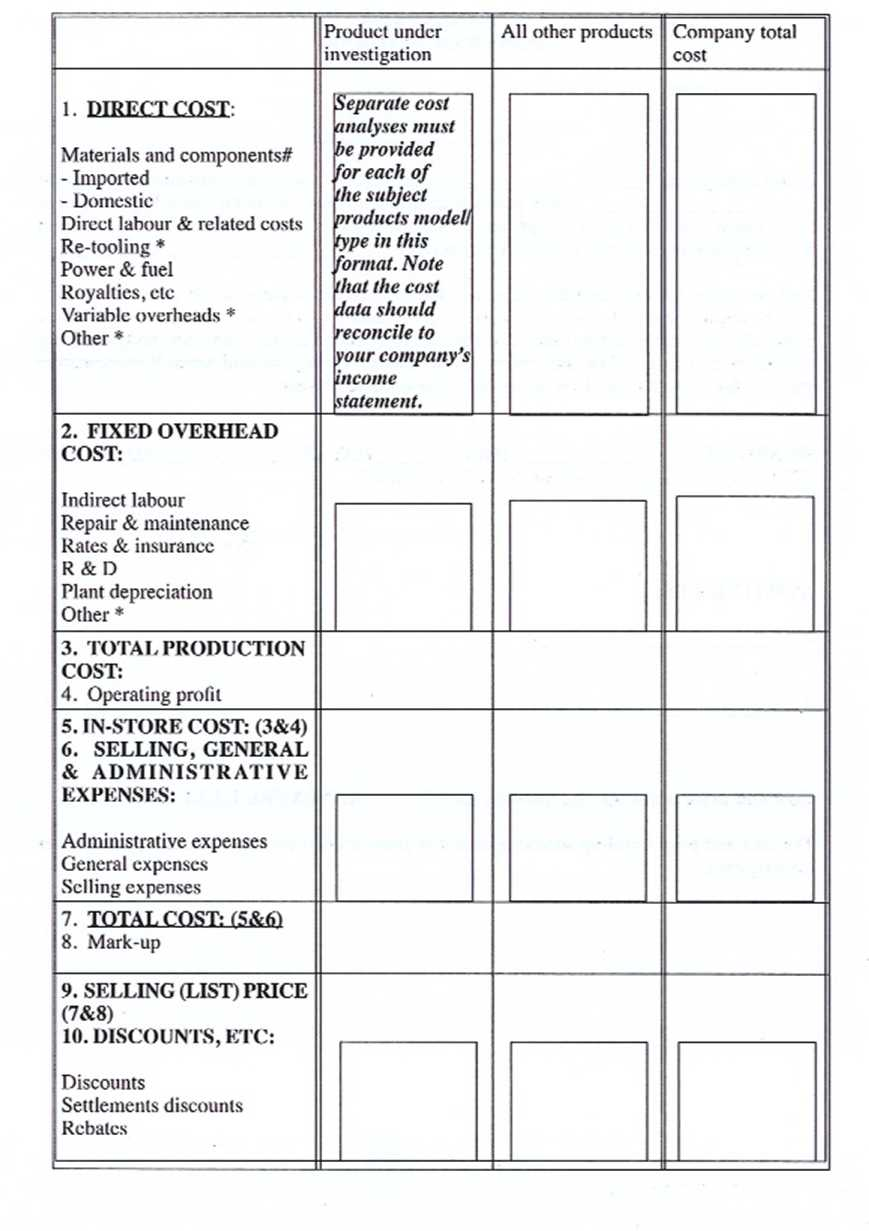
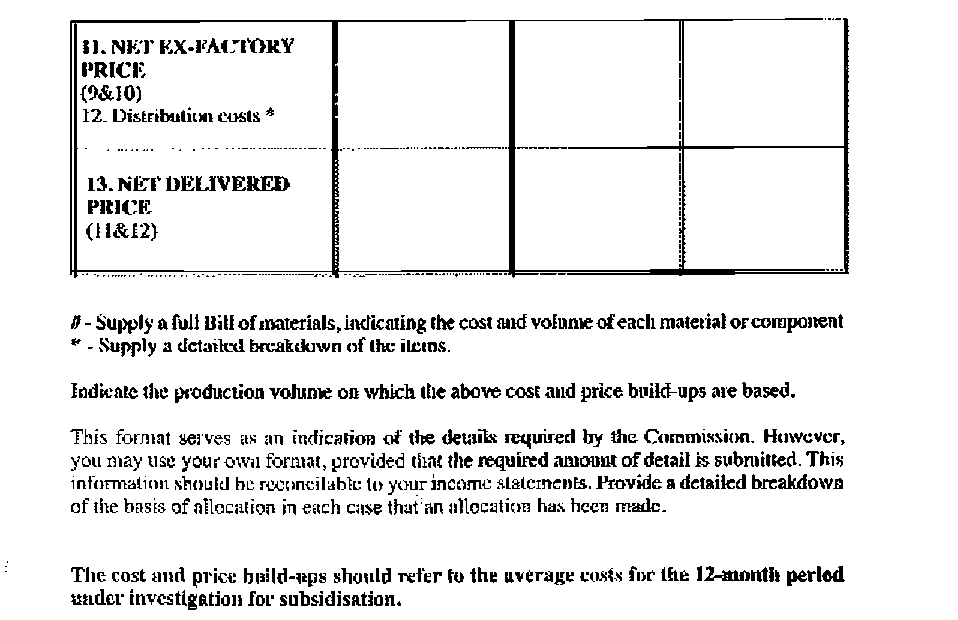
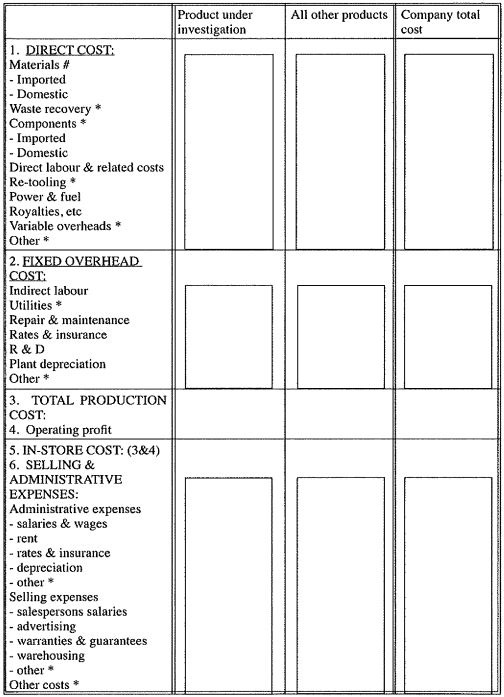
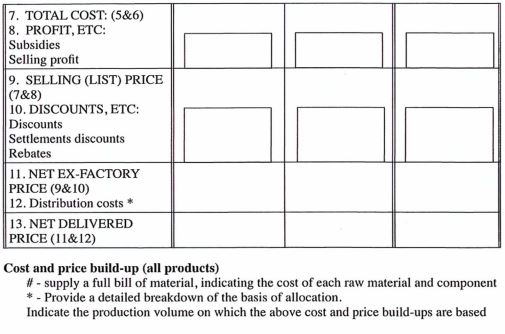
E4.1 Please supply a cost build-up in the format indicated in Annexure E4.1. Where your management accounts do not allow for the specific cost elements indicated in the pro forma, please indicate the information that is available and supply as much detail as possible.
The cost and price build-ups should refer to the average costs for the most recent 12-month period of the POI.
E4.2 Indicate the production volume on which the cost and price build-ups are based.
E4.3 Have any cost items provided in the cost and price build up been allocated? If so provide a detailed breakdown of the basis of allocation in each case that an allocation has been made.
E4.4 Supply a full Bill of Materials for the domestic like or directly competitive product indicating the cost and volume of each material or component as Annexure E4.4
E5 SACU INDUSTRY SALES AND MARKET SHARE
E5.1 Please supply the following information on your sales volume in SACU. State the unit of measurement.
|
|
20xx |
20xx |
20xx |
|
Sales volume |
|
|
|
|
Sales by other SACU producers |
|
|
|
|
Total volume of SACU sales by SACU producers |
|
|
|
|
Volume of imports |
|
|
|
|
Market share (Applicant) |
|
|
|
|
Total market share held by SACU producers |
|
|
|
|
Market share held by imports |
|
|
E5.2 Attach as Annexure E5.2 a table indicating, the quarterly volumes of imports for the last six consecutive quarters of the POI.
E5.3 Indicate how the information in paragraphs E5.1 and E5.2 supports your allegation of serious injury.
|
|
20xx |
20xx |
20xx |
|
Gross profit margin (%) |
|
|
|
|
Gross profit per unit |
|
|
|
|
Units sold |
|
|
|
|
Total gross profit |
|
|
|
|
Net profit margin (%) |
|
|
|
|
Net profit per unit |
|
|
|
|
Net gross profit |
|
|
E5.4 If sales of the product is of a cyclical nature comment on the nature thereof, indicating the length of the cycle and the prices both during the up and down phases.
E6 Profit/loss
E6.1 Supply the following information regarding your profit for the product concerned (where the information cannot be supplied separately for the product concerned indicate the group of products to which the profit applies and submit your calculations, indicating how costs and profit were allocated):
E6.2 Comment on the changes in profits.
E7 Output
E7.1 Supply the following information regarding your actual production volumes for the POI:
|
|
20xx |
20xx |
20xx |
|
Total production of the product concerned |
|
|
|
|
Production for SACU consumption |
|
|
|
|
Other SACU producers’ production for SACU consumption |
|
|
E7.2 Comment on the changes in production, both total and for SACU consumption.
E8 Employment and productivity
E8.1 Provide the following information regarding employment and productivity:
|
|
20xx |
20xx |
20xx |
|
Total production volume |
|
|
|
|
Number of employees (manufacturing only) |
|
|
|
|
Units per employee |
|
|
|
|
Total employment |
|
|
|
|
Total investment |
|
|
|
|
Output ratio* |
|
|
|
*Output ratio: Indicate the value of the output compared to the total investment in your company/ industry |
|
E9 Capacity and capacity utilisation |
|
E9.1 Supply the information requested below regarding capacity and capacity utilisation for the product concerned. State the unit of measurement. |
|
|
20xx |
20xx |
20xx |
|
capacity (units) |
|
|
|
|
Actual production |
|
|
|
|
Capacity utilisation % |
|
|
|
|
Rest of SACU capacity |
|
|
|
|
Rest of SACU production |
|
|
|
|
Rest of SACU capacity utilisation %> |
|
|
E9.2 State the normal number of shifts per week, number of hours per shift and number of labour units involved, for each—
|
|
20xx |
20xx |
20xx |
|
Your company Number of shifts |
|
|
|
|
Workers per shift |
|
|
|
|
Other SACU producers Number of shifts— |
|
|
|
|
Other SACU producers Workers per shift— |
|
|
E9.3 State whether your production capacity can be increased without additional machinery, equipment and buildings indicating the method (e.g. more shifts, hours or labour units) and the extent of the possible increase in terms of volume.
E10 Other injury information
Please indicate any other injury information to be considered by the Commission and not covered by the questions above.
SECTION F: THREAT OF SERIOUS INJURY
Note: It is not necessary to complete this section if you can prove actual current serious injury.
Note: Any allegation of threat of serious injury should be based on concrete evidence and not only mere conjecture or remote possibility. Information provided on threat should be sufficient to clearly indicate that serious injury is clearly imminent
F1 Give details on the freely disposable capacity or imminent substantial increase in capacity of the exporter/s. Substantiate your reply.
F2 Substantiate any significant increase of imports into the SACU market indicating the likelihood of substantially increased importation.
F3 State whether the demand for imports of the product concerned is likely to further increase. Substantiate your reply.
F4 Give any other information relevant to your allegation that the infliction of serious injury is imminent.
SECTION G: CAUSE OF SERIOUS INJURY
Note: In order to justify a safeguards action the Commission must be satisfied that serious injury is caused by the increase in imports. SGR – provides as follows:
“In considering whether there is a causal link between the imports of the product concerned and the serious injury the Commission shall consider all relevant factors including factors other than the imports of the product concerned that may have contributed to the SACU industry’s injury, provided that a participating interested party has submitted, or the Commission otherwise has, information on such factor or factors.”
SGR – provides that “The injury caused by other factors shall not be attributed to the increased imports.”
G 1 Give the reasons for your belief that the imports are the cause of the alleged serious injury or threat thereof.
G 2 Indicate the view that your clients have regarding:
(a) the quality of your product;
(b) your delivery times;
(c) your service; and
(d) your after sales service, including guarantees and warranties and technical training to customers.
Please elaborate on all of the above issues.
G 3 Indicate the state of your workforce and its attitude towards the company, indicating inter alia how wage negotiations are conducted.
G 4 Have you had any strikes, go-slows or lock-outs during the past twelve calendar months? Please elaborate.
G 5 Has there been a contraction in demand for your product or has there been a change in consumption patterns? Please elaborate.
G 6 Indicate the technology developments that have taken place since you last updated your manufacturing process.
G 7 Comment on your productivity vis-a-vis that of the exporters.
G 8 Any other relevant factor
SECTION I: RELIEF SOUGHT
Indicate the relief sought (safeguards measure) clearly indicating how it was determined, with all substantiating evidence included.
This may be based on price undercutting, price disadvantage or any relevant factor as the Commission may consider.
SECTION J: GENERAL
(a) Indicate efforts taken or planned to compete with the imports.
(b) Should the Commission initiate an investigation, the industry will be required to submit a plan not later than 60 days after initiation of the investigation, indicating how it will adjust to increase its competitiveness.
(c) Provide any other evidence you wish to bring to the attention of the Commission.
CERTIFICATION
The undersigned certifies that all information herein supplied in response to the questionnaire is complete and correct to the best of his knowledge and belief and understands that the information submitted may be subject to audit and verification by the Botswana Trade Commission. The undersigned has been authorised to represent (company name).
|
Date |
Signature of authorised person |
|
……………………. |
………………………………………………………. |
ANNEXURE A-2
LETTER OF AUTHORISATION
Type the following letter on your company letterhead
To whom it may concern
We the undersigned, hereby authorise ………………………………………………….. to act on our behalf in all manners relating to this application, including signing all documents and being the point of contact.
Any and all acts carried out by the agent/representative on our behalf shall have the same effect as acts of our own.
Further details of the agent/representative are provided below:
Name:
Address:
Telephone No:
Fax No:
E-mail address:
This authorisation is valid for the entirety of the application and investigation process or until further notice from (company name), whichever occurs first.
|
|
Yours sincerely |
|
|
……………………………….. |
|
|
(Duly authorised person) |
BOTSWANA TRADE COMMISSION (TARIFF INVESTIGATIONS) REGULATIONS
(section 37)
(28th February, 2025)
ARRANGEMENT OF REGULATIONS
REGULATION
1. Citation
2. Interpretation
3. Application for investigation
4. Self initiation for tariff investigation
5. Acknowledgement of receipt of application
6. Confidentiality of information provided by applicant
7. Compliance assessment or evaluation of application
8. Evaluation criteria during investigations
9. Publication of Notice
10. Register of investigations
11. Verification of information
12. Oral hearing
13. Representation
14. Increase of customs duty, reduce, amend, remove rebate or drawbacks
15. Final recommendation to Board
16. Communication of final decision of SACU Council
17. Termination of investigation
18. Deadlines
19. Review
>SCHEDULES
S.I. 27, 2025.
These Regulations may be cited as the Botswana Trade Commission (Tariff Investigations) Regulations.
In these Regulations, unless the context otherwise requires—
“applicant” means a domestic party submitting an application as provided for under regulation 3 for the purposes of initiating a tariff investigation;
“day” means any day other than a Saturday, Sunday or any day which is a public holiday under the Public Holidays Act (Cap. 03:07);
“Industrial Development Policy” has the same meaning assigned to the term under the Industrial Development Act (Cap.43:01);
“interested party” may include—
(a) a producer in SACU;
(b) an exporter in SACU;
(c) an importer in SACU; or
(d) a trade or business association whose members are—
(i) SACU producers, exporters or importers; or
(ii) foreign producers, exporters or importers;
“SME” means small and medium enterprises; and
“tariff investigation” means investigation to increase ordinary customs duties, reduce ordinary customs duties, create, amend, remove rebate or the drawback provisions regarding customs duty.
3. Application for investigation
(1) Any interested party who wishes to apply for a tariff investigation shall, in writing apply to the Commission for tariff investigation.
(2) An application referred to under subregulation (1), shall be made in either Form A or B or C or D set out in the Schedule and be accompanied by—
(a) an application fee of P500; and
(b) such supporting documents or information as may be required by the Commission.
4. Self initiation for tariff investigation
(1) Notwithstanding regulation 3, the Commission may initiate tariff investigation without having received any written application from any interested party, to initiate the investigation.
(2) The Commission may initiate an investigation depending on different reasons, including, the following reasons—
(a) looking at the challenges faced by the industry;
(b) request made by the Government entity, trade or business associations; or
(c) to review the customs duty related to a product or the range of products.
5. Acknowledgment of receipt of application
(1) The Commission shall, in writing, acknowledge receipt of the application submitted under regulation 3 within five working days from the date of receiving the application.
(2) The Commission shall, in the acknowledgement letter include the names and the contact details of the assigned lead investigating officer.
6. Confidentiality of information provided by applicant
(1) The Commission shall, upon good cause shown, keep confidential information provided by an applicant or any interested party which information—
(a) by nature is confidential;
(b) if disclosed could have a significant adverse effect upon the provider of, or a person supplying the information; and
(c) was provided on a confidential basis by a party to the investigation.
(2) For the purposes of these Regulations, the following types of information shall be deemed to be by nature confidential information if such information—
(a) concerns the financial statement of a company which is not publicly available such as—
(i) management of accounts,
(ii) financial accounts of a private company,
(iii) actual and individual sales prices,
(iv) actual costs, including cost of production and importation costs,
(v) actual sales volume, and
(vi) information, the release of which could have significant adverse effect on the owner of, or the person that provided the information;
(b) concerns the costs, identification of customers, sales, inventory, shipment, or amount or source of any income, profit, loss or expenditure related to the owner of or the person that provided the information; and
(c) would be of significant competitive advantage to a competitor of the owner of the information.
(3) A party who seeks confidentiality over certain information shall, request in writing, for such treatment at the time the information is submitted to the Commission, including the reasons as to why such confidential treatment shall be warranted.
(4) The applicant shall furnish non-confidential summary of all information for which confidential treatment is sought.
(5) The non-confidential summary referred to under subregulation (4), shall be in sufficient detail to permit a reasonable understanding of the substance of the information submitted in confidence.
(6) The Commission shall consider a request made under subregulation (3).
(7) Where the Commission decides that a request for confidentiality is not warranted, the Commission shall inform the party submitting the information that the request for confidential treatment is not warranted.
(8) The Commission shall give its decision made under subregulation (7) in writing and state the reasons thereof.
(9) The Commission may disregard any information indicated to be confidential that is not accompanied by a non-confidential summary as required in subregulation (4).
(10) A party who is not satisfied with the decision made by the Commission to disregard any information indicated to be confidential, may appeal to the Minister within 14 days of the receipt of the decision made by the Commission.
(11) The Commission may not disregard any information indicated to be confidential until the Minister determines the application made under subregulation (3) or until the 14 days have elapsed with no application being made to the Minister.
7. Compliance assessment or evaluation of application
(1) The Commission shall, upon receipt of the application, assess the application for tariff investigation and may decide that such application is deficient if the—
(a) application is not in the manner and form provided by the Commission;
(b) required information has not been provided in full;
(c) application contains incorrect or conflicting information; or
(d) application contains confidential information and the applicant has failed to provide a non-confidential summary in conformity with regulation 6(4).
(2) The Commission shall, in the case of a deficient application, inform an applicant in writing to rectify the deficiency within the time provided by the Commission.
(3) The applicant shall, rectify the deficient application referred to under subregulation (2) and submit the corrected application in conformity with regulation 6(4).
(4) The Commission shall exercise its discretion to regard the application as materially deficient and reject the application, in the event where the applicant fails to provide the requested information within the set period of 14 days provided by the Commission.
(5) The Chief Executive Officer shall evaluate an application for an investigation and where the Chief Executive Officer rejects the application, the Chief Executive Officer shall notify the applicant of the reasons why such application was rejected.
(6) The Chief Executive Officer shall notify the applicant of the reasons for the rejection within seven days of the Chief Executive Officer’s determination.
(7) Where the Chief Executive Officer approves the application, the Chief Executive Officer shall submit a preliminary recommendation to initiate an investigation to the Board.
(8) Where the Board approves the recommendation made by Chief Executive Officer to initiate the investigation, the Board shall authorise the Chief Executive Officer to publish a Notice in the Gazette, to initiate the investigation and submit a report to the Board in accordance with section 31(3) of the Act.
(9) The Chief Executive Officer shall inform the SACU Secretariat of its decision to initiate tariff investigation through the Ministry.
8. Evaluation criteria during investigations
(1) The Commission shall in evaluating the application, assess the following factors—
(a) the domestic industry’s production capacity and potential;
(b) employment creation, labour intensity and labour demographics of the relevant industrial sector;
(c) investment;
(d) price differentials between the domestically manufactured product and the imported product;
(e) the market shares;
(f) import and export data;
(g) demand and supply conditions;
(h) the financial state of the domestic industry, profitability and return on investment ratios;
(i) the price and cost structures;
(j) the rate of effective protection;
(k) the availability of a domestically manufactured identical or substitute product; and
(l) any information considered to be relevant by the Commission.
(2) The evaluation of the application shall also be informed by the—
(a) Industrial Development Policy; and
(b) Government’s economic objectives including—
(i) economic diversification,
(ii) employment creation,
(iii) poverty eradication,
(iv) productivity and investment,
(v) citizen economic empowerment, and
(vi) SME development.
(3) The Chief Executive Officer may, where the application is deficient, notify an applicant in writing, to provide for additional information for an application to be re-assessed.
(1) The Chief Executive Officer may, once it receives an application, publish a Notice of such application in the Gazette as provided by section 31(2) of the Act, to allow interested parties to make comments about the application within 30 days.
(2) An interested party may request for an extension of time to make comments on the application made under subregulation (1), showing good cause why such an extension should be granted.
(3) The Commission may grant such extension period of 14 days, taking into account the time limits for the investigation.
(4) The Notice referred to under subregulation (1) shall include—
(a) the name, address and telephone number of the applicant;
(b) the nature of the application and the reference number;
(c) the name and contact details of designated lead investigating officer;
(d) the time period for publication and due date for the comments; and
(e) a brief statement of the reason for the application.
(5) The comments referred to under subregulation (1) shall be—
(a) in writing; and
(b) submitted through any means of communication either electronically, by mail or hand delivery.
(6) If the comments referred to in subregulation (1) and (5) are classified as confidential, a non-confidential summary with a valid reason that is sufficient to qualify, as confidentiality shall be submitted to the Commission.
(7) The comments that are not accompanied by a non-confidential summary or are not otherwise clearly indicated as confidential, may be treated as non-confidential.
10. Register of investigations
(1) The Commission shall establish and maintain a register relating to each investigation undertaken in terms of the Act.
(2) The Commission shall record the following information—
(a) all public notices relating to the investigation;
(b) all non-confidential documents that are part of the record of the investigation;
(c) all other information developed or obtained by the Commission; and
(d) any other documents which the Commission deems appropriate for public disclosure.
(3) The register referred to under subregulation (1) may, be accessed by interested party for inspection—
(a) on prior request to the lead investigating officer;
(b) for a particular case;
(c) at the offices of the Commission; and
(d) at the normal business hours during the course of the investigation.
11. Verification of information
(1) The Commission may, during the course of an investigation, satisfy itself of the accuracy of the information supplied by an interested party by conducting verifications as it deems necessary.
(2) The Commission may, when carrying out the verifications, conduct an on-the-spot verification visit to obtain the information and data required for the investigation.
(3) The Commission may, in writing, inform and notify the interested party concerned of the date of an intended verification visit.
(4) Where an interested party to be verified is from another Member State, the Government of that State and the SACU Secretariat would be informed of the verification visit and dates.
(5) The Commission may terminate any verification activities and may disregard the information submitted by an interested party, and may come to the conclusions of verifications according to the best information which is available, where for purposes of verification, the interested party—
(a) refuses to attend the verification visit;
(b) refuses to grant the Commission access to the relevant information;
(c) fails to provide information within the timeline set by the Commission; or
(d) otherwise acts so as to impede the verification process.
(6) The Commission shall, after verification visit, prepare a report stating the information verified and the information which was not available for verification.
(7) The failure of interested parties to agree on the information verified, shall not preclude the Commission to use the verified information in its findings.
(8) A non-confidential verification report shall be placed on the public register for inspection.
(9) An interested party shall be given seven days to comment on the verification report and the Commission may grant an extension upon good cause shown by an interested party.
(1) The Commission shall provide a fair opportunity for any interested party concerned to defend the party’s interest during the period of investigation and the Commission may, upon request, hold a hearing for an interested party to present the interested party’s view and arguments.
(2) Any interested party may present oral submission during the hearing.
(3) The interested party shall within seven days of the oral hearing reduce information presented during the oral hearing to writing and a non-confidential version of the information shall be placed on the public file.
(4) Where the interested party fails to submit the written submissions in accordance with subregulation (3), the Commission shall not consider the oral submissions under subregulation (2).
(5) Where an interested party requests for an oral hearing, such party shall indicate the reasons for not relying on written submissions only.
(6) The Commission may reject a request for an oral submission where the Commission determines that—
(a) substantially similar information has already been submitted in written form to the Commission;
(b) written submission, in the Commission’s view, adequately sets out the matter intended for an oral submission; or
(c) the oral submission would unduly delay finalisation of the investigation.
(7) An interested party requesting an oral hearing shall at the time of request provide the Commission with an agenda for an oral hearing.
(1) Where an interested party is represented by another party in an investigation, the interested party shall provide the Commission with a letter of appointment of the interested party’s representative.
(2) The letter of appointment referred to under subregulation (1), shall—
(a) contain details of the representative, scope and duration of the representation; and
(b) be signed by the highest level of authority or an authorised representative, with proof of authorisation.
(3) Where any interested party terminates a representation made under subregulation (1) such party shall provide the Commission with a letter of termination and the letter shall comply with the requirements provided under subregulation 2(b).
(4) Where an interested party has appointed a representative, communication between the Commission and the interested party shall be through the appointed representative.
(5) Notwithstanding subregulation (4), the Commission may communicate directly with an interested party.
(6) The communication of the appointment of an interested party’s representative shall be made at the time of submitting an application referred to under regulation 3.
14. Increase of customs duty, reduce, amend, remove rebate or drawbacks
(1) An increase in the rate of customs duty shall be recommended to protect domestic producers who are experiencing the threatening import pressures so that such producers can become internationally competitive and such recommendation shall be by an application in Form B set out in Schedule.
(2) A reduction or removal of custom duty shall be recommended depending on—
(a) a case-by case basis;
(b) a resource-based inputs to lower input costs; and
(c) instances whereby intermediate goods, consumption goods, or capital goods are not produced domestically or are unlikely to be manufactured domestically.
(3) The rebate and drawbacks shall be recommended to provide a customs duty waiver.
15. Final recommendation to Board
(1) The Chief Executive Officer shall submit final recommendation to the Board upon completion of the investigations in accordance with section 31(6) of the Act.
(2) The recommendation submitted by the Chief Executive Officer to the Board under subregulation (1) shall contain the following information—
(a) identity of the applicant;
(b) a full description of the product under investigation;
(c) the methodology used by the Commission to investigate and factors considered during the investigations;
(d) the Commission’s findings; and
(e) all relevant issues of fact and law considered by the Commission in reaching its determination.
(3) Where the Board approves the recommendation submitted under subregulation (1), the Board shall submit a written report to the SACU Tariff Board.
16. Communication of final decision of SACU Council
(1) The Commission shall inform the applicant, in writing, of the decision made by the SACU Council.
(2) The Commission shall publish, by Notice in the Gazette, the decision made by the SACU Council in relation to the application.
(3) The Notice referred to under subregulation (2), shall detail the findings and conclusions reached on all issues of fact and the law, which led to the decision to accept or reject the Board recommendation for tariff amendment.
17. Termination of investigation
(1) An investigation may be terminated at any time when—
(a>) the applicant withdraws the application; or
(b) the Commission determines, upon evaluation of the application, that the availed evidence is not adequate to support recommendation for tariff investigation.
(2) The Commission may terminate the investigation at any time where the Commission has self-initiated an investigation—
(a) when the industry does not furnish the Commission with the requested information; or
(b) when the preliminary investigation reveals that the industry is not affected.
The Commission shall conclude an investigation within 18 months after the initiation of the application.
Any person who is aggrieved by the decision of the Minister or Commission under these Regulations, may within 30 days of such decision, apply to the High Court for the review of such decision.
SCHEDULE
FORM A
(regulation 3(2))
APPLICATION FOR CUSTOMS TARIFF AMENDMENT CREATION OF A REBATE FACILITY
Please address all correspondence to the Chief Executive Officer, Botswana Trade Commission, and forward your application choosing one of the following—
|
Postal address: |
Private Bag 3ADD, Poso House, Gaborone |
|
Physical address: |
Plot 55745, Block 8, Main Airport Road, Gaborone |
|
Email: |
info@botc.org.bw |
NOTES:
(i) It is imperative to study the contents of the document titled “TARIFF INVESTIGATIONS REGULATIONS”, which can be found on BOTC’s website (
(ii) applicants should feel free to submit any information or comment considered to be relevant to the application, not called for specifically in the questionnaire. The application should include a duly signed affidavit on the company’s letterhead averring the accuracy of the information being provided and be accompanied by a cover letter signed by the CEO of the applying company authorising the submission of the application.
(iii) It is advisable that the Office of the Commissioner General for the BURS be consulted in connection with the tariff classification and description of the product concerned. This applies to questions 10 and 11 of the questionnaire. Should an additional 8-digit tariff subheading be required, it is also necessary to obtain the relevant description of such a provision from BURS before the application can be submitted.
(iv) If rebate of the custom duty is required on more than one product, information should be furnished separately throughout the questionnaire for each product.
(v) The statistical information may be given for either calendar years or financial years, but the basis selected should be stated.
INFORMATION REQUIRED IN SUPPORT OF AN APPLICATION FOR THE CREATION OF A REBATE FACILITY
A COMPANY DETAILS
Name of the applicant: ………………………………………………………………………………………..
Company’s registration number: …………………………………………………………………………….
………………………………………………………………………………………………………………………
………………………………………………………………………………………………………………………
Postal Address: …………………………………………………………………………………………………
………………………………………………………………………………………………………………………
Physical Address: ………………………………………………………………………………………………
………………………………………………………………………………………………………………………
………………………………………………………………………………………………………………………
Tel: (…………………………. ) ………………………………… .. Fax: ( …………………) …………………..
Webpage: ………………………………………………………………………………………………………..
Email: ……………………………………………………………………………………………………………..
2. Provide the contact details of the applicant/representative. Should an interested party wish to be represented by a third party in an investigation, the interested party must provide the Commission with a letter of appointment of its representative, detailing the identity of the representative and the scope and duration of the representation. These requirements are set forth in greater detail in regulation 13 of the Tariff Investigations Regulations.
Contact person: …………………………………………………………………………………………………
Postal Address: …………………………………………………………………………………………………
Physical Address: ………………………………………………………………………………………………
………………………………………………………………………………………………………………………
Tel:(……………………..) …………………….. Fax:(…………………………) ……………………………..
Webpage: ………………………………………………………………………………………………………..
Email: …………………………………………………………………………………………………………….
3. Provide the physical location of the factory and warehouse:
………………………………………………………………………………………………………………………
………………………………………………………………………………………………………………………
4. State the nature of the business conducted by the applicant:
………………………………………………………………………………………………………………………
………………………………………………………………………………………………………………………
It should be noted that in terms of regulation 8(3) of the Tariff Investigations Regulations, the Commission may, inter alia, require an applicant to provide additional information in respect of the application:
………………………………………………………………………………………………………………………
………………………………………………………………………………………………………………………
………………………………………………………………………………………………………………………
………………………………………………………………………………………………………………………
………………………………………………………………………………………………………………………
………………………………………………………………………………………………………………………
B PRODUCT DESCRIPTION AND TARIFF CLASSIFICATION
Provide the existing tariff structure as per the table below—
|
Tariff heading |
Tariff subheading |
Description |
Statistical unit |
Rate of duty |
|
|
|
|
|
|
|
|
|
General |
EU |
EFTA |
SADC |
AfCFTA |
|
(4 digit) |
|
(Tariff heading description) |
|
|
|
|
|
|
|
|
(6 or 8 digit) |
(Tariff subheading description) |
|
|
|
|
|
Provide the existing tariff structure as per the table below:
Table 2: Current Tariff Position or the Final Product Manufactured by the Applicant
|
Tariff heading |
Tariff subhead ing |
Description |
Statistical unit |
Rate of duty |
||||
|
|
|
|
|
General |
EU |
EFTA |
SADC |
AfCFTA |
|
(4 digit) |
|
(Tariff heading description) |
|
|
|
|
|
|
|
|
(6 or 8 digit) |
(Tariff subheading description) |
|
|
|
|
|
8. Please provide the description of the requested rebate provision as supplied by BURS and also indicate the extent of rebate sought. Include the actual communication from BURS confirming the wording of the proposed rebate provision (attach if possible):
………………………………………………………………………………………………………………………
………………………………………………………………………………………………………………………
………………………………………………………………………………………………………………………
………………………………………………………………………………………………………………………
………………………………………………………………………………………………………………………
………………………………………………………………………………………………………………………
9. Describe the product in the fullest detail with regard to composition, method/process of manufacturing, function and method of use. Such a description should be supported, where possible, with clearly illustrated literature, (attach if possible):
………………………………………………………………………………………………………………………
………………………………………………………………………………………………………………………
………………………………………………………………………………………………………………………
………………………………………………………………………………………………………………………
………………………………………………………………………………………………………………………
10. Please furnish information with regard to all intermediate inputs which are all industrial inputs, except the primary inputs of capital and labour used in the manufacture of the final product manufactured by the applicant as indicated in the table below. (attach if possible).
………………………………………………………………………………………………………………………
………………………………………………………………………………………………………………………
………………………………………………………………………………………………………………………
………………………………………………………………………………………………………………………
………………………………………………………………………………………………………………………
………………………………………………………………………………………………………………………
Table 3A: Input Products
|
List all domestically sourced intermediate products and indicate Common Custom Area Supply Chains |
Tariff subheading |
Percentage of ex-factory sales value |
|
|
|
|
|
|
|
|
|
|
|
|
|
|
|
|
|
|
|
|
|
|
|
|
|
|
|
|
|
|
|
|
|
|
|
|
|
|
|
|
|
|
|
Table 3B: Input Products
|
List all imported intermediate products |
Tariff subheading |
Percentage of ex-factory sales value |
|
|
|
|
|
|
|
|
|
|
|
|
|
|
|
|
|
|
|
|
|
|
|
|
|
|
|
|
|
|
|
|
|
|
|
|
|
|
|
14. Give a technical description of the end product and describe or provide a diagram of the position of the product in the value chain (i.e. intermediate product or final product) (attach if possible).
………………………………………………………………………………………………………………………
………………………………………………………………………………………………………………………
………………………………………………………………………………………………………………………
………………………………………………………………………………………………………………………
………………………………………………………………………………………………………………………
………………………………………………………………………………………………………………………
………………………………………………………………………………………………………………………
C REASONS FOR THE APPLICATION
15. Give a brief statement of the reasons for the application. Please note that the particulars given will form the basis of the application and could be made available to interested parties (attach if possible).
………………………………………………………………………………………………………………………
………………………………………………………………………………………………………………………
………………………………………………………………………………………………………………………
………………………………………………………………………………………………………………………
D INDUSTRY AND MARKET
16. Furnish the names and addresses or websites of other SACU manufacturers of the product or end product including details of the known SACU industry representative organisations.
………………………………………………………………………………………………………………………
………………………………………………………………………………………………………………………
………………………………………………………………………………………………………………………
………………………………………………………………………………………………………………………
E MARKET AND TRADE INFORMATION
17. Furnish the company’s recent three-year information on market and trade data and indicate the proportion of the total allocated to the product being the subject of the application where applicable. Please use table 4 below for ease of presentation of the information.
Table 4: Market and Trade Data
|
No |
Items |
Year 1 |
Year 2 |
Current year |
|||
|
|
|
Company Total |
Subject Product |
Company Total |
Subject Product |
Company Total |
Subject Product |
|
1 |
Estimated SACU Domestic demand – kg/li/ units |
|
|
|
|
|
|
|
2 |
Estimated SACU Domestic supply – kg/ li/units |
|
|
|
|
|
|
|
3 |
Applicant total production (volume – kg/li/units) |
|
|
|
|
|
|
|
4 |
Applicant total sales (volume – kg/li/units) |
|
|
|
|
|
|
|
5 |
Applicant total sales (value, P) |
|
|
|
|
|
|
|
6 |
Applicant SACU sales (volume – kg/li/units) |
|
|
|
|
|
|
|
7 |
Applicant SACU sales (value, P) |
|
|
|
|
|
|
|
8 |
Applicant production capacity |
|
|
|
|
|
|
|
9 |
Applicant market share (%) |
|
|
|
|
|
|
|
10 |
SACU industry market share (%) |
|
|
|
|
|
|
|
11 |
Applicant total investment (Pm) |
|
|
|
|
|
|
|
|
Plant & machinery Buildings |
|
|
|
|
|
|
|
12 |
Applicant total export |
|
|
|
|
|
|
|
|
Volume (kg/ li/units) value (P) Destination |
|
|
|
|
|
|
|
13 |
Applicant total import |
|
|
|
|
|
|
|
|
Volume (kg/ li/units) value (P) Origin |
|
|
|
|
|
|
|
14 |
Applicant total employment |
|
|
|
|
|
|
|
|
Senior management middle management direct factory workers administrative staff |
|
|
|
|
|
|
|
|
Male Female |
|
|
|
|
|
|
|
|
Female • Youth (18 years – 35 years) • Adult (35 years and above) |
|
|
|
|
|
|
|
|
Citizens Non-citizens |
|
|
|
|
|
|
|
|
Skilled • Youth (18 years-35 years) Semiskilled • Youth (18 years-35 years) Unskilled • Youth (18 years-35 years) Total direct factory workers • Youth (18 years-35 years) |
|
|
|
|
|
|
|
|
Disabled |
|
|
|
|
|
|
|
15 |
Applicant total wage (P) |
|
|
|
|
|
|
|
|
Senior management Middle management Direct factory workers Administrative staff |
|
|
|
|
|
|
|
|
Male Female |
|
|
|
|
|
|
|
|
Female • Youth (18 years – 35 years) • Adult (35 years and above) |
|
|
|
|
|
|
|
|
Citizens Non-citizens |
|
|
|
|
|
|
|
|
Skilled • Youth (18 years-35 years) Semiskilled • Youth (18 years-35 years) Unskilled • Youth (18 years-35 years) Total direct factory workers • Youth (18 years-35 years) |
|
|
|
|
|
|
|
|
Disabled |
|
|
|
|
|
|
|
16 |
Applicant supply side measures (P) |
|
|
|
|
|
|
|
17 |
Research and development skilled development and training Upgrading machinery & equipment other (list and populate) |
|
|
|
|
|
>>Note: unit of measure should he in line with the Customs Act
18. Is the applicant receiving any financial, capital or other form of support from any Government Department or Government Institution in the SACU or financial institutions outside SACU? If so provide the details about the type, duration and the extent of the already acquired support. Please provide supporting documentation (attach if possible).
………………………………………………………………………………………………………………………
………………………………………………………………………………………………………………………
………………………………………………………………………………………………………………………
F COMPETITIVENESS
19. Provide the present cost and price structure of the subject product if the product is not further processed by your firm or being used in the processing of another product (use Table 5):
Table 5: Cost and Price Structure
|
Items |
Year 1 |
Year 2 |
Current year |
|
P per kg/li/units |
P per kg/li/units |
P per kg/li/units |
|
|
F.O.B value |
|
|
|
|
Freight, insurance, landing charges |
|
|
|
|
Customs duty |
|
|
|
|
Other (specify) |
|
|
|
|
In-store costs |
|
|
|
|
Selling and administration costs |
|
|
|
|
Profit |
|
|
|
|
Selling price (total of above amounts) |
|
|
Note: please give breakdown of the selling and administration costs
20. If the product is further processed by your firm or being used in the processing of another product, furnish the following details of the present cost and price structure (use Table 6).
Table 6: Cost and Price Structure
|
No. |
Items |
Year 1 |
Year 2 |
Current year |
||||||
|
|
|
Price per kg/li/ units |
% total cost of production |
% ex-factory selling price |
Price per kg/li/units |
% total cost of production |
% ex- factory selling price |
Price per kg/li/ units |
% total cost of production |
% ex- factory selling price |
|
1 |
direct Variable Cost |
|
|
|
|
|
|
|
|
|
|
|
Material and components |
|
|
|
|
|
|
|
|
|
|
|
Imported F.O.B Customs duty Freight, insurance and landing and other charges other imported inputs Domestic sourced Direct labour and related costs Tooling* Royalties, etc Other* |
|
|
|
|
|
|
|
|
|
|
2 |
Indirect variable cost |
|
|
|
|
|
|
|
|
|
|
|
Labour Utilities R and D Other variable overheads* |
|
|
|
|
|
|
|
|
|
|
3 |
Fixed over- head cost |
|
|
|
|
|
|
|
|
|
|
|
Labour Repair and maintenance Rates and insurance Plant depreciation Net interest paid Rent Other* |
|
|
|
|
|
|
|
|
|
|
4 |
Total production cost |
|
|
|
|
|
|
|
|
|
|
5 |
Selling general and administrative expenses |
|
|
|
|
|
|
|
|
|
|
|
Admin- istrative expenses Selling expenses General expenses |
|
|
|
|
|
|
|
|
|
|
6 |
Total Cost |
|
|
|
|
|
|
|
|
|
|
7 |
Selling (list) price |
|
|
|
|
|
|
|
|
|
|
8 |
Discounts |
|
|
|
|
|
|
|
|
|
|
|
Rebates |
|
|
|
|
|
|
|
|
|
|
9 |
Net profit |
|
|
|
|
|
|
|
|
|
|
10 |
Net ex-factory price |
|
|
|
|
|
|
|
|
|
|
11 |
Net cash flow |
|
|
|
|
|
|
|
|
Note: Supply a detailed breakdown of the items in asterisks (*). Cost items such as tooling can be a direct or indirect cost depending on the specific industry. Separate cost analyses must be provided for each of the subject products in this format. This format serves as an indication of the details required by the Commission. This information should be reconcilable to your income statements. Provide a detailed breakdown of the basis of allocation in each case that an allocation has been made.
21. Give an assessment (consumer benefit or downstream benefit to a specific industry) of how your cost and price structure would be affected should the application succeed. To what extent will your firm’s selling price for the product be influenced should the application for amendment in the duty be successful?
………………………………………………………………………………………………………………………
………………………………………………………………………………………………………………………
………………………………………………………………………………………………………………………
………………………………………………………………………………………………………………………
………………………………………………………………………………………………………………………
22. Furnish in the table below prices of equivalent imported products competing with the SACU manufactured product.
|
Country of Origin |
Free on board import prices |
Landed cost at SACU port including insurance, freight and other costs (CIF) |
|
|
|
|
|
|
|
|
|
|
|
|
|
|
|
|
|
|
|
NOTE: Wherever possible, the particulars in the above table should be substantiated with price lists, invoices, or other documentary evidence. If these are not available, the sources of the information relating to this data should be furnished.
G RECIPROCITY COMMITMENTS
23. The Commission takes a developmental or strategic approach to customs tariffs. It has begun to make all tariff support conditional on reciprocal commitments by applicants, gauging the performance of beneficiaries against the policy objectives of, among others, increased economic growth and competitiveness, as well as investment, employment creation and retention.
24. As a rebate provision is considered for the purpose of providing relief to domestic producers that may be experiencing injurious import pressures, support will be tied to conditions related to economic performance over time and may be reviewed after a specified period.
25. State the increased economic benefits that can be realised should the tariff relief be provided by completing the table below, where applicable (Table 7).
Table 7: Reciprocity Commitments
|
|
|
Should the support be given |
||
|
No |
Items |
Year 1 |
Year 2 |
Year 3 |
|
1 |
Expected total production volume (kg/li/unit) |
|
|
|
|
2 |
Expected ex-factory selling price per (kg/li/unit) |
|
|
|
|
3 |
Expected total investment (Rm) |
|
|
|
|
|
Plant & machinery Buildings |
|
|
|
|
4 |
Supply side measures (Rm) |
|
|
|
|
|
Research and development Skills development and training Upgrading machinery & equipment Other (list) |
|
|
|
|
5 |
Expected total export |
|
|
|
|
|
Volume (kg/li/unit) Value (P) |
|
|
|
|
6 |
Expected total employment |
|
|
|
|
|
Skilled • Youth (18 years – 35 years) Semiskilled • Youth (18 years – 35 years) Unskilled • Youth (18 years – 35 years) Total direct factory workers • Youth (18 years – 35 years) |
|
|
|
|
5 |
Expected total wage (P) |
|
|
|
|
|
Skilled •Youth (18 years – 35 years) Semiskilled • Youth (18 years – 35 years) Unskilled • Youth (18 years – 35 years) Total direct factory workers • Youth (18 years – 35 years) |
|
|
26. How do you support or plan to support the participation in manufacturing and related activities by small businesses, citizen owned enterprises and Common Customs Area supply chains (explain)?
………………………………………………………………………………………………………………………
………………………………………………………………………………………………………………………
………………………………………………………………………………………………………………………
………………………………………………………………………………………………………………………
………………………………………………………………………………………………………………………
……………………………………………………………..
27. Elaborate on the future pricing of the product should the support sought be granted.
………………………………………………………………………………………………………………………
………………………………………………………………………………………………………………………
………………………………………………………………………………………………………………………
………………………………………………………………………………………………………………………
………………………………………………………………………………………………………………………
………………………………………………………………………………………………………………………
………………………………………………………………………………………………………………………
……………………………………………………………..
28. In order to enable BOTC to gauge the performance of beneficiaries against their commitments in terms of employment, provide the following information—
(a) a reasonable approximation of the jobs that may be lost should the support not be granted;
(b) similarly, the number of jobs to be created if tariff support is granted; and
(c) please substantiate the estimates provide in (a) and (b).
H DEVELOPMENTAL PLAN
29. Commitment to economic performance provided in Table 7 requires, but is not limited to, the following—
(a) a development plan;
(b) a restructuring plan; or
(c) other relevant plans.
30. Where you contend that the proposed customs tariff relief is necessary to protect, maintain and/or increase market share, provide an explanation how this will be achieved, drawing on what is provided in paragraphs 25 to 29, if applicable.
………………………………………………………………………………………………………………………
………………………………………………………………………………………………………………………
………………………………………………………………………………………………………………………
………………………………………………………………………………………………………………………
………………………………………………………………………………………………………………………
………………………………………………………………………………………………………………………
………………………………………………
I SUPPORTING DOCUMENTATION
31. Submit copies of the firm’s latest audited financial statements (or management accounts) and business plan (attach if possible).
………………………………………………………………………………………………………………………
………………………………………………………………………………………………………………………
………………………………………………………………………………………………………………………
………………………………………………………………………………………………………………………
………………………………………………………………………………………………………………………
………………………………………………………………………………………………………………………
32. Please submit a statement of compliance with labour laws and agreements gazetted by the Minister of Labour and Home Affairs (attach if possible).
………………………………………………………………………………………………………………………
………………………………………………………………………………………………………………………
………………………………………………………………………………………………………………………
………………………………………………………………………………………………………………………
………………………………………………………………………………………………………………………
33. The applicant must submit a TIN Number to enable BOTC to verify the applicant’s tax clearance status on the BURS Tax Clearance System. Should challenges exist in providing this information give detailed reason/s for the absence thereof (attach).
………………………………………………………………………………………………………………………
………………………………………………………………………………………………………………………
………………………………………………………………………………………………………………………
………………………………………………………………………………………………………………………
………………………………………………………………………………………………………………………
…………………………………….
34. Should the provision of tariff relief not be sufficient to place the firm in a competitive position, are there any further plans in place to address this gap (explain).
………………………………………………………………………………………………………………………
………………………………………………………………………………………………………………………
………………………………………………………………………………………………………………………
………………………………………………………………………………………………………………………
………………………………………………………………………………………………………………………
………………………………………………….
35. Tables 4, 5, 6 and 7 are also to be provided in Excel spread sheets.
36. For this Application form to be duly completed please see overleaf.
37. Submission of the Affidavit by the Chief Executive Officer of the company.
AFFIDAVIT
I ,………………………………………………………… (Full name), of Identity Number …………………………………………, in my capacity as …………………………………… of ……………………………………………………………….. hereby declare that the information furnished in this application is to the best of my knowledge true and correct. I also submit to furnish BOTC with information in the form of Tables 4, 5 and 6 on an annual basis over the period of the support, should the support be given.
I CERTIFY THAT THE DEPONENT HAS ACKNOWLEDGED THAT HE/SHE KNOWS AND UNDERSTANDS THE CONTENTS OF THIS AFFIDAVIT, AND THAT HE/SHE HAS NO OBJECTION TO TAKING THE PRESCRIBED OATH, AND THAT HE/SHE CONSIDERS THIS OATH TO BE BINDING ON HIS/HER CONSCIENCE.
Name: …………………………………………………………………………………………………………………….
Designation: ……………………………………………………………………………………………………………..
Signature of Deponent: ………………………………………………………………………………………………..
Date: ……………………………………………………………………………………………………………………….
SIGNED AND SWORN TO BEFORE ME AT…………………………………………………………..ON THIS
…………………………..DAY OF…………………………………….YEAR………………………………………….
|
|
………………………………………………….. |

FORM B
(regulation 3 (2))
APPLICATION FOR THE CUSTOMS TARIFF AMENDMENT REDUCTION IN THE RATE OF CUSTOMER DUTY
Please address all correspondence to the Chief Executive Officer, Botswana Trade Commission, and forward your application choosing one of the following options—
|
Postal address: |
Private Bag 3AAD Poso House, Gaborone |
|
Physical address: |
Plot 55745, Block 8, Main Airport Road, Gaborone |
|
Email Address: |
|
NOTES:
(i) It is imperative to study the contents of the document titled “TARIFF INVESTIGATIONS REGULATIONS”, which can be found on BOTC’s website (
(ii) applicants should feel free to submit any information or comment considered to be relevant to the application, not called for specifically in the questionnaire. The application should include a duly signed affidavit on the company’s letterhead averring the accuracy of the information being provided and be accompanied by a cover letter signed by the CEO of the applying company authorising the submission of the application.
(iii) it is advisable that the Office of the Commissioner General for the BURS be consulted in connection with the tariff classification and description of the product concerned. This applies to questions 10 and 11 of the questionnaire). Should an additional 8-digit tariff subheading be required, it is also necessary to obtain the relevant description of such a provision from BURS before the application can be submitted.
(iv) if a reduction of the custom duty is required on more than one product, information should be furnished separately throughout the questionnaire for each product.
(v) the statistical information may be given for either calendar years or financial years, but the basis selected should be stated.
SUPPORTING DOCUMENTS
INFORMATION REQUIRED IN SUPPORT OF AN APPLICATION FOR AN INCREASE IN THE RATE OF THE CUSTOM DUTY
A COMPANY DETAILS
1. State the full name of the applicant: ……………………………………………………………………………
2. State the postal and physical address: ………………………………………………………………………..
3. State the web address if available: ………………………………………………………………………………
4. State the company’s registration number: ……………………………………………………………………..
5. Provide the contact details of the applicant/representative. Should an interested party wish to be represented by a third party in an investigation, the interested party must provide the Commission with a letter of appointment of its representative, detailing the identity of the representative and the scope and duration of the representation (these requirements are set forth in greater detail in regulation 13 of the Tariff Investigations Regulations):
Contact person: …………………………………………………………………………………………………
Tel:(……………………..) …………………….. Fax:(…………………………) ……………………………..
Cell phone number: ……………………………………………………………………………………………..
Email Address: …………………………………………………………………………………………………..
6. Provide the physical location of the factory and warehouse: …………………………………………..
7. State the nature of the business conducted by the applicant: …………………………………………
8. It should be noted that in terms of regulation 8(3) of Tariff Investigations Regulations, the Commission may, inter alia, require an applicant to provide additional information in respect of the application (attach if possible).
……………………………………………………………………………………………………………………….
……………………………………………………………………………………………………………………….
……………………………………………………………………………………………………………………….
……………………………………………………………………………………………………………………….
……………………………………………………………………
B PRODUCT DESCRIPTION AND TARRIF CLASSIFICATION
9. Provide the existing tariff structure as per the table below:
|
Table 1: Current Tariff Position |
||||||||
|
Tariff heading |
Tariff subheading |
Description |
Statistical unit |
Rate of duty |
||||
|
|
|
|
|
General |
EU |
EFTA |
SADC |
AfCTA |
|
(4 digit) |
|
(Tariff heading description) |
|
|
|
|
|
|
|
|
(6 or 8 digit) |
(Tariff subheading description) |
|
|
|
|
|
10. If the application is for an increase in duty by way of creating a new 8-digit tariff sub-heading, please provide the proposed tariff description as supplied by BURS. Include the actual communication from BURS confirming the wording of the proposed 8-digit tariff subheading (attach if possible).
……………………………………………………………………………………………………………………….
……………………………………………………………………………………………………………………….
……………………………………………………………………………………………………………………….
……………………………………………………………………………………………………………………….
……………………………………………………………………………………………………………………….
………………………………………………………….
11. Provide the requested tariff structure as per the Table 2 below:
|
Table 2: Requested Tariff Position |
||||||||
|
Tariff heading |
Tariff subheading |
Description |
Statistical unit |
Rate of duty |
||||
|
|
|
|
|
General |
EU |
EFTA |
SADC |
AfCFTA |
|
(4 digit) |
|
(Tariff heading descrip tion) |
|
|
|
|
|
|
|
|
(6 or 8 digit) |
(Tariff subheading description) |
|
|
|
|
|
12. Describe the product in the fullest detail with regard to composition, method/process of manufacturing, function and method of use. Such a description should be supported, where possible, with clearly illustrated literature.
……………………………………………………………………………………………………………………….
……………………………………………………………………………………………………………………….
……………………………………………………………………………………………………………………….
……………………………………………………………………………………………………………………….
…………………………………………………………..
13. Please furnish information with regard to all intermediate inputs except the primary inputs of capital and labour used in the manufacture of the product as indicated in the table below.
|
Table 3A: Input Products |
||
|
List all domestically sourced intermediate products and indicate Common Custom Area Supply Chains |
Tariff subheading |
Percentage of ex-factory sales value |
|
|
|
|
|
|
|
|
|
|
|
|
|
|
|
|
|
|
|
|
|
|
|
|
Table 3B: Input Products |
||
|
List all imported intermediate products |
Tariff subheading |
Percentage of ex-factory sales value |
|
|
|
|
|
|
|
|
|
|
|
|
|
|
|
|
|
|
|
|
|
|
|
|
|
|
|
14. Describe or provide a diagram of the position of the product in the value chain (i.e. raw material, intermediate product or end product) (attach if possible).
C REASONS FOR THE APPLICATION
15. Give a brief statement of the reason(s) for the application. Please note that the particulars given will form the basis of the application and could be made available to interested party.
……………………………………………………………………………………………………………………….
……………………………………………………………………………………………………………………….
……………………………………………………………………………………………………………………….
……………………………………………………………………………………………………………………….
D INDUSTRY AND MARKET
16. Furnish the names and addresses or websites of other SACU manufacturers of the product and/or end product, including details of known SACU industry representative organisations.
……………………………………………………………………………………………………………………….
……………………………………………………………………………………………………………………….
……………………………………………………………………………………………………………………….
……………………………………………………………………………………………………………………….
……………………………………………………………………………………………………………………….
E MARKET AND TRADE INFORMATION
17. Furnish the company’s information on market and trade data for the most recent three-year period available and indicate the proportion of the total allocated to the product being the subject of the application where applicable. Please use Table 4 below for case of presentation of the information.
Table 4: Market and Trade Data
|
|
|
Year 1 |
Year 2 |
Current year |
|||
|
No |
Items |
Company Total |
Subject Product |
Company Total |
Subject Product |
Company Total |
Subject Product |
|
1 |
Estimated SACU Domestic demand – kg/ li/units |
|
|
|
|
|
|
|
2 |
Estimated SACU Domestic supply – kg/li/ units |
|
|
|
|
|
|
|
3 |
Applicant total production (volume – kg/ li/units) |
|
|
|
|
|
|
|
4 |
Applicant total sales (volume – kg/li/units) |
|
|
|
|
|
|
|
5 |
Applicant total sales (value, P) |
|
|
|
|
|
|
|
6 |
Applicant SACU sales (volume – kg/ li/units) |
|
|
|
|
|
|
|
7 |
Applicant SACU sales (value, P) |
|
|
|
|
|
|
|
8 |
Applicant production capacity |
|
|
|
|
|
|
|
9 |
Applicant market share (%) |
|
|
|
|
|
|
|
10 |
SACU industry market share (%) |
|
|
|
|
|
|
|
11 |
Applicant total investment (Pm) |
|
|
|
|
|
|
|
|
Plant and machinery Buildings |
|
|
|
|
|
|
|
12 |
Applicant total export |
|
|
|
|
|
|
|
|
Volume (kg/li/ units) Value (P) Destination |
|
|
|
|
|
|
|
13 |
Applicant total import |
|
|
|
|
|
|
|
|
Volume (kg/li/ units) Value (P) Origin |
|
|
|
|
|
|
|
14 |
Applicant total employment |
|
|
|
|
|
|
|
|
Senior management Middle management Direct factory workers Administrative staff |
|
|
|
|
|
|
|
|
Male Female |
|
|
|
|
|
|
|
|
Female • Youth (18 years-35 years) • Adult (35 years and above) |
|
|
|
|
|
|
|
|
Citizens Non-citizens |
|
|
|
|
|
|
|
|
Skilled • Youth (18 years-35 years) Semiskilled • Youth (18 year-35 years) Unskilled • Youth (18 years-35 years) Total direct factory workers • Youth (18 years-35 years) |
|
|
|
|
|
|
|
|
Disabled |
|
|
|
|
|
|
|
15 |
Applicant total wage (P) |
|
|
|
|
|
|
|
|
Senior management Middle management Direct factory workers Administrative staff |
|
|
|
|
|
|
|
|
Male Female |
|
|
|
|
|
|
|
|
Female • Youth (18 years-35 years) • Adult (35 years and above) |
|
|
|
|
|
|
|
|
Citizens Non-citizens |
|
|
|
|
|
|
|
|
Skilled • Youth (18 years-35 years) Semiskilled • Youth (18 years-35 years) Unskilled • Youth (18 years-35 years) Total direct factory workers • Youth (18 years-35 years) |
|
|
|
|
|
|
|
|
Disabled |
|
|
|
|
|
|
|
16 |
Applicant supply side measures (P) |
|
|
|
|
|
|
|
|
Research and development Skilled development and training Upgrading machinery and equipment Other (list and populate) |
|
|
|
|
|
>Note: unit of measure should be in line with the Customs Act
18. Is the applicant receiving any financial, capital or other form of support from any Government Department or Government Institution in the SACU or financial institutions outside SACU? If so provide the details about the type, duration and the extent of the already acquired support. Please provide supporting documentation.
……………………………………………………………………………………………………………………….
……………………………………………………………………………………………………………………….
……………………………………………………………………………………………………………………….
……………………………………………………………………………………………………………………….
……………………………………………………………………………………………………………………….
F COMPETITIVENESS
19. Provide the present cost and price structure of the product:
|
Table 5: Cost and Price Structure |
||||||||||
|
No |
Items |
Year 1 |
Year 2 |
Current year |
||||||
|
Price per kg/li/ units |
% total cost of production |
% ex- factory selling price |
Price per kg/li/ units |
% total cost of produ-ction |
% ex- factory selling price |
Price per kg/ li/units |
% total cost of production |
% ex- factory selling price |
||
|
1 |
Direct Variable Cost |
|
|
|
|
|
|
|
|
|
|
|
a) Material and components Imported F.O.B Customs duty Freight, insurance and landing and other charges Other imported inputs Domestic sourced a) Direct labour and related costs b) Tooling* c) Royalties d) Other* |
|
|
|
|
|
|
|
|
|
|
2 |
Indirect variable cost |
|
|
|
|
|
|
|
|
|
|
|
Labour Utilities R&D Other variable overheads* |
|
|
|
|
|
|
|
|
|
|
3 |
Fixed overhead cost |
|
|
|
|
|
|
|
|
|
|
|
Labour Repair and maintenance Rates and insurance Plant depreciation Net interest paid Rent Other* |
|
|
|
|
|
|
|
|
|
|
4 |
Total production cost |
|
|
|
|
|
|
|
|
|
|
5 |
Selling general and administrative expenses |
|
|
|
|
|
|
|
|
|
|
|
Administrative expenses Selling expenses General expenses |
|
|
|
|
|
|
|
|
|
|
6 |
Total cost |
|
|
|
|
|
|
|
|
|
|
7 |
Selling (list) price |
|
|
|
|
|
|
|
|
|
|
8 |
Discounts etc. |
|
|
|
|
|
|
|
|
|
|
|
Discounts Rebates |
|
|
|
|
|
|
|
|
|
|
9 |
Net profit |
|
|
|
|
|
|
|
|
|
|
10 |
Net ex-factory price |
|
|
|
|
|
|
|
|
|
|
11 |
Net cash flow |
|
|
|
|
|
|
|
|
Note: Supply a detailed breakdown of the items in asterisks (*). Cost items such as tooling can be a direct or indirect cost depending on the specific industry. Separate cost analyses must be provided for each of the subject products in this format. This format serves as an indication of the details required by the Commission. This information should be reconcilable to your income statements. Provide a detailed breakdown of the basis of allocation in each case that an allocation has been made.
20. Give an assessment (consumer benefit or downstream benefit to a specific industry) of how your cost and price structure would be affected should the application succeed. To what extent will your firm’s selling price for the product be influenced should the application for amendment in the duty be successful?
……………………………………………………………………………………………………………………….
……………………………………………………………………………………………………………………….
……………………………………………………………………………………………………………………….
21. Furnish in the table below prices of equivalent imported products competing with the SACU manufactured product.
|
Table 6: prices of Imported Products |
||
|
Country of Origin |
Free on board import prices |
Landed cost at SACU port including insurance, freight and other costs (CIF) |
|
|
|
|
|
|
|
|
|
|
|
|
|
|
|
|
|
|
|
|
|
|
|
|
|
|
|
|
|
|
|
>NOTE: Wherever possible, the particulars in the above table should be substantiated with price lists, invoices or other documentary evidence. If these are not available, the sources of the information relating to this data should be furnished.
G RECIPROCITY COMMITMENTS
22. The Commission takes a developmental or strategic approach to customs tariffs. It has begun to make all tariff support conditional on reciprocal commitments by applicants, gauging the performance of beneficiaries against the policy objectives of, among others, increased economic growth and competitiveness, as well as investment, employment creation and retention.
23. As an increase in customs duties is considered for the purpose of providing relief for domestic producers that may be experiencing injurious import pressures, thereby allowing such producers to adjust and restructure so that in the medium to long term they can become internationally competitive without any support in the form of customs duty protection, support will be tied to conditions related to economic performance overtime and will be reviewed after a specified period.
24. State the increased economic benefits that can be realised should the tariff support be provided by completing (he table below, where applicable.
……………………………………………………………………………………………………………………….
……………………………………………………………………………………………………………………….
……………………………………………………………………………………………………………………….
……………………………………………………………………………………………………………………….
……………………………………………………………………………………………………………………….
|
Table 7: Reciprocity Commitments |
||||
|
|
|
Should the support be given |
||
|
No |
Items |
Year 1 |
Year 2 |
Year 3 |
|
1 |
Expected total production volume (kg/li/unit) |
|
|
|
|
2 |
Expected ex-factory selling price per (kg/li/unit) |
|
|
|
|
3 |
Expected total investment (Rm) |
|
|
|
|
|
Plant and machinery Buildings |
|
|
|
|
4 |
Supply side measures (Rm) |
|
|
|
|
|
Research and development Skills development and training Upgrading machinery & equipment Other (list) |
|
|
|
|
5 |
Expected total export |
|
|
|
|
|
Volume (kg/li/unit) Value (P) |
|
|
|
|
6 |
Expected total employment |
|
|
|
|
|
Skilled • Youth (18 years – 35 years) Semiskilled • Youth (18 years – 35 years) Unskilled • Youth (18 years – 35 years) Total direct factory workers • Youth (18 years – 35 years) |
|
|
|
|
|
Female • Youth (18 years – 35 years) • Adult (35 years and above) |
|
|
|
|
|
Disabled |
|
|
|
|
7 |
Expected total wage (P) |
|
|
|
|
|
Skilled • Youth (18 years – 35 years) Semiskilled • Youth (18 years – 35 years) Unskilled • Youth (18 years – 35 years) Total direct factory workers • Youth (18 years – 35 years) |
|
|
|
|
|
Female • Youth (18 years – 35 years) • Adult (35 years and above) |
|
|
|
|
|
Disabled |
|
|
25. How do you support or plan to support the participation in manufacturing and related activities by small businesses, citizen-owned enterprises and Common Customs Area supply chains? (explain).
……………………………………………………………………………………………………………………….
……………………………………………………………………………………………………………………….
……………………………………………………………………………………………………………………….
……………………………………………………………………………………………………………………….
26. Elaborate on the future pricing of the product should the support sought be granted.
……………………………………………………………………………………………………………………….
……………………………………………………………………………………………………………………….
……………………………………………………………………………………………………………………….
……………………………………………………………………………………………………………………….
……………………………………………………………………………………………………………………….
27. In order to enable BOTC to gauge the performance of beneficiaries against their commitments in terms of employment, please provide the following information—
(a) a reasonable approximation of the jobs that may be lost should the support not be granted;
(b) similarly, the number of jobs to be created if tariff support is granted; and
(c) please substantiate the estimates provided in (a) and (b).
H DEVELOPMENTAL PLAN
28. Commitment to economic performance provided in Table 6 requires, but is not limited to, the following—
(a) a development plan;
(b) a restructuring plan; or
(c) other relevant plans.
29. Where you contend that the proposed customs tariff support is necessary to protect, maintain or increase market share, provide an explanation how this will be achieved, drawing on what is provided in paragraphs 24 to 28, if applicable.
……………………………………………………………………………………………………………………….
……………………………………………………………………………………………………………………….
……………………………………………………………………………………………………………………….
……………………………………………………………………………………………………………………….
……………………………………………………………………………………………………………………….
I SUPPORTING DOCUMENTATION
30. Submit copies of the firm’s latest audited financial statements (or management accounts) and business plan (attach if possible).
……………………………………………………………………………………………………………………….
……………………………………………………………………………………………………………………….
……………………………………………………………………………………………………………………….
……………………………………………………………………………………………………………………….
31. Please submit a statement of compliance with labour laws and agreements gazetted by the Minister of Labour and Home Affairs.
……………………………………………………………………………………………………………………….
……………………………………………………………………………………………………………………….
……………………………………………………………………………………………………………………….
32. The applicant must submit a TIN Number to enable BOTC to verify the Applicant’s tax clearance status on the BURS Tax Clearance System. Should challenges exist in providing this information give detailed reason/s for the absence thereof (attach).
……………………………………………………………………………………………………………………….
……………………………………………………………………………………………………………………….
……………………………………………………………………………………………………………………….
33. Should the provision of tariff support not be sufficient to place the firm in a competitive position, are there any further plans in place to address this gap (illustrate).
……………………………………………………………………………………………………………………….
……………………………………………………………………………………………………………………….
……………………………………………………………………………………………………………………….
……………………………………………………………………………………………………………………….
34. Tables 4, 5 and 6 are also to be provided in Excel spread sheets.
35. For this Application form to be duly completed please see overleaf.
36. Submission of the Affidavit by the Chief Executive Officer of the company.
AFFIDAVIT
I,……………………………………………………………(Full name) and the Identity Number……………………………………………….in my capacity as…………………………………….of……………………………………………………………………………………………………………….hereby declare that the information furnished in this application is to the best of my knowledge true and correct, I also submit to furnish BOTC with information in the form of Tables 4 and 5 specified above, on an annual basis over the period of the support, should the support be given.
Name: ………………………………………………………………………………………………………………….
Designation: …………………………………………………………………………………………………………..
Signature of applicant: ………………………………………………………………………………………………
Date: …………………………………………………………………………………………………………………….
I CERTIFY THAT THE DEPONENT HAS ACKNOWLEDGED THAT HE/SHE KNOWS AND UNDERSTANDS THE CONTENTS OF THIS AFFIDAVIT, AND THAT HE/SHE HAS NO OBJECTION TO TAKING THE PRESCRIBED OATH, AND THAT HE/SHE CONSIDERS THIS OATH TO BE BINDING ON HIS/HER CONSCIENCE.
SIGNED AND SWORN TO BEFORE ME AT……………………………………………………………………….
ON THIS……………………………….DAY OF…………………………………YEAR………………………………
|
|
…………………………………………….. |

FORM C
(regulation 3(2))
APPLICATION FOR CUSTOMS TARIFF AMENDMENT REDUCTION IN THE RATE OF CUSTOMS DUTY
Please address all correspondence to the Chief Executive Officer, Botswana Trade Commission, and forward your application choosing one of the following options—
|
Postal address: |
Private Bag 3ADD, Poso House, Gaborone |
|
Physical address: |
Plot No. 55745, Block 8, Main Airport Road, Gaborone |
|
Email: |
|
NOTES:
(i) it is imperative to study the contents of the document titled “TARIFF INVESTIGATIONS REGULATIONS”, which can be found on BOTC’s website (
(ii) applicants should feel free to submit any information or comment considered to be relevant to the application, not called for specifically in the questionnaire. The application should include a duly signed affidavit on the company’s letterhead averring the accuracy of the information being provided and be accompanied by a cover letter signed by the CEO of the applying company authorising the submission of the application.
(iii) it is advisable that the Office of the Commissioner General for the BURS be consulted in connection with the tariff classification and description of the product concerned. This applies to questions 10 and 11 of the questionnaire. Should an additional 8-digit tariff subheading be required, it is also necessary to obtain the relevant description of such a provision from BURS before the application can be submitted.
(iv) If a reduction of the custom duty is required on more than one product, information should be furnished separately throughout the questionnaire for each product.
(v) The statistical information may be given for either calendar years or financial years, but the basis selected should be stated.
SUPPORTING DOCUMENTS
INFORMATION REQUIRED IN SUPPORT OF AN APPLICATION FOR A REDUCTION IN THE RATE OF THE CUSTOM DUTY
A COMPANY DETAILS
1. State the full name of the applicant: ………………………………………………………………………
2. State the postal and physical address: …………………………………………………………………..
3. State the web address if available: …………………………………………………………………………
4. State the company’s registration number: ………………………………………………………………..
5. Provide the contact details of the applicant/representative. Should an interested party wish to be represented by a third party in an investigation, the interested party must provide the Commission with a letter of appointment of its representative, detailing the identity of the representative and the scope and duration of the representation (these requirements are set forth in greater detail in regulation 13 of the Tariff Investigations Regulations):
Contact person: …………………………………………………………………………………………………
Tel:(……………………..) …………………….. Fax:(…………………………) ……………………………..
Cell phone number: ……………………………………………………………………………………………..
Email Address: …………………………………………………………………………………………………..
6. Provide the physical location of the factory and warehouse:
. State the nature of the business conducted by the applicant:
8. It should be noted that in terms of regulation 8(3) of Tariff Investigations Regulations the Commission may, inter alia, require an applicant to provide additional information in respect of the application.
…………………………………………………………………………………………………………………………
…………………………………………………………………………………………………………………………
…………………………………………………………………………………………………………………………
…………………………………………………………………………………………………………………………
…………………………………………………………………………………………………………………………
9. Provide the existing tariff structure as per the table below:
|
Table 1: Current Tariff Position |
||||||||
|
Tariff heading |
Tariff subheading |
Description |
Statistical unit |
Rate of duty |
||||
|
|
|
|
|
General |
EU |
EFTA |
SADC |
AfCFTA |
|
(4 digit) |
|
(Tariff heading description) |
|
|
|
|
|
|
|
|
(6 or 8 digit) |
(Tariff subheading description) |
|
|
|
|
|
10. If the application is for the reduction of duty by way of creating a new 8-digit tariff subheading, please provide the proposed tariff description as supplied by BURS. Include the actual communication from BURS confirming the wording of the proposed 8-digit tariff subheading (attach if possible).
11. Provide the requested tariff structure as per the table below:
Table 2: Requested Tariff Position
|
Tariff heading |
Tariff subheading |
Description |
Statistical unit |
Rate of duty |
||||
|
|
|
|
|
General |
EU |
EFTA |
SADC |
AfCFTA |
|
(4 digit) |
|
(Tariff heading descrip tion) |
|
|
|
|
|
|
|
|
(6 or 8 digit) |
(Tariff subheading description) |
|
|
|
|
|
12. Give a technical description of the product and describe or provide a diagram of the position of the product in the value chain (i.e. input product, intermediate product or end product) (attach if possible).
…………………………………………………………………………………………………………………………
…………………………………………………………………………………………………………………………
…………………………………………………………………………………………………………………………
…………………………………………………………………………………………………………………………
…………………………………………………………………………………………………………………………
C REASONS FOR THE APPLICATION
13. Give a brief statement of the reason(s) for the application. Please note that the particulars given will form the basis of the application and that it is possible that they will be made available to interested party.
…………………………………………………………………………………………………………………………
…………………………………………………………………………………………………………………………
…………………………………………………………………………………………………………………………
…………………………………………………………………………………………………………………………
…………………………………………………………………………………………………………………………
D INDUSTRY AND MARKET
14. Furnish the names and addresses or websites of other SACU manufacturers of the product and/or end product including details of the known SACU industry representative organisations.
…………………………………………………………………………………………………………………………
…………………………………………………………………………………………………………………………
…………………………………………………………………………………………………………………………
…………………………………………………………………………………………………………………………
…………………………………………………………………………………………………………………………
…………………………………………………………………………………………………………………………
…………………………………………………………..
E MARKET AND TRADE INFORMATION
15. Furnish the company’s recent three-year information on market and trade data and indicate the proportion of the total allocated to the product being the subject of the application, where applicable (i.e. where the subject product is an intermediate product, which is used by the applicant in the production of another product please also provide figures for the relevant end product). Please use Table 3 below for ease of presentation of the information.
Table 3: Market and Trade Data
|
|
|
Year 1 |
Year 2 |
Current year |
|||
|
No |
Items |
Company Total |
Subject Product |
Company Total |
Subject Product |
Company Total |
Subject Product |
|
1 |
Estimated SACU Domestic demand – kg/ li/units |
|
|
|
|
|
|
|
2 |
Estimated SACU Domestic supply – kg/li/ units |
|
|
|
|
|
|
|
3 |
Applicant total production (volume – kg/ li/units) |
|
|
|
|
|
|
|
4 |
Applicant total sales (volume – kg/li/units) |
|
|
|
|
|
|
|
5 |
Applicant total sales (value, P) |
|
|
|
|
|
|
|
6 |
Applicant SACU sales (volume – kg/ li/units) |
|
|
|
|
|
|
|
7 |
Applicant SACU sales (value, P) |
|
|
|
|
|
|
|
8 |
Applicant production capacity |
|
|
|
|
|
|
|
9 |
Applicant market share (%) |
|
|
|
|
|
|
|
10 |
SACU industry market share (%) |
|
|
|
|
|
|
|
11 |
Applicant total investment (Pm) |
|
|
|
|
|
|
|
|
Plant and machinery Buildings |
|
|
|
|
|
|
|
12 |
Applicant total export |
|
|
|
|
|
|
|
|
Volume (kg/li/ units Value (P) Destination |
|
|
|
|
|
|
|
13 |
Applicant total import |
|
|
|
|
|
|
|
|
Volume (kg/li/ units) Value (P) Origin |
|
|
|
|
|
|
|
14 |
Applicant total employment |
|
|
|
|
|
|
|
|
Senior management Middle management Direct factory workers Administrative staff |
|
|
|
|
|
|
|
|
Male Female |
|
|
|
|
|
|
|
|
Female * Youth (18 years -35 years) • Adult (35 years and above) |
|
|
|
|
|
|
|
|
Citizens Non-citizens |
|
|
|
|
|
|
|
|
Skilled • Youth (18 years-35 years) Semiskilled • Youth (18 years-35 years) Unskilled • Youth (18 years-35 years) Total direct factory workers • Youth (18 years-35 years) |
|
|
|
|
|
|
|
|
Disabled |
|
|
|
|
|
|
|
15 |
Applicant total wage (P) |
|
|
|
|
|
|
|
|
Senior management Middle management Direct factory workers Administrative staff |
|
|
|
|
|
|
|
|
Male Female |
|
|
|
|
|
|
|
|
Female • Youth (18 years-35 years) • Adult (35 years and above) |
|
|
|
|
|
|
|
|
Citizens Non-citizens |
|
|
|
|
|
|
|
|
Skilled • Youth (18 years-35 years) Semiskilled • Youth (18 years-35 years) Unskilled • Youth (18 years-35 years) Total direct factory workers • Youth (18 years-35 years) |
|
|
|
|
|
|
|
|
Disabled |
|
|
|
|
|
|
|
16 |
Applicant supply side measures (P) |
|
|
|
|
|
|
|
|
Research and development Skilled development and training Upgrading machinery and equipment Other (list and populate) |
|
|
|
|
|
Note: >unit of measure should be in line with the Customs Act
16. Is the applicant receiving any financial, capital or other form of support from any Government Department or Government Institution in the SACU or financial institutions outside SACU? If so provide the details about the type, duration and the extent of the already acquired support. Please provide supporting documentation.
…………………………………………………………………………………………………………………………
…………………………………………………………………………………………………………………………
…………………………………………………………………………………………………………………………
…………………………………………………………………………………………………………………………
……………………………………………………………………………….
F COMPETITIVENESS
17. Provide the present cost and price structure of the subject product:
|
Table 4: Cost and Price Structure |
|||
|
Items |
Year 1 |
Year 2 |
Current year |
|
P per kg/li/units |
P per kg/li/units |
P per kg/li/units |
|
|
F.O.B value |
|
|
|
|
Freight, insurance, landing charges |
|
|
|
|
Customs duty |
|
|
|
|
Other (specify) |
|
|
|
|
In-store costs |
|
|
|
|
Selling and administration costs |
|
|
|
|
Profit |
|
|
|
|
Selling price (total of the above amounts) |
|
|
Note: please give a breakdown of the selling and administration costs
18. If the product is further processed by your firm or being used in the processing of another product, furnish the following details of the present cost and price structure.
|
Table 5: Cost and Price Structure |
||||||||||
|
No |
Items |
Year 1 |
Year 2 |
Current year |
||||||
|
Price per kg/li/ units |
% total cost of produc- tion |
% ex-fac- tory selling price |
Price per kg/ li/units |
% total cost of production |
% ex- factory selling price |
Price per kg/li/ units |
% total cost of production |
% ex- factory selling price |
||
|
1 |
Direct Variable Cost |
|
|
|
|
|
|
|
|
|
|
|
a) Mate- rial and compo- nents Imported F.O.B Customs duty Freight, insurance and landing and other charges Other imported inputs Domestic sourced b) Direct labour and related costs c) Tool- ing* d) Royal- ties e) Other* |
|
|
|
|
|
|
|
|
|
|
2 |
indirect variable cost |
|
|
|
|
|
|
|
|
|
|
|
Labour Utilities R and D Other variable over- heads* |
|
|
|
|
|
|
|
|
|
|
3 |
Fixed overhead cost |
|
|
|
|
|
|
|
|
|
|
|
Labour Repair and main- tenance Rates and insurance Plant deprecia- tion Net inter- est paid Rent Other* |
|
|
|
|
|
|
|
|
|
|
4 |
Total production cost |
|
|
|
|
|
|
|
|
|
|
5 |
Selling general admin istrative expenses |
|
|
|
|
|
|
|
|
|
|
|
Admin istrative expenses Selling expenses General expenses |
|
|
|
|
|
|
|
|
|
|
6 |
Total cost |
|
|
|
|
|
|
|
|
|
|
7 |
Selling (list) price |
|
|
|
|
|
|
|
|
|
|
8 |
Discounts etc. |
|
|
|
|
|
|
|
|
|
|
|
Discounts Rebates |
|
|
|
|
|
|
|
|
|
|
9 |
Net profit |
|
|
|
|
|
|
|
|
|
|
10 |
Net ex-factory price |
|
|
|
|
|
|
|
|
|
|
11 |
Net cash flow |
|
|
|
|
|
|
|
|
Note:> Supply a detailed breakdown of the items in asterisks (*). Cost items such as tooling can be a direct or indirect cost depending on the specific industry. Separate cost analyses must be provided for each of the subject products in this format. This format serves as an indication of the details required by the Commission. This information should be reconcilable to your income statements. Provide a detailed breakdown of the basis of allocation in each case that an allocation has been made.
19. Give an assessment (consumer benefit or downstream benefit to a specific industry) of how your cost and price structure would be affected should the application succeed. To what extent will your firm’s selling price for the product be influenced should the application for amendment in the duty be successful?
…………………………………………………………………………………………………………………………
…………………………………………………………………………………………………………………………
…………………………………………………………………………………………………………………………
20. How do you support or plan to support the participation in manufacturing and/or related activities by small businesses, citizen owned enterprises and Common Customs Area supply chains?
…………………………………………………………………………………………………………………………
…………………………………………………………………………………………………………………………
…………………………………………………………………………………………………………………………
21. In order to enable BOTC to understand the impact that the proposed reduction would have on employment, provide the number of jobs to be created or retained if tariff relief is granted and substantiate these estimates.
…………………………………………………………………………………………………………………………
…………………………………………………………………………………………………………………………
…………………………………………………………………………………………………………………………
22. Where you contend that the proposed customs tariff relief is necessary to protect, maintain or increase market share, provide an explanation how this will be achieved.
…………………………………………………………………………………………………………………………
…………………………………………………………………………………………………………………………
…………………………………………………………………………………………………………………………
23. Furnish BOTC with information pertaining to the impact on investment by the applicant, if tariff relief is granted and substantiate this submission.
…………………………………………………………………………………………………………………………
…………………………………………………………………………………………………………………………
…………………………………………………………………………………………………………………………
24. Furnish in the table below prices of equivalent imported products competing with the SACU manufactured product.
|
Country of Origin |
Free on board import prices |
Landed cost at SACU port including insurance, freight and other costs (CIF) |
|
|
|
|
|
|
|
|
|
|
|
|
|
|
|
|
|
|
|
|
|
|
|
|
|
|
|
|
|
|
|
|
|
|
|
NOTE: Wherever possible, the particulars in the above table should be substantiated with price lists, invoices, or other documentary evidence. If these are not available, the sources of the information relating to this data should be furnished.
25. If the product is further processed, furnish in the table below recent prices of imported substitute products competing with the SACU manufactured product.
|
Country of Origin |
Free on board import prices |
Landed cost at SACU port including insurance, freight and other costs (CIF) |
|
|
|
|
|
|
|
|
|
|
|
|
|
|
|
|
|
|
|
|
|
|
|
|
|
|
|
|
|
|
|
NOTE: Wherever possible, the particulars in the above table should be substantiated with price lists, invoices, or other documentary evidence. If these are not available, the sources of the information relating to this data should be furnished.
G SUPPORTING DOCUMENTATION
26. Submit copies of the firm’s latest audited financial statements (or management accounts) and business plan (attach if possible).
…………………………………………………………………………………………………………………………
…………………………………………………………………………………………………………………………
…………………………………………………………………………………………………………………………
27. Please submit a statement of compliance with labour laws and agreements gazetted by the Minister of Labour and Home Affairs, (attach if possible).
…………………………………………………………………………………………………………………………
…………………………………………………………………………………………………………………………
…………………………………………………………………………………………………………………………
28. The applicant must submit a TIN Number to enable BOTC to verify the Applicant’s tax clearance status on the BURS Tax Clearance System. Should challenges exist in providing this information give detailed reason/s for the absence thereof (attach if possible).
…………………………………………………………………………………………………………………………
…………………………………………………………………………………………………………………………
…………………………………………………………………………………………………………………………
29. Should the provision of tariff relief not be sufficient to place the firm in a competitive position, are there any further plans in place to address this gap (provide if applicable).
…………………………………………………………………………………………………………………………
…………………………………………………………………………………………………………………………
…………………………………………………………………………………………………………………………
…………………………………………………………………………………………………………………………
30. Tables 3, 4 and 5 are also to be provided in Excel spread sheets.
31. For this Application form to be duly completed please see overleaf.
32. Submission of the Affidavit by the Chief Executive Officer of the company.
AFFIDAVIT
I,…………………………………….(Full name), of Identity Number……………………………………..in my capacity as……………..of………………………………hereby declare that the information furnished in this application is to the best of my knowledge true and correct.
Name: ……………………………………………………………………………………………………………….
Designation: ……………………………………………………………………………………………………….
Signature: ………………………………………………………………………………………………………….
Date: ………………………………………………………………………………………………………………..
I CERTIFY THAT THE DEPONENT HAS ACKNOWLEDGED THAT HE/SHE KNOWS AND UNDERSTANDS THE CONTENTS OF THIS AFFIDAVIT, AND THAT HE/SHE HAS NO OBJECTION TO TAKING THE PRESCRIBED OATH, AND THAT HE/SHE CONSIDERS THIS OATH TO BE BINDING ON HIS/HER CONSCIENCE.
SIGNED AND SWORN TO BEFORE ME AT……………………..ON THIS……………………………………
DAY OF………………………………………..YEAR…………………………………………………………………..
|
|
…………………………………………….. |

FORM D
(regulation 3 (2))
APPLICATION FOR THE CREATION OF REBATE PROVISIONS ON ORDINARY CUSTOMS AND SAFEGUARD DUTIES APPLICABLE TO CERTAIN PRIMARY STEEL CLASSIFICATION
Please address all correspondence to the Chief Executive Officer, Botswana Trade Commission, and forward your application choosing one of the following options—
|
Postal address: |
Private Bag 3AAD Poso House, Gaborone |
|
Physical address: |
Plot 55745, Block 8, Main Airport Road, Gaborone |
|
Email Address: |
info@botc.org.bw |
NOTES:
(i) It is imperative to study the contents of the document titled “TARIFF INVESTIGATIONS REGULATIONS”, which can be found on BOTC’s website (www)
(ii) an applicant should feel free to submit any information or comment considered to be relevant to the application, not called for specifically in the questionnaire. The application should include a duly signed affidavit on the company’s letterhead averring the accuracy of the information being provided and be accompanied by a cover letter signed by the CEO of the applying company authorising the submission of the application.
(iii) it is advisable that the Office of the Commissioner General for the BURS be consulted in connection with the tariff classification and description of the product concerned. This applies to questions 10 and 11 of the questionnaire. Should an additional 8-digit tariff subheading be required, it is also necessary to obtain the relevant description of such a provision from BURS before the application can be submitted.
(iv) if rebate of the custom duty is required on more than one product, information should be furnished separately throughout the questionnaire for each product.
(v) the statistical information may be given for either calendar years or financial years, but the basis selected should be stated.
SUPPORTING DOCUMENTS
INFORMATION REQUIRED IN SUPPORT OF AN APPLICATION FOR THE CREATION OF A REBATE FACILITY
A) COMPANY DETAILS
1. State the full name of the applicant: ………………………………………………………………………………….
2. State the postal and physical address: ……………………………………………………………………………..
3. State the web address if available: ……………………………………………………………………………………
4. State the company’s registration number in terms of Companies Act, Cap. 42:01: ……………………….
5. Provide the contact details of the applicant/representative. Should an interested party wish to be represented by a third party in an investigation, the interested party must provide the Commission with a letter of appointment of its representative, detailing the identity of the representative and the scope and duration of the representation (these requirements are set forth in greater detail in regulation 13 of the Tariff Investigations Regulations):
Contact person: …………………………………………………………………………………………………
Tel:(……………………..) …………………….. Fax:(…………………………) ……………………………..
Cell phone number: ……………………………………………………………………………………………..
Email Address: …………………………………………………………………………………………………..
6. Provide the physical location of the factory and warehouse: …………………………………………..
7. State the nature of the business conducted by the applicant: ………………………………………..
8. It should be noted that in terms regulations 8(3) of the Tariff Investigations Regulations, the Commission may inter alia, require an applicant to provide additional information in application.
B) PRODUCT DESCRIPTION AND TARIFF CLASSIFICATION
9. Provide the existing tariff structure as per the table below:
|
Table 1: Current Tariff Position (Product to be Rebated) |
||||||||
|
Table 1 A: Rate of Ordinary Customs Duty |
||||||||
|
Tariff heading |
Tariff subheading |
Description |
Statistical unit |
Rate of ordinary customs duty |
||||
|
|
|
|
|
General |
EU |
EFTA |
SADC |
AfCFTA |
|
(4 digit) |
|
(Tariff heading description) |
|
|
|
|
|
|
|
|
(6 or 8 digit) |
(Tariff subheading description) |
|
|
|
|
|
Table 1B: Rate of Safeguard Duty
|
Tariff heading |
Tariff subheading |
Description |
Statistical unit |
Rate of safeguard duty |
|
|
|
|
|
|
|
(4 digit) |
|
(Tariff heading description) |
|
|
|
|
(6 or 8 digit) |
(Tariff subheading description) |
|
10. Provide the existing tariff structure as per the table below:
Table 2: Current Tariff Position (Final Product Manufactured by the Applicant)
|
Tariff heading |
Tariff subheading |
Description |
Statistical unit |
Rate of duty |
||||
|
|
|
|
|
General |
EU |
EFTA |
SADC |
AfCFTA |
|
(4 digit) |
(6 or 8 digit) |
(Tariff heading description) |
|
|
|
|
|
|
|
(Tariff subheading description) |
|
|
|
|
|
11. Please provide the description of the requested rebate provision as supplied by BURS and also indicate the extent of rebate sought. Include the actual communication from BURS confirming the wording of the proposed rebate provision (attach if possible).
…………………………………………………………………………………………………………………………
…………………………………………………………………………………………………………………………
…………………………………………………………………………………………………………………………
12. Describe the product in the fullest detail with regard to composition, method/process of manufacturing, function and method of use. Such a description should be supported, where possible, with clearly illustrated literature.
…………………………………………………………………………………………………………………………
…………………………………………………………………………………………………………………………
…………………………………………………………………………………………………………………………
C) REASONS FOR THE APPLICATION
13. Give a brief statement of the reason(s) for the application. Please note that the particulars given will form the basis of the application and could be made available to interested party.
…………………………………………………………………………………………………………………………
…………………………………………………………………………………………………………………………
…………………………………………………………………………………………………………………………
…………………………………………………………………………………………………………………………
………………………………………………………….
D) MARKET AND TRADE INFORMATION
14. Furnish the company’s recent three-year information on market and trade data for the final product (See Attached Excel file – Table 3).
15. Is the applicant receiving any financial, capital or other form of support from any Government Department or Government Institution in the SACU? If so provide the details about the type, duration and the extent of the already acquired support. Please provide supporting documentation.
…………………………………………………………………………………………………………………………
…………………………………………………………………………………………………………………………
…………………………………………………………………………………………………………………………
…………………………………………………………………………………………………………………………
……………………………………………………………………………
E) COMPETITIVENESS
16. Provide the present cost and price structure of the subject product.
|
Table 3 — Cost and Price Structure |
||||||||||
|
No |
Items |
Year 1 |
Year 2 |
Current year |
||||||
|
Price per kg/ li/units |
% total cost of production |
% ex-factory selling price |
Price per kg/li/units |
% total cost of production |
% ex-factory selling price |
Price per kg/li/ units |
% total cost of production |
% ex-factory selling price |
||
|
1 |
Direct Variable Cost |
|
|
|
|
|
|
|
|
|
|
|
i) Material and components Imported F.O.B Customs duty Freight, insurance and landing and other charges Other imported inputs Domestic sourced ii) Direct labour and related costs iii) Tooling* iv) Royalties v) Other* |
|
|
|
|
|
|
|
|
|
|
2 |
Indirect variable cost |
|
|
|
|
|
|
|
|
|
|
|
Labour Utilities R and D Other variable overheads* |
|
|
|
|
|
|
|
|
|
|
3 |
Fixed overhead cost |
|
|
|
|
|
|
|
|
|
|
|
Labour Repair and main- tenance Rates and insurance Plant depreciation Net interest paid Rent Other* |
|
|
|
|
|
|
|
|
|
|
4 |
Total production cost |
|
|
|
|
|
|
|
|
|
|
5 |
Selling general and administra- tive expenses |
|
|
|
|
|
|
|
|
|
|
|
Administrative expenses Selling expenses General expenses |
|
|
|
|
|
|
|
|
|
|
6 |
Total cost |
|
|
|
|
|
|
|
|
|
|
7 |
Selling (list) price |
|
|
|
|
|
|
|
|
|
|
8 |
Discounts etc. |
|
|
|
|
|
|
|
|
|
|
|
Discounts Rebates |
|
|
|
|
|
|
|
|
|
|
9 |
Net profit |
|
|
|
|
|
|
|
|
|
|
10 |
Net ex-factory price |
|
|
|
|
|
|
|
|
|
|
11 |
Net cash flow |
|
|
|
|
|
|
|
|
F) SUPPORTING DOCUMENTATION
17. Submit copies of the firm’s latest audited financial statements (or management accounts) and business plan.
…………………………………………………………………………………………………………………………
…………………………………………………………………………………………………………………………
…………………………………………………………………………………………………………………………
…………………………………………………………………………………………………………………………
…………………………………………………………..
18. Please submit a statement of compliance with labour laws and agreements gazetted by the Minister of Labour and Home Affairs.
…………………………………………………………………………………………………………………………
…………………………………………………………………………………………………………………………
…………………………………………………………………………………………………………………………
…………………………………………………………………………………………………………………………
…………………………………………………………..
19. Submission of the Affidavit by the Chief Executive Officer of the company.
AFFIDAVIT
I,………………………………………(Full name) and Identity Number…………………………………..in my capacity as………………………of………………………….hereby declare that the information furnished in this application is to the best of my knowledge true and correct.
Name: ……………………………………………………………………………………………………………….
Designation: ……………………………………………………………………………………………………….
Signature: ………………………………………………………………………………………………………….
Date: ………………………………………………………………………………………………………………..
I CERTIFY THAT THE DEPONENT HAS ACKNOWLEDGED THAT HE/SHE KNOWS AND UNDERSTANDS THE CONTENTS OF THIS AFFIDAVIT, AND THAT HE/SHE HAS NO OBJECTION TO TAKING THE PRESCRIBED OATH, AND THAT HE/SHE CONSIDERS THIS OATH TO BE BINDING ON HIS/HER CONSCIENCE.
SIGNED AND SWORN TO BEFORE ME AT………………ON THIS………….DAY OF…………. YEAR………..
|
|
…………………………………………….. |
BOTSWANA TRADE COMMISSION (ANTI-DUMPING (INVESTIGATION)) >REGULATIONS
(section 37)
(28th February, 2025)
ARRANGEMENT OF REGULATIONS
REGULATION
PART I
Preliminary
1. Citation
2. Interpretation
3. Application
PART II
Application for Investigation
4. Application for investigation
5. Evidence and information required in application for investigation
6. Acknowledgment of receipt of application for investigation
7. Compliance assessment of application for investigation
8. Normal value standard for compliance assessment of application for investigation
9. Confidentiality
10. Evaluation of application for investigation
11. Notification of receipt of application for investigation
12. Notification after Board approval to initiate investigation
13. Response to initiation notice by interested party
14. Deficient response to notice by interested party
15. Extension for submission of response
PART III
Investigation Process
16. Investigation
17. Duration of investigation
18. Representation
19. Oral hearing
20. Preliminary report
21. Comments on preliminary report
22. Conclusion of investigation
23. Withdrawal of application for investigation
24. Termination for insufficient evidence, de minimis or negligible volume
25. Determination of like product
26. Determination of normal value
27. Constructed normal value
28. Related foreign market producer and reseller
29. Constructed export price
30. Comparison of normal value and export price
31. Currency conversion
32. Margin of dumping
33. Material injury
34. Threat of material injury
35. Material retardation of establishment of industry
36. Causality
37. Lesser duty rule
38. Verification of information
39. Communication of final decision of SACU Council
40. Non-cooperation by exporter or foreign producer
41. Duration of application of provisional measure
42. Definitive anti-dumping duty
43. Price undertaking
44. Acceptance of price undertaking
45. Notification of price undertaking
46. Completion of investigation
47. Violation of price undertaking
PART IV
Review
48. Initiation of review
49. Notification
50. Response by interested party
PART V
Interim Review
51. Time frame
52. Commission changed circumstances
53. Interim review procedure
54. Commission’s recommendation under interim review
PART VI
New Shipper Review
55. Eligibility
56. Information required under new shipper review
57. Suspension of anti-dumping duty
58. New shipper review procedure
59. Commission’s recommendation under new shipper review
PART VII
Sunset Review
60. Duration of anti-dumping duty
61. Initiation of sunset review
62. Notification of lapse of anti-dumping duty
63. Sunset review procedure
64. Information required under sunset review
65. Non-cooperation
66. Commission’s recommendation under sunset review
PART VIII
Anti-Circumvention Review
67. Circumvention
68. Anti-circumvention review procedure
69. Information required under anti-circumvention review
70. Commission’s recommendation under anti-circumvention review
PART IX
Miscellaneous
71. Judicial review
72. Application for refund
73. Refund following interim review
74. Offence and penalties
>SCHEDULE
S.I. 28, 2025.
PART I
Preliminary
These Regulations may be cited as the Botswana Trade Commission (Anti-Dumping (Investigation)) Regulations.
In these Regulations, unless the context otherwise requires—
“anti-circumvention review” means a review undertaken in a case where it is alleged that an anti-dumping duty is being circumvented;
“applicant” means an individual SACU producer who submits an application on behalf of the SACU industry;
“day” means any day other than a Saturday, Sunday or any day which is a public holiday under the Public Holidays Act (Cap. 03:07);
“deadline” means the final date as communicated by the Commission, for submissions, responses, comments and requests as envisaged under these Regulations;
“de minimis“ means a margin of less than 2 per cent expressed as a percentage of the export price, or less than 3 per cent expressed as a percentage of the total volume of imports in a dumping investigation;
“dumping margin” means the difference between an export price and a normal value;
“facts available” means information that is available to the Commission at the time of making a determination, whether preliminary or final, and in cases of non-cooperation by an exporter, facts available may include—
(a) for normal value—
(i) the price of another seller in that market,
(ii) the information contained in the application, or
(iii) any other information at the Commission’s disposal; or
(b) for export prices—
(i) the information contained in the application,
(ii) the information contained in the national import statistics, and
(iii) any other information at the disposal of the Commission:
Provided that the Commission has, where practicable, checked the information from any other independent source at the disposal of the Commission;
“foreign producer” means a producer outside SACU;
“good cause” for an extension of the submission of information does not include merely citing insufficient time to complete a response to the notice of the Commission;
“interested party” includes—
(a) a producer in SACU;
(b) an exporter;
(c) a foreign producer;
(d) an importer;
(e) a trade or business association whose members are—
(i) SACU producers, exporters or importers, or
(ii) foreign producers, exporters or importers; or
(f) the Government of a country of origin and of export, of a product under investigation or a like product, and this does not preclude the Commission from accepting any other party as an interested party at the behest of the Commission in an anti-dumping investigation;
“interim review” means an investigation to determine whether an existing anti-dumping duty should be varied or revoked due to a change of circumstances;
“investigation” means an anti-dumping investigation;
“investigation period for dumping” means a period for which it is assessed whether dumping took place and the period is 12 months or more, but not less than six months;
“like product” means—
(a) a product which is identical, or alike in all respects to the product under consideration; or
(b) in the absence of such a product, another product which, although not alike in all respects, has characteristics closely resembling those of the product under consideration;
“margin of dumping” means the extent to which the normal value is higher than the export price, after adjustments have been made for comparative purposes;
“material injury” means the economic effects of the dumped imports on the SACU industry determined by either price depression or price suppression, or an injury that has been caused to a domestic industry and is not negligible;
“material retardation” means a standard of determining the injury to the establishment of a domestic industry as opposed to actual injury or threat of material injury;
“negligible” means the volume of dumped imports of an investigated product from a particular country which is found to account for less than 3 per cent of total imports of the investigated and like product in the SACU market, unless an import of the investigated product from a country under investigation which individually accounts for less than 3 per cent of the total imports of the investigated and like product in SACU market collectively account for more than 7 per cent of imports of the investigated and like product in the SACU market;
“new shipper review” means a review undertaken to determine an individual margin of dumping for a new exporter or producer that did not export, and is not related or affiliated with an exporter or producer that exported to SACU during the original investigation period;
“price depression” means where the SACU industry’s ex-factory selling price decreases during an investigation period;
“price disadvantage” means the extent to which a price of an imported product is lower than the unsuppressed selling price of the like product produced by the SACU industry, as measured at the appropriate point of comparison;
“price suppression” means where the cost-to-price-ratio of the SACU industry increases, or where the SACU industry sells at a loss during an investigation period or part of the investigation period;
“price undercutting” means the extent to which the price of an imported product is lower than the price of a like product produced by the SACU industry, as measured at the appropriate point of comparison;
“price undertaking” means a pledge, guarantee or commitment by an exporter to increase the export price of the subject product or to cease any export to the SACU at a dumped price;
“questionnaire” means a set of questions crafted for the purpose of extracting information relevant to an investigation;
“related party” means a party deemed to be related to another party for purposes of an anti-dumping investigation, and sales may be considered not to be at arm’s length where—
(a) one party directly or indirectly owns, controls or holds five per cent or more of the equity shares of the other party;
(b) one party has the power to directly or indirectly nominate or appoint a director to the management of the other party;
(c) one party is an officer or director of the other party’s business;
(d) both parties are legally recognised partners in business;
(e) one party is employed by the other party;
(f) both parties are both directly or indirectly controlled by a third person;
(g) both parties together directly or indirectly control a third person;
(h) both parties appear to be related by virtue of the parties conduct;
(i) both parties are blood relatives or are related by marriage, common law partnership or adoption; or
(j) the parties relationship is otherwise of such a nature that trade between the parties cannot be regarded to be at arm’s length;
“SACU industry” means the domestic producers in the SACU who produce like products or those producers whose collective output of the products constitutes a major proportion of the total domestic production of those products;
“single investigation phase” means a preliminary assessment undertaken by the Commission which is followed by a recommendation to the SACU Tariff Board without following the investigation process under Part III of these Regulations;
“subject product” means a product under consideration or investigation in the application for investigation;
“sunset review” means an investigation to determine whether there is a likelihood that the removal of the existing anti-dumping duty would lead to a continuation or reoccurrence of injurious dumping;
“third country” means any country outside SACU that is neither the export nor the foreign producer’s country; and
“unsuppressed selling price” means the price at which the SACU industry would have been able to sell a like product in question in the absence of dumping, and can be determined with reference to—
(a) an expected or required return of the SACU industry for a like or similar product;
(b) a profit margin of the industry for a like product before the entry of a dumped import;
(c) the price obtained for a like product by the industry directly before the entry of a dumped import; or
(d) any other reasonable basis.
These Regulations shall apply to an anti-dumping investigation.
PART II
Application for Investigation
4. Application for investigation
(1) The SACU industry or a person acting on behalf of the SACU industry shall, in writing, apply to the Commission for an investigation.
(2) An application referred to under subregulation (1) shall be as set out in the Schedule and accompanied by a fee of P500.
(3) An applicant shall attach to an application, a non-confidential summary with sufficient detail so as to permit a reasonable understanding of the substance of the information submitted in confidence.
(4) An application shall be regarded as brought by or on behalf of the SACU industry where—
(a) at least 25 per cent of the SACU producers by domestic production volume support the application; and
(b) of those producers that express an opinion on the application, at least 50 per cent by domestic production volume, support such application.
(5) An application shall include evidence of—
(a) dumping;
(b) injury; and
(c) a causal link between dumping and the material injury under regulation 36(1).
5. Evidence and information required in application for investigation
An application for an investigation shall contain—
(a) the name, address and telephone number of the applicant;
(b) the identity of the SACU industry by or on behalf of which the application is being made, including the names, addresses and telephone numbers of all other known producers in the SACU industry;
(c) the volume and value of the domestic like product produced by the applicant and by each domestic producer identified;
(d) a complete description of the allegedly dumped product, including the technical characteristics, uses of the product and the product’s current tariff classification number;
(e) the country in which the allegedly dumped product is manufactured or produced and, where the product is imported from a country other than the country of manufacture or production, the intermediate country from which the product is imported;
(f) the name and address of each person the applicant believes sells the allegedly dumped product, and the proportion of total exports to SACU the person accounted for during the most recent 12 months period;
(g) the evidence with regard to the existence, amount and nature of the dumping; and
(h) the evidence that the alleged injury to a domestic industry is caused by dumped imports.
6. Acknowledgment of receipt of application for investigation
(1) The Commission shall within five days of receiving an application under regulation 4, acknowledge in writing, receipt of such application.
(2) The Commission shall by way of acknowledgement letter communicate to the applicant the name and contact details of the assigned lead investigating officer.
7. Compliance assessment of application for investigation
(1) Upon receipt of an application for an investigation, the Commission shall assess the application and may decide that such application is deficient where—
(a) the application is not in the manner and format set out by the Commission;
(b) the required information under regulation 5 has not been provided in full; and
(c) the application contains confidential information, and the applicant has failed to provide a non-confidential version in accordance with regulation 9.
(2) The Commission shall in the case of a deficient application, inform an applicant in writing, within five days after the assessment, to rectify the deficiency by providing more information within the time provided by the Commission.
(3) The applicant shall submit the corrected application in accordance with regulations 4(3) and 5.
(4) The applicant shall provide the information required under regulation 5 by the Commission within 14 days of request, and in the event the applicant fails to provide the requested information within the set time, the Commission shall exercise its discretion to regard the application as materially deficient and reject the application.
8. Normal value standard for compliance assessment of application for investigation
(1) An applicant who applies for an investigation shall submit such information as is reasonably available on the price for a like product sold in the country of origin or of export.
(2) For the purpose of subregulation (1), the Commission shall consider an invoice indicating the price, quote for domestic sales of a like product, price lists, international publications or any other reasonable proof of such domestic price.
(3) Where the price under subregulation (1) is not available at the same level of trade as for export purposes, the applicant shall in the application indicate reasonable adjustments to allow the Commission to compare the submitted normal value and the submitted export price.
(4) Where the domestic selling price under subregulation (1) is not reasonably available to an applicant, the applicant shall state such applicant’s effort to obtain such price, and where the applicant is unsuccessful after having undertaken reasonable efforts to obtain a domestic selling price, the applicant may submit information in respect of normal value—
(a) by constructing such value; or
(b) with reference to the export price from the exporting country or country of origin to any third country.
(5) Where the applicant supplies a constructed value in terms of subregulation (4)(a), such constructed value shall be more detailed where possible and shall separately indicate—
(a) direct costs;
(b) indirect costs;
(c) selling, general and administrative costs; and
(d) profit.
(6) An applicant—
(a) shall substantiate direct and indirect costs with any relevant publication or other information; and
(b) may base the selling, general and administrative expenses, and profit on reasonable assumptions.
(7) An applicant may supply an export price of any country under consideration as contained in the export statistics of that country, or any other reasonable proof of the export price from that country to another country, to substantiate a normal value in terms of subregulation (4)(b).
(1) An applicant or any interested party who provides confidential information in any correspondence shall furnish a non-confidential summary of the information, and the summary shall indicate in each instance the reasons for confidentiality.
(2) The non-confidential information referred to in subregulation (1) shall be sufficient in detail to permit a reasonable understanding of the substance of the information submitted in confidence.
(3) The Commission shall keep confidential information which—
(a) by nature is confidential;
(b) if disclosed could have a significant adverse effect upon the owner of or a person supplying the information; and
(c) was provided on a confidential basis by a party to an investigation.
(4) For the purposes of these Regulations, the following types of information shall be deemed to be confidential by nature—
(a) information concerning the financial condition of a company which is not publicly available including—
(i) management accounts,
(ii) financial accounts of a private company,
(iii) actual and individual sales prices,
(iv) actual costs, including costs of production and importation,
(v) actual sales volume, and
(vi) information, the release of which may have significant adverse effects on the owner of, or the person who provided the information;
(b) information concerning the costs, identification of customers, sales, inventory, shipment, or amount or source of any income, profit, loss or expenditure related to the owner of or the person that provided the information; and
(c) information that would be of significant competitive advantage to a competitor of the owner of the information.
(5) Where the Commission decides that a request for confidentiality is not warranted, the Commission shall inform the party submitting the information that the request is not warranted.
(6) The Commission shall give its decision under subregulation (5) in writing and state reasons for such a decision.
(7) The Commission may disregard any information indicated to be confidential that is not accompanied by a non-confidential summary as required under subregulation (1).
(8) A party who is not satisfied with the decision of the Commission to disregard any information indicated to be confidential, may appeal to the Minister within 14 days of receipt of the decision.
(9) The Commission may not disregard any information indicated to be confidential until the Minister determines the application made under subregulation (8) or until the 14 days have elapsed with no application being made to the Minister.
10. Evaluation of application for investigation
(1) The Chief Executive Officer shall evaluate an application for an investigation and where the Chief Executive Officer rejects the application, the Chief Executive Officer shall notify the applicant of the reasons why such application was rejected.
(2) The Chief Executive Officer shall notify the applicant of the reasons for the rejection within seven days of the Chief Executive Officer’s determination.
(3) Where the Chief Executive Officer approves the application, the Chief Executive Officer shall submit a preliminary recommendation to initiate an investigation to the Board.
(4) Where the Board, using the information reasonably available determines that—
(a) there is insufficient evidence of dumping, injury, or causal link;
(b) the volume of imports of the allegedly dumped product from a country into SACU is negligible; or
(c) the dumping margin is de minimis, the Board shall not authorise the Chief Executive Officer to carry out the investigation.
11. Notification of receipt of application for investigation
The Commission shall, before the initiation of an investigation, and after a verification of the SACU industry’s injury information, notify a representative of a country of origin and of export that the Commission has received a properly documented application for an investigation.
12. Notification after Board approval to initiate investigation
(1) Where the Board approves a recommendation to initiate an investigation, the Commission shall—
(a) inform any known interested party of the initiation of the investigation; and
(b) supply such party with all relevant documentation inclusive of the non-confidential version of the application, unless the number of interested parties makes it impracticable to supply the parties with the relevant documentation.
(2) The Board shall cause a public notice initiating the investigation to be published in the Gazette, in order to allow an interested party to make comments on the application within 30 days.
(3) The notice referred to in subregulation (2) shall include—
(a) the name, address and telephone number of the applicant;
(b) the nature of the application and the reference number of the application;
(c) the name and contact details of the designated lead investigating officer;
(d) the name of the country of export and the country of origin of the investigated product;
(e) a description of the investigated product, including—
(i) the technical characteristics and uses of the product, and
(ii) the investigated product’s current tariff classification number;
(f) a description of the alleged dumping practice to be investigated;
(g) a summary of the factors on which the allegations of injury and causal link are based;
(h) the address where information and comments shall be submitted;
(i) the date of initiation of the investigation;
(j) the proposed schedule for the investigation; and
(k) the time for publication and due date for the comments.
(4) The Commission shall inform the SACU Secretariat of the Board’s decision to initiate an investigation.
13. Response to initiation notice by interested party
(1) The Commission shall issue a questionnaire in a format to be determined by the Commission, to an interested party so that the interested party may note its response to the public notice referred to under regulation 12(2).
(2) An interested party shall be deemed to have received the questionnaire seven days after the dispatch of the questionnaire by the Commission.
(3) The service of the questionnaire shall be done electronically, by mail or through hand delivery.
(4) An interested party shall within 30 days after receipt of the questionnaire, submit a response to the Commission.
(5) The deadline for submission by a party not directly informed of the investigation by the Commission shall be 40 days from the date of the initiation of such investigation by public notice in the Gazette.
(6) A response by an interested party shall be in writing and submitted in a format to be determined by the Commission.
(7) A response that is not accompanied by a non-confidential version or a response not otherwise clearly indicated as confidential, may be treated as non-confidential.
(8) Failure by a party to comply with this provision may result in the submission being regarded as deficient.
14. Deficient response to notice by interested party
(1) The Commission shall inform an interested party, in writing, to rectify any identified deficiency within seven days from the date the interested party is informed of such deficiency.
(2) The Commission shall not consider any submission which is deficient, after the deadline under subregulation (1) for the purpose of the Commission’s preliminary finding to the Board.
15. Extension for submission of response
(1) Where an interested party shows good cause why an extension for submission of a response should be granted, the Commission may grant an interested party the extension.
(2) Notwithstanding subregulation (1), the Commission shall not grant an extension for the submission where there was ignorance of an ongoing investigation by the interested party.
(3) An extension granted under subregulation (1) shall apply only to a party to which such an extension was granted and not to any other interested party.
PART III
Investigation Process
(1) The Commission shall, upon acceptance of a written application under regulation 4, initiate an investigation.
(2) Notwithstanding subregulation (1), the Commission may initiate an investigation without having received a written application for the initiation of such investigation.
(3) The Commission shall initiate an investigation under subregulation (2), where the Commission has sufficient evidence of dumping injury or a causal link, to justify the imitation of such investigation.
(4) At any stage of the investigation, the Commission may request or gather additional information.
(5) Where the Commission during its investigation finds out that the subject product is imported under a tariff subheading not initially indicated to be in the scope of the investigation, the Commission may include the imports of such subject product in the Commission’s injury analysis.
The Commission shall conclude an investigation within one year after initiation of such investigation, and the investigation may be extended for a period of not more than six months.
(1) Where an interested party wishes to be represented by an outside party in an investigation, the interested party shall provide the Commission with a letter of appointment of the interested party’s representative.
(2) The letter of appointment under subregulation (1) shall—
(a) detail the identity of the representative, the scope and duration of the representation;
(b) be signed by the highest level of authority or an authorised representative with proof of authorisation; and
(c) be submitted together with an application under reguIation 4.
(3) Where any interested party wishes to terminate a representation under subregulation (1), such party shall provide the Commission with a letter to this effect and the letter shall comply with the requirements under subregulation (2) (b).
(4) Where an interested party has appointed a representative, communication between the Commission and the interested party shall be through the appointed representative.
(5) Notwithstanding subregulation (4), the Commission may communicate directly with an interested party.
(1) The Commission shall provide a fair opportunity for any interested party concerned to defend the party’s interests during the period of investigation and the Commission may, upon request, hold a hearing for the interested party to present the interested party’s views and arguments.
(2) Any interested party may present oral submissions during the hearing.
(3) The interested party shall within seven days of the oral hearing, reduce the information presented during the oral hearing to writing and a non-confidential version of the information shall be placed on the public file.
(4) Where the interested party fails to submit the written oral submissions in accordance with subregulation (3), the Commission shall not consider the oral submissions under subregulation (2).
(5) Where a party requests for an oral hearing, such party shall indicate the reasons for not relying on written submissions only.
(6) The Commission shall have a discretion to reject a request for an oral hearing where the Commission determines that—
(a) substantially similar information has already been submitted in written form to the Commission;
(b) written submission, in the Commission’s view, adequately sets out the matter intended for an oral submission; or
(c) the submission would unduly delay finalisation of the investigation.
(7) An interested party requesting an oral hearing shall at the time of request provide the Commission with an agenda for the oral hearing.
(1) Where the Commission has made its preliminary findings, the Commission shall publish a preliminary report in the Gazette.
(2) The Commission shall make available a non-confidential report within seven days of the publication of the Commission’s preliminary report.
(3) The preliminary report shall contain the following—
(a) the identity of the applicant;
(b) a full description of the product under investigation;
(c) the date of the decision of the Commission to initiate the investigation;
(d) initiation date and notice number;
(e) the date of the preliminary findings of the Commission on dumping and injury;
(f) the margin of dumping;
(g) the methodology used by the Commission to determine the margin of dumping;
(h) the injury factors considered;
(i) the causality factors considered; and
(j) the Commission’s finding.
(4) The preliminary report shall while preserving the requirements of confidentiality contain relevant issues of fact and law considered by the Commission when reaching the Commission’s preliminary determination.
21. Comments on preliminary report
(1) An interested party shall within 14 days from the date the preliminary report is made available, make comments to the report in writing.
(2) The Commission may grant an interested party an extension on the deadline under subregulation (1) where such interested party shows good cause why an extension should be granted.
(3) A request for an extension to the deadline shall be made in writing at least seven days prior to such deadline, and the request shall contain a proper motivation for the request.
(4) Other than under subregulation (5), the Commission shall not accept any new information after the Commission’s preliminary finding.
(5) Where an interested party has submitted a deficient response, and has addressed the deficiency prior to the deadline under subregulation (1), such interested party, may subject to the discretion of the Commission and the requirements to finalise an investigation timely, be deemed to be a cooperating party, and the Commission may consider the party’s information in the Commission’s final finding.
22. Conclusion of investigation
(1) Upon conclusion of an investigation, the Chief Executive Officer shall submit recommendations to the Board in terms of section 31(6) of the Act.
(2) Upon receipt of the recommendation under subregulation (1), the Board shall make a determination regarding—
(a>) whether a dumping margin exists regarding the subject products, and the amount of such margin; and
(b) whether—
(i) the subject product is through the effects of dumping, causing or threatening to cause material prejudice to the SACU industry in producing like products, or
(ii) the subject product is through the effects of dumping, materially impeding the establishment of the SACU industry.
(3) Where the Board makes a negative final determination, the Board shall cause the Commission to terminate the investigation and publish a notice of the negative determination and the reasons for the negative determination.
(4) The Commission may, where an applicant requests, grant the SACU industry an oral hearing to discuss the reasons for rejecting the application.
(5) Where the Board makes an affirmative determination, the Board shall recommend to the SACU Tariff Board for the imposition of an anti-dumping duty on the subject product which is being investigated.
(6) The recommendation under subregulation (5) shall be accompanied by a report which contains the following—
(a) the identity of the applicant;
(b) a full description of the product under investigation;
(c) the initiation date and notice number;
(d) the margin of dumping;
(e) the methodology used by the Commission to determine the margin of dumping;
(f) the injury factors considered;
(g) the causality factors considered; and
(h) the Board’s lending.
(7) The report shall while preserving the requirements of confidentiality, contain relevant issues of fact and law considered by the Board in considering a recommendation to the SACU Tariff Board.
23. Withdrawal of application for investigation
(1) An applicant may withdraw an application at any time after an investigation has been initiated, and the Commission shall terminate the investigation.
(2) Where the Commission determines that it is in the public interest to continue an investigation, the Commission shall not withdraw an application and such investigation shall be continued.
24. Termination for insufficient evidence, de minimis or negligible volume
(1) The Commission shall terminate an investigation at any time where the Commission is satisfied that there is insufficient evidence of dumping, injury or causal link.
(2) The Commission may terminate an investigation where the Commission determines that the dumping margin is de minimis, the volume of dumped imports, actual or potential is negligible, or the injury, is negligible.
25. Determination of like product
The Commission may, in determining whether a product has characteristics closely resembling those of a product under investigation consider—
(a) the raw materials and other inputs used In producing the product;
(b) the production process;
(c) the physical characteristics and appearance of the product;
(d) the end-use of the product;
(e) the substitutability of the product with the product under investigation;
(f) tariff classification; or
(g) any other factor proven to the satisfaction of the Commission to be relevant.
26. Determination of normal value
(1) Where an industry involves a large number of producers, the Commission may determine support and opposition by reference to the largest number of producers that can be reasonably included in the investigation, or by using statistically valid sampling techniques based on the information available to the Commission at the time of its finding.
(2) Where there is no sale of a like product in the ordinary course of trade in the domestic market of an exporting country, the Commission shall determine the normal value of the investigated product.
(3) The Commission shall consider a domestic sale or export sale to a third country to be not in the ordinary course of trade if the Commission determines that such a sale—
(a) took place at a price below total costs, including cost of production and administrative costs, selling, general and packaging costs:
Provided such a sale took place—
(i) in a substantial quantity equalling at least 20 per cent by volume of total domestic sales during the investigation period, and
(ii) over an extended period of time, which period shall normally be one year, but in not less than six months;
(b) was made to a related party; or
(c) does not reflect normal commercial quantities.
(4) A domestic sale of a like product shall be considered a sufficient volume to determine a normal value if such sale constitutes 5 per cent or more of the sales volume of the product to the SACU.
(5) The Commission may deem a sale representing less than 5 per cent of the export sales to the SACU to be sufficient where such sales are of sufficient magnitude to provide for a proper comparison.
(6) Where the product is not shipped directly from the country of origin and the product is exported to the SACU from an intermediate country, the price at which the product is sold from the country of origin or export for shipment to the SACU may be compared with the comparable price in the country of export or of origin.
(7) An export may be deemed to originate in the country indicated—
(a) on the certificate of origin;
(b) on the bills of entry; or
(c) in the import statistics provided by the Botswana Unified Revenue Service.
(8) Where the number of producers, exporters, importers or types of products is large, the investigation may be limited to a reasonable number of parties or types of products by using—
(a) the largest percentage of the exports from the country in question which can reasonably be investigated; or
(b) a sample that is statistically valid on the basis of the information available to the Commission at the time of the selection.
(9) Where the Commission decides to limit the Commission’s investigations under subregulation (8), any selection may be made after there has been consultation with the relevant exporter.
(10) Where the Commission has limited its investigation, the Commission shall nevertheless determine an individual margin of dumping for any exporter or foreign producer not initially selected, who submits the necessary information in time for that information to be considered with the information of exporters or producers selected, except where the number of exporters or producers is large and an individual examination would be unduly burdensome to the Commission.
(1) Where the Commission constructs a normal value, the Commission may do so on any reasonable basis including—
(a) the cost of the producer or exporter concerned;
(b) the cost of another producer in the same country;
(c) the information contained in the application; or
(d) any oilier information at the Commission’s disposal.
(2) The cost build-up shall include—
(a) cost of production;
(b) overheads;
(c) selling, general and administrative costs;
(d) any other costs deemed necessary by the Commission to compare the constructed normal value to the export price; and
(e) a reasonable profit.
(3) The normal value under subregulation (1) shall be constructed using the producer’s own costs and profit:
Provided that such cost—
(a) reflects the actual costs of the product;
(b) is Generally Accepted Accounting Practice (GAAP) consistent; and
(c) is historically based.
(4) The selling, general and administrative expenses under subregulation (2) shall be determined—
(a) with reference to the product under investigation; or
(b) in the absence of information in terms of paragraph (a)—
(i) with reference to the average of such expenses inclined by other sellers in that market,
(ii) with reference to the narrowest range of products that are identified, or
(iii) on any other reasonable basis.
(5) The reasonable profit margin that is included in the constructed normal value shall be determined with reference to—
(a) the actual profit realised on a sale of the product under investigation;
(b) the actual profit realised on a sale of the narrowest range of products that can be identified;
(c) the average of such actual profit realised by another seller on a sale of the same category of products in that market where the profit margin cannot be properly isolated from the information kept by the producer under investigation; or
(d) on any other reasonable basis:
Provided that the profit included shall be based on the actual profit realised on sales before extraordinary items, interest, tax and any other circumstances that may affect such profit margin.
(6) The Commission may determine the normal value of the product under consideration for the foreign producer or country in question on the basis of—
(a) the normal value established for or in a third country; or
(b) the cost and profit of the company in question as listed under subregulation (2) and in accordance with this regulation.
(7) Where the Commission determines the normal value in terms of subregulation (6) (b) such cost inputs shall be accorded the market related cost of the different inputs, whether determined in that country or in a third country.
(8) For purposes of this regulation, “constructed normal value” means a price of a subject product calculated where there are no sales in the exporting country market.
28. Related foreign market producer and reseller
(1) Where a foreign producer sells a product under investigation on the foreign producer’s domestic market through a related party—
(a) the normal value shall be determined as the resale price to the first independent buyer; and
(b) where such a product is not subsequently resold or not resold in the condition sold to that related party, the normal value shall be determined—
(i) with reference to sales to an independent buyer only, or
(ii) where there are no such sales to an independent buyer, on any other reasonable basis.
(2) Where a party has a domestic sale both through a related party or unrelated party, the Commission may decide to use the sales to unrelated parties.
(1) An export price shall be a price actually paid or payable for an investigated product when sold for export from the exporting country.
(2) Where there is no export price or where it appears to the Commission that the export price is unreliable, the export price may be determined—
(a) on the basis of the price at which an imported product is first resold to an independent buyer; or
(b) where the product is not resold to an independent buyer, or not resold in the condition as imported, on such reasonable basis as the Commission may consider appropriate.
(3) The Commission may construct an export price from the first point of resale to an independent buyer where—
(a) there is no export price at the time of importation;
(b) the exporter or the foreign producer and the importer are related; or
(c) the invoiced export price appears to be unreliable for any other reason.
(4) When constructing an export price the Commission shall deduct—
(a) the cost between the exporter and the importer; and
(b) a reasonable profit.
(5) The Commission may determine the reasonable profit by—
(a) calculating the total cost to the producer or exporter;
(b) calculating the total cost to the importer, including costs from the ex-factory export point of the producer or exporter;
(c) calculating the total profit realised by both the producer or exporter and the importer; and
(d) allocating the profit in the same ratio as the cost incurred by the two parties.
(6) The reasonable profit allocated under subregulation (5) shall not be less than zero.
(7) The Commission may construct the export price on any reasonable basis where—
(a) the imported product is not resold;
(b) the imported product is not resold in the same condition imported; or
(c) information on the resale price is not available.
(8) For purposes of this regulation, “constructed export price” means a price which is calculated where there is no export price, or where it appears to the Commission that the export price is unreliable.
30. Comparison of normal value and export price
(1) The Commission shall make an adjustment in each case, on its merit for differences which affect price comparability at the time of setting a price, including—
(a) conditions and terms of trade;
(b) taxation;
(c) levels of trade;
(d) physical characteristics; and
(e) quantity.
(2) The Commission shall request the adjustment in the interested party’s original response to the relevant questionnaire, and the adjustment shall be—
(a) substantiated;
(b) verifiable;
(c) directly related to the sale under consideration; and
(d) clearly demonstrated to have affected price comparability at the time of setting the price.
(3) The Commission shall make a comparison between the normal value and the export price at the ex-factory level and between a sale at the same level of trade, such as at distributor, wholesale or retail level.
(4) The Commission shall make the comparison under subregulation (3) on the same terms of trade, including packaging, terms of delivery and payment terms.
(5) The Commission shall make the comparison between the normal value and the export price on a weighted average to weighted average basis, but such comparison may be made on a transaction-by-transaction basis where the circumstances require such comparison.
(6) Where the Commission finds a pattern of an export price which differs significantly among different purchasers, regions or time periods, a normal value established on a weighted average basis may be compared to a price of an individual export transaction.
(7) Where the Commission has determined the margin of dumping, the Commission shall indicate reasons for its decision in all subsequent reports.
(1) Where a price comparison requires a conversion of currency, the Commission shall make such conversion based on the rate of exchange on the date of sale.
(2) The date of sale shall be the date of contract, purchase order, order confirmation or invoice, whichever establishes the material terms of sale.
(3) The Commission shall not take into account fluctuations in exchange rates.
(1) The Commission shall determine a dumping margin for each product under investigation.
(2) Where only one product is under investigation, the margin of dumping shall be determined as the amount by which the normal value exceeds the export price.
(3) The Commission may limit the investigation to a representative sample where the number of exporters, producers, importers or type of products involved is large to an extent that an individual examination would—
(a) either be unduly burdensome to the Commission and prevent timely completion of the investigation; or
(b) make it impracticable to determine an individual dumping margin for each known exporter or producer of a product under investigation.
(4) For the purposes of subregulation (2), the margin of dumping shall be applied as follows—
(a) individual margins of dumping; or
(b) the weighted average of the margins applied to the representative sample of exporters by using information available at the time of the selection.
(1) The Commission shall when determining material injury to the SACU industry, verify the existence of a significant increase in dumped imports, either in absolute terms or relative to production or consumption within SACU.
(2) The Commission shall with regard to the effect of the dumped imports on prices consider whether—
(a) there is a significant price undercutting by the dumped imports as compared with the price of the SACU industry like product;
(b) the effect of such imports is to depress the price of the like product to a significant degree; or
(c) the effect of such imports is to prevent the price increase which otherwise would have occurred.
(3) The Commission shall when determining material injury to the SACU industry, verify the economic effects of the dumped imports on the SACU industry reflected in the following—
(a) the actual and potential decline in sales, profits and loss, production, market share, productivity, return on investment or utilisation of capacity;
(b) magnitude of the margin of dumping;
(c) the actual and potential negative effects on cash flow, inventories, employment, wages, investment, growth and ability to raise capital or investment; and
(d) any other factor that the Commission may deem to be significant.
(1) The Commission shall when determining a threat of injury to the domestic industry, verify that the threat of injury is clear and imminent.
(2) The Commission shall when making a determination under subregulation (1) consider the following—
(a) the rate of increase of the dumped imports;
(b) the likelihood of significant increase in dumped imports into the domestic market of the SACU in light of contracts or future purchase orders;
(c) whether the imports are entering the SACU market at a price that will have a significant depressing or suppressing effect on SACU prices, and would likely increase the demand for further imports;
(d) the existence of significant export capacity or inventories of the product in question in the exporting companies; and
(e) any other factor which the Commission may determine to have an economic effect on the industry.
35. Material retardation of establishment of industry
(1) The Commission shall not initiate an investigation on the basis of a material retardation of the establishment of SACU industry, unless the industry or proposed industry has supplied the Commission with a comprehensive business plan indicating the establishment of such industry in the absence of dumping.
(2) The Commission may request a provisional payment or recommend an anti-dumping duty where the establishment of such SACU industry is materially retarded by dumped imports.
(3) Where significant progress has not been made to establish an industry in accordance with subregulation (2) within one year following the imposition of an anti-dumping duty, the Commission may recommend that the anti-dumping duty be withdrawn.
(1) The Commission shall determine whether there is a causal link between dumping and the material injury under regulation 33.
(2) The causal link between the dumped imports and the injury to the SACU industry shall be based on an examination of relevant factors including—
(a) the change in volume of dumped imports, whether absolute or relative to the production or consumption in the SACU market;
(b) the price undercutting experienced by the SACU industry in relation to the imported product;
(c) the market share of the dumped import;
(d) the magnitude of the margin of dumping; and
(e) the price of the undumped import available in the market.
(3) The Commission may cumulatively assess the effect of the dumped import only where the Commission finds that cumulation is appropriate in-light of—
(a) competition between imports from different countries;
(b) competition between the imported products and the SACU like products;
(c) the imports from the countries are not negligible; and
(d) the margin of dumping is two per cent or more when expressed as a percentage of the export price.
(4) The Commission shall examine any known factor other than the dumped import which at the same time is injuring the SACU industry, and any other injury caused by such factor shall not be attributed to the dumped imports.
(5) The factors that may be relevant under subregulation (4) shall include—
(a) the volume and price of imports not sold at a dumping price;
(b) the contraction in demand or changes in the patterns of consumption;
(c) the trade restrictive practice and competition between the foreign and domestic producers;
(d) any development in technology;
(e) the export performance and productivity of the SACU industry; and
(f) any other factor affecting the SACU prices.
(1) The Commission may apply the lesser duty rule where both the corresponding importer and exporter have cooperated fully.
(2) For purposes of this regulation, “lesser duty” means a provisional payment or anti-dumping duty imposed at the lesser of the margin of dumping or the margin of injury, and is deemed by the Commission to be sufficient to remove the injury caused by the dumping.
38. Verification of information
(1) The Commission may, during the course of an investigation, satisfy itself of the accuracy of the information supplied by an interested party by conducting a verification as the Commission may deem necessary.
(2) The Commission may when carrying out the verification, conduct an on-the-spot verification visit to obtain information and data required for the investigation.
(3) In order to carry out the verification, the Commission may inform the interested party concerned of the date of an intended verification visit by the Commission.
(4) The Commission shall inform the Government of the country concerned of the date of the intended verification visit, and conduct the verification on such date unless that Government of the country concerned objects to the verification.
(5) Where the Government of the country concerned objects to the Commission’s verification, the Commission may—
(a) make a preliminary or final decision based on the facts available; and
(b) exclude any information submitted by any party in that country.
(6) The Commission may terminate any verification activity and disregard the information submitted by an interested party, and come to a conclusion according to the best information available, where for purposes of a verification, the interested party—
(a) refuses to attend the verification;
(b) refuses the Commission access to relevant information;
(c) fails to provide information within the timeline set by the Commission; or
(d) otherwise acts so as to impede the verification process.
(7) The Commission shall after the verification visit, prepare a report stating the information which was verified and which information was not available for verification.
(8) The failure by interested parties to agree on the information verified shall not preclude the Commission from using such information in the Commission’s findings.
(9) The Commission shall keep and maintain a public register which shall be open to the public for inspection and a non-confidential verification report shall be placed on such register.
(10) An interested party shall be given seven days to comment on the verification report and where an interested party shows good cause why an extension is to be granted, the Commission may grant such extension.
39. Communication of final decision of SACU Council
(1) Where the SACU Council has considered a recommendation in relation to an investigation, the Commission shall in writing, inform the applicant of the outcome of the applicant’s application.
(2) The Commission shall by Notice in the Gazette publish the decision of the SACU Council.
(3) The Notice under subregulation (2) shall give details of the findings and conclusions reached on issues of fact and law which led to the decision of the SACU Council.
40. Non-cooperation by exporter or foreign producer
(1) Where an exporter or producer from another country fails to cooperate in an investigation by the set deadline, the Commission may request the imposition of a provisional payment on the basis of facts available.
(2) Where an exporter or producer in another country cooperates, while another exporter or producer does not cooperate, the Commission may, for the purposes of the non-cooperating exporter or producer, base the Commission’s preliminary decision on the best information available.
(3) The Commission may split investigations between cooperating and non-cooperating exporters in order to expedite proceedings.
(4) Where an exporter has submitted a deficient submission by the set deadline, the Commission shall disregard the exporter’s information for file purpose of the Commission’s preliminary finding.
41. Duration of application of provisional measure
(1) The Commission shall not recommend an imposition of a provisional measure within less than 60 days after the initiation of an investigation.
(2) The provisional measure imposed under subregulation (1) shall not be applied for a period exceeding six months, and such period may be extended to nine months.
42. Definitive anti-dumping duty
(1) A definitive anti-dumping duty shall remain in place for a period of five years from the date of publication of the SACU Council’s final decision unless otherwise specified, or reviewed by the Commission prior to the lapse of the five-year period.
(2) The definitive anti-dumping duty may be imposed with retroactive effect.
(1) The Commission may suspend or terminate the proceedings where an exporter has made a satisfactory price undertaking to revise the exporter’s price or to cease any export to the SACU at a dumped price so that the Commission is satisfied that dumping or injurious effect is eliminated:
Provided that the Commission has made at least a preliminary determination in the matter.
(2) The Commission may decide on the information to be submitted in respect of the offering and maintenance of a price undertaking, and may terminate a price undertaking if the set conditions are not met.
(3) The exporter shall maintain the price undertaking for a reasonable period of time which is sufficient to eliminate the margin of dumping.
(4) The price undertaking by the exporter may not be accepted if the Commission considers the price undertaking’s acceptance impractical, such as where the number of exporters is too great, or for other reasons, including reasons of general policy.
44. Acceptance of price undertaking
(1) A price increase under an undertaking shall nor be higher than the amount by which a normal value exceeds an export price to eliminate a margin of dumping.
(2) Where the Commission declines to accept a price undertaking, the Commission shall—
(a) provide to the exporter or, where appropriate, the Government of the exporting country that offered the undertaking, the reasons for the Commissions decision; and
(b) provide the exporter or Government an opportunity to make written comments on the decision.
(3) The Commission may require from any exporter or Government, from which an undertaking has been accepted, periodical information relevant to the fulfilment of the undertaking, and to permit verification of any pertinent data.
45. Notification of price undertaking
(1) Where the Commission accepts a price undertaking, the Commission shall by Notice in the Gazette publish such decision and the Notice shall include the non-confidential part of the price undertaking.
(2) A copy of the Notice under subregulation (1) shall be forwarded to the Government of the country of the products which are the subject of the price undertaking, and to any other interested party.
46. Completion of investigation
Notwithstanding the fact that a price undertaking has been accepted, the Commission may upon request by an exporter, or where the Commission thinks fit, complete an investigation.
47. Violation of price undertaking
Where a price undertaking is being violated, the Commission may—
(a) resume an anti-dumping investigation and make a determination on facts available; and
(b) in the interim, while undertaking the anti-dumping investigation, recommend for imposition of a provisional measure.
PART IV
Review
(1) A person or a representative of an interested party shall make a written application to initiate—
(a) an interim review;
(b) a sunset review;
(c) a new shipper review; or
(d) an anti-circumvention review.
(2) Notwithstanding subregulation (1), the Commission may initiate a review without having received a written application from any relevant interested party, and in such a case, the Commission shall proceed only where the Commission has sufficient evidence of a significant change in circumstances relating to dumping, material injury or a causal link, to justify the initiation of such review.
(3) The Commission shall initiate a review through a Notice in the Gazette and such Notice shall indicate the following—
(a) the identity of the applicant;
(b) the product under consideration;
(c) the investigation period for dumping and injury;
(d) the scope of the review;
(e) the current anti-dumping measures in place; and
(f) a summary indicating the basic information on which the review is based.
(1) Where the Commission receives a properly documented application for review, the Commission shall notify the Government of a country concerned of such application.
(2) The Government of the country concerned, and all other known interested parties shall be supplied with all the relevant non-confidential information as soon as the review in question has been initiated in accordance with regulation 48 (3).
50. Response by interested party
(1) An interested party shall be issued a questionnaire in a formal to be determined by the Commission, to note his or her response to a Notice referred to in regulation 48(3).
(2) An interested party shall be deemed to have received the questionnaire seven days after the dispatch of the questionnaire by the Commission.
(3) An interested party shall, upon receipt of the questionnaire submit the party’s response to the Commission within 30 days after receipt.
(4) The deadline for submission by an interested party not directly informed of the review by the Commission shall be 40 days from the date of the Notice referred to in regulation 48(3).
(5) A response by an interested party shall be in a format to be determined by the Commission, and where relevant, the provisions of regulation 9 shall apply.
(6) A response that is not accompanied by a non-confidential version or a response not otherwise clearly indicated as confidential, may be treated as non-confidential.
(7) Failure by an interested party to comply with this provision may result in the submission being regarded as deficient.
PART V
Interim Review
The Commission shall consider an application for an interim review tinder regulation 48(1)(a) 12 months after the publication of SACU Council’s final finding in the original investigation or the previous review.
52. Commission changed circumstances
(1) The Commission shall only initiate an interim review if the party requesting such interim review can prove that the circumstances have significantly changed.
(2) Where an interested party has not cooperated in the Commission’s investigation that led to the imposition of the anti-dumping duty, and such interested party is subsequently willing to supply such information, such change in disposition shall not qualify as significantly changed circumstances.
(3) An interested party shall not be precluded by the Commission from requesting an interim review simultaneously with a sunset review in order to expand or limit the scope of application or level of any anti-dumping duty.
(1) An interim review shall consist of a single investigation phase.
(2) The Commission may verify such information as the Commission deems necessary to confirm the accuracy and adequacy of the information submitted by any interested party.
54. Commission’s recommendation under interim review
(1) The Commission’s final finding shall be in the form of a recommendation to the SACU Tariff Board and may result in an increase, decrease, withdrawal or reconfirmation of an existing anti-dumping duty.
(2) The SACU Council may increase, decrease or confirm the scope of Application of such anti-dumping duty.
PART VI
New Shipper Review
(1) An exporter that did not export to SACU during an investigation period for dumping may request a new shipper review.
(2) The exporter requesting a new shipper review tinder subregulation (1) shall provide sufficient information to prove that the exporter is not related to any party to which an anti-dumping duty was applied.
(3) The Commission shall not consider a request for a new shipper review before a definitive anti-dumping duty has been imposed.
56. Information required under new shipper review
(1) A new shipper shall—
(a) provide the Commission with full information on the normal value, export price and any other information deemed necessary by the Commission; and
(b) submit such information in a formal to be determined by the Commission.
(2) Where a new shipper has not exported any product to SACU during the period under review, the new shipper shall provide the Commission with the required information in the form to be determined by the Commission.
57. Suspension of anti-dumping duty
(1) An anti-dumping duty in respect of a new shipper shall be withdrawn simultaneously with the initiation of a new shipper review.
(2) The Commission may recommend to the SACU Tariff Board to impose a provisional payment at the same level as the anti-dumping duty, simultaneously with the withdrawal of the anti-dumping duty, and such provisional payment shall remain in force for the duration of the new shipper review.
58. New shipper review procedure
(1) A new shipper review shall consist of a single investigation phase.
(2) The Commission may verify such information as the Commission deems necessary to confirm the accuracy and adequacy of any information submitted by any interested party.
(3) An exporter’s margin of dumping shall be determined as the difference between the normal value and the export price to the member state.
(4) Where no export price to a member state is established, the Commission may determine the export price on any reasonable basis including reference to the new shipper’s export price to an appropriate third country.
59. Commission’s recommendation under new shipper review
The Commission’s final finding may result in a recommendation to the SACU Tariff Board for—
(a) imposition of an anti-dumping duty equal to or lower than the margin of dumping; or
(b) termination of the provisional payment.
PART VII
Sunset Review
60. Duration of anti-dumping duty
(1) An anti-dumping duty shall be valid for a period not exceeding five years from the imposition of a sunset review or from the last sunset review.
(2) Where a sunset review has been initiated prior to the lapse of an anti-dumping duty, such anti-dumping duty shall remain valid until the sunset review has been finalised.
61. Initiation of sunset review
(1) Approximately six months prior to the lapse of an anti-dumping duty, the Commission shall publish a Notice in the Gazette which indicates that such anti-dumping duty shall lapse on a specific date unless a sunset review is initiated.
(2) The Commission shall directly inform an interested party known from an investigation or last sunset review of the subject product, of the imminent lapse of the anti-dumping duty as soon as the Notice under subregulation (1) has been published.
(3) An interested party shall request the Commission for a sunset review within 30 days from the date of publication of the Notice under subregulation (1).
(4) Where the Commission decides to initiate a sunset review, the Commission shall publish an initiation Notice in the Gazette prior to the lapse of an antidumping duty.
62. Notification of lapse of anti-dumping duty
(1) The Commission shall notify the Government of any country concerned, of the imminent lapse of an anti-dumping duty.
(2) The Commission shall notify the Government of the country concerned and any other interested party of—
(a) the initiation of the investigation; or
(b) the termination of the proceeding, after publication of the Notice under regulation 61(1).
(1) A sunset review shall consist of a single investigation phase.
(2) The Commission may verify such information as the Commission deems necessary, to confirm the accuracy and the adequacy of any information submitted by any interested party.
64. Information required under sunset review
(1) After the publication of a Notice under regulation 61(1), the SACU industry shall indicate whether the SACU industry shall request a sunset review to be undertaken.
(2) The SACU industry shall provide the Commission with detailed information in the manner provided by the Commission, indicating the likelihood of a continuation or recurrence of dumping and injury in the event that the anti-dumping duty is removed.
(3) Where a sunset review has been initiated, an exporter or a foreign producer shall be required to submit information in the required format to enable the Commission to make a finding on the dumping.
(4) An exporter or a foreign producer shall not be precluded from supplying any other information that such exporter or foreign producer may deem relevant.
(5) The Commission may require an importer to supply any information the Commission deems necessary, and such importer shall not be precluded from supplying any other information that he or she may deem relevant.
(1) Where the SACU industry does not request a sunset review, or does not supply the required information within the set deadline following a Notice published in the Gazette the Commission shall recommend that the anti-dumping duty lapse on the date indicated in such Notice.
(2) Where Lite SACU industry has provided the required information, and an exporter or foreign producer docs not cooperate within the set time frame, the Commission may rely on the facts available to reach the Commission’s final decision.
66. Commission’s recommendation under sunset review
The Commission’s recommendation to the SACU Tariff Board may result in the withdrawal, amendment or reconfirmation of the original anti-dumping duty.
PART VIII
Anti-Circumvention Review
(1) Other than circumvention under subregulation (2)(a) and (d), circumvention shall be deemed to take place where one or more of the following conditions are met—
(a) a change in the pattern of trade between third countries and Botswana or the common customs area of SACU which results from a practice, process or work for which there is no or insufficient cause or economic justification other than the imposition of the anti-dumping duty;
(b) remedial effects of the anti-dumping measure are being undermined in terms of the volumes or prices of the products under investigation; or
(c) dumping can be found in relation to normal values previously established for the like or similar products.
(2) For purposes of anti-circumvention, the following types of circumvention shall be treated separately—
(a) improper declaration of—
(i) the value of the product;
(ii) the origin of the product; or
(iii) the nature or classification of the product;
(b) any minor modification to the product subject to anti-dumping duty;
(c) the export of parts, components and sub-assemblies with assembly in a third country or within the common customs area of SACU;
(d) the absorption of the anti-dumping duty by either an exporter or the importer;
(e) country hopping;
(f) declaration under a different tariff heading, even where such different tariff heading does provide for the clearance of that product; and
(g) any other form of circumvention as may be submitted for the Commission’s consideration.
(3) Any instance of circumvention under subregulation (2)(a) shall be referred to the Botswana Unified Revenue Service for further investigation, and this shall not preclude the Commission from taking anti-dumping action if the information at the Commission’s disposal, including information obtained through submissions by any interested party, warrants such action.
(4) A minor modification of the product shall be deemed to have taken place where the subsequently exported product—
(a) has materially the same production processes, uses the same raw materials and has basically the same physical appearance or characteristics; or
(b) is a substitute for the product on which an anti-dumping duty has been imposed.
(5) Where value added in a third country or in the common customs area of SACU does not exceed 25 per cent or does not constitute a major transformation process, assembly in a third country or within the common customs area of SACU shall be deemed to have taken place.
(6) An assembly under subregulation (5) shall not be regarded as changing the country of origin.
(7) The value added in terms of subregulation (5) shall be determined with reference to the direct and indirect costs of production only, and shall not include selling, general, administrative or packaging expenses or profit.
(8) An absorption of the anti-dumping duty shall be deemed to take place where—
(a) the exporter decreases the exporter’s export price in any manner to compensate the importer or a third party for the extra burden imposed by the anti-dumping duty, unless there is a correspondent decrease in the normal value of the product;
(b) the importer does not increase the importer’s price in line with the antidumping duty, unless such importer can provide evidence indicating that the importer absorbed such anti-dumping duties without assistance from any other party and only from revenue generated by the specific product in question; or
(c) in cases involving tenders, the tender price is not increased by the effect of the anti-dumping duty.
(9) For purposes of these Regulations country hopping shall be deemed to take place where an import, following the imposition of an anti-dumping duty or provisional payment or the initiation of an anti-dumping investigation switch to a supplier related to the supplier against which an antidumping investigation has been or is being conducted and that is based in another country or customs territory.
(10) For the purpose of this regulation, “assembly” means to fit together separate component parts of the subject product.
68. Anti-circumvention review procedure
(1) An anti-circumvention review shall consist of a single investigation phase.
(2) Where an anti-circumvention review is lodged with the Commission prior to or within one year of publication of the SACU Council’s final determination, the SACU industry shall not be required to update the SACU industry’s injury information.
(3) Where an anti-circumvention review is lodged with the Commission prior to or within one year of the publication of SACU’s final finding, and in relation to any circumvention in regulation 67(2)(b), (c), (d), (e), (f) or (g), the Commission may use the normal value previously established to determine the margin of dumping until such time as the exporter or foreign producer has submitted proper information.
(4) Where a relevant interested party has not submitted appropriate information before the set deadline, the Commission shall make its decision on the basis of the facts available.
(5) Where there is a deficient response, an interested party will receive the opportunity to address any deficiency within a reasonable time and such additional information shall be taken into consideration by the Commission in its determination.
(6) In an anti-circumvention review involving absorption, the Commission may construct the export price from the first point of resale by subtracting such costs as were indicated in the original investigation.
(7) The Commission may conduct a verification where the Commission deems necessary, to confirm the accuracy and the adequacy of any information submitted by any interested party.
69. Information required under anti-circumvention review
(1) The SACU industry or other interested party shall provide the Commission with such information that is reasonably available to a to indicate that circumvention is taking place.
(2) Any request by the SACU industry for an anti-circumvention review shall include information of the specific type of circumvention that is alleged to take place.
(3) The Commission may require any interested party to submit such information as it deems necessary to properly conduct an anti-circumvent ton review.
(4) Where an interested party against which the allegation is made does not respond within the stated deadline, the Commission may make a decision on the facts available to it.
70. Commission’s recommendation under anti-circumvention review
Where the Commission makes a finding that circumvention has taken place, the SACU Tariff Hoard’s final recommendation may result in—
(a) the increase of an anti-dumping duty to compensate for the absorption of any anti-dumping duty;
(b) file extension of the scope of the anti-dumping duty to apply to parts, components or substitute like products, or new models; or
(c) the extension of the anti-dumping duty at the required level to the supplier in the country from which the product is exported subsequent to the imposition of the original provisional payment, anti-dumping duty or the initiation of the original investigation, including to parts, components or substitute like products, or new models.
PART IX
Miscellaneous
A person aggrieved by the decision of the Commission may, within 30 days of the decision, approach the High Court for a review of such decision.
(1) An importer or an exporter may request the Commission for a reimbursement of an anti-dumping duty collected where it is clear that the dumping margin, on the basis of which an anti-dumping duty was paid, has been eliminated or has been reduced to a level which is below the level of the duty in force.
(2) Any request containing all the determined information for a refund shall, other than as stated under subregulation (1), be submitted to the Commission during the anniversary month of the anti-dumping duty, and shall relate only to the preceding 12 months period.
(3) An application for a refund shall—
(a) be considered as duty supported by evidence where the application contains precise information on the amount of the refund of an antidumping duty claimed and all customs documentation relating to the calculation and payment of such anti-dumping duty; and
(b) include, for the relative period under review, information on the normal value and export price to the SACU for the producer or exporter to which the anti-dumping duty applies.
(4) An application for a refund shall be in a formal to be determined by the Commission.
(5) The Commission may, at any time after receiving a refund application, decide to initiate an interim review, whereupon the information and findings from such interim review shall be used to determine whether a refund is justified.
73. Refund following interim review
Where the Commission, following an interim review, recommends that the existing anti-dumping duty be decreased or withdrawn, the relevant importer may request that an anti-dumping duty be refunded in line with the SACU Council’s final findings.
Any person who knowingly or wilfully provides false, misleading or incorrect information to the Commission, whether in an application received under these Regulations or otherwise in connection with an investigation under the Act, commits an offence and shall on conviction be liable to a fine of P2 000 or to imprisonment for a term not exceeding two years, or to both.
SCHEDULE
Application for anti-dumping investigation
(reg. 4(2))

1. Introduction
1.1 This questionnaire should be completed by an applicant alleging that dumping of a particular product is causing material injury. It is important that the applicant provides all the information required in the prescribed manner.
1.2 When completing the questionnaire, please read all the instructions carefully. You should be aware that your response to the questionnaire and any subsequent additional requests formulated by the Commission will constitute the basis of which preliminary and final findings will be made regarding the investigation. Non-submission of all relevant information or the submission of incomplete information can have unfavourable consequences on the outcome of the investigation. In this respect, it is essential that your response to the questionnaire is accurate and complete as possible and should attach supporting documents. Do not leave any question or section blank.
2. Purpose
The purpose of this questionnaire is to help the Southern African Customs Union (SACU) industry bring together in a concise and logical form the information needed by the Botswana Trade Commission (Commission) to obtain information deemed necessary to decide whether or not to initiate a formal investigation and will also serve as a basis for further investigation.
3. Legal framework
3.1 Anti-dumping investigations are conducted in terms of (i) the Botswana Trade Commission Act, which mandates the Commission to investigate allegations of dumping within the Southern African Customs Union (SACU) and (ii) Botswana Trade Commission (Anti-Dumping investigation) Regulations (ADR) which provide for the manner in which the investigations are to be initiated and conducted.
3.2 Being a member of the World Trade Organisation (WTO), the Commission shall act consistently with Article VI of the General Agreement on Tariffs and Trade 1994 and the WTO Anti-Dumping Agreement.
3.3 This document is available at
4. Submission of Confidential Information
4.1 If the response to the questionnaire is based in part on confidential material, it shall contain a non-confidential version of the confidential material together with an explanation of why it is confidential.
(1) A person may, when submitting information to the Commission, identify information that the person claims to be information that—
(a) is confidential by its nature; or
(b) the person otherwise wishes to be recognised as confidential.
(2) A person making a claim in terms of subparagraph (1) shall support that claim with—
(a) a written statement in the prescribed form—
(i) explaining, in the case of information that is confidential by its nature, how the information satisfies the requirements set out in the definition of “information that is by nature confidential” in paragraph 1(2); or
(ii) motivating, in the case of other information, why that information should be recognised as confidential; and
(b) either—
(i) a written abstract of the information in a non-confidential form; or
(ii) a sworn affidavit setting out the reasons why it is impossible to comply with subparagraph (i).
4.2 These summaries should be in sufficient detail to permit a reasonable understanding of the substance of the information submitted in confidence. Therefore, where confidential and non-confidential versions are supplied, parties shall—
(a) indicate where information has been omitted in each case;
(b) provide reasons for confidentiality in each instance;
(c) provide a summary of the confidential information which permits a reasonable understanding of the substance of the confidential information in each instance; and
(d) where information is not susceptible to a non-confidential summary, indicate this in each instance and provide a sworn affidavit setting out the reasons why the information is not susceptible to summarisation.
The Commission will not accept as duty completed any response to its questionnaires unless a proper non-confidential version has been submitted. If the Commission finds that a request for confidentiality is not warranted and if the foreign manufacturer/exporter is either unwilling to make the information public or to authorise its disclosure in summarised format, the Commission will not consider such information in determining the findings of the investigation.
5. General
1.1 Foreign manufacturers or exporters shall provide full and accurate information and provide supporting documentary evidence. The Commission will not consider unsubstantiated information. All cost related information should be reconcilable to the financial statements or management accounts.
1.2 Please take note that the rules relating to confidential information and the submission of non-confidential versions of your responses applies to all correspondence, which unless clearly indicated to be confidential and filed together with a non-confidential version, will be placed on the public file and be made available to other interested parties.
1.3 If a document is indicated to be confidential but a proper non-confidential document complying with the above-mentioned rules is not filed, then the document will not be taken into consideration by the Commission. The public file is available for inspection at the Commission’s offices by all interested parties, by appointment.
1.4 Should you require an extension, kindly contact the officer in charge before the expiry of the deadline to request an extension. No request for an extension will be attended to unless they are received before the expiry of the deadline and provision of good cause for such extension.
1.5 Kindly note that a response submitted after the lapse of the deadline, or the submission of a deficient response may be rejected by the Commission. In this respect, the Commission may establish preliminary or final findings based on the information available in the application.
1.6 In accordance with ADR, the Commission is required to ensure that all interested parties are given reasonable opportunity to have access to all non-confidential information that is relevant to the presentation of their cases and that is used by the Commission in the investigation. To meet this requirement, all non-confidential documents relating to an investigation will be placed on a public file accessible to the public.
1.7 Regarding electronic submissions, both confidential and non-confidential versions shall be submitted electronically and shall be made on a flash drive, which shall be write-protected and labelled clearly indicating (i) the company’s name, (ii) product(s) concerned and (iii) whether the information is confidential or non-confidential.
1.8 Further to the above mandatory submission formats, the company has an option to make additional submissions by email to (
1.9 Any documents, whether hard copies or electronic submissions, not complying with the above formalities may be returned to the party submitting them and not be used by the Commission for the purpose of this investigation.
1.10 The response to this questionnaire, as well as to any other additional request formulated by the Commission, is to be made in hard copy and electronic form. Regarding hard copy submissions, the applicant shall submit one (1) original and three (3) copies of the original (both confidential and non-confidential versions) and address to:
Chief Executive Officer
Botswana Trade Commission
Plot 55745, Main Airport Road
Block 8 BOBS Building
Private Bag 3AAD
Poso House
Gaborone
1.11 The Commission has authority to verify any in formation provided in response to the questionnaire or any subsequent information provided.
1.12 The investigation is to be conducted in English and therefore only information for which an English version or translation is provided will be considered in the investigation.
1.13 In the event you encounter any difficulty in interpreting the information requested in this questionnaire, contact can be made to the officers in charge of the investigation.
|
GLOSSARY |
|
|
ADR> |
Anti-Dumping Regulations |
|
Anti-Dumping Agreement> |
Agreement on Implementation of Article VI of General Agreement on Tariffs and Trade 1994 |
|
Commission> |
Botswana Trade Commission (BOTC) |
|
BOTC Act> |
Botswana Trade Commission Act |
|
SACU> |
Southern African Customs Union (Botswana, Lesotho, Namibia, South Africa and Eswatini) |
|
WTO> |
World Trade Organisation |
|
The next paragraphs deal with specific information relating to the product concerned. |
PARAGRAPH A: APPLICANT
A1 Company:
Postal Address:
Physical Address:
Tel: ( )
Fax: ( )
Email:
Please attach a map indicating how to reach you as Annex A1.
Applicant’s production relative to total SACU production (%) is:
A2 The applicant’s manufacturing sites are situated at:
Physical Address:
Please attach a map as Annex A2 (if different to A1)
A3 State the names, telephone numbers of and positions held by the company’s officers to be contacted.
Person:
Designation:
Direct line: ( )
Direct fax: ( )
Email:
*Note: The contact person should be somebody that has been involved with the completion of the Questionnaire and that would be in a position to answer questions the Commission might raise.
A4 If you have appointed a representative to assist you in this proceeding, please provide the following details about the representative.
Person:
Designation:
Direct line: ( )
Direct fax: ( )
Email:
Attach a copy of the letter of appointment, a template is enclosed as Annexure A4.1. Alternatively, if you have appointed a legal representative to assist you in these proceedings, attach the original Power of Attorney. A template is enclosed ns Annexure A4.2.
*Note: Without authorisation in accordance with template A4.1 or A4.2, the Commission will only liaise with the contact person and cannot engage in any contact with the nominated representative. This is to protect the Commission and prevent the unauthorised release of any information that might be regarded as confidential.
A5 Provide a diagram of your company’s group structure and indicate the percentage stockholdings and cross-holdings. Attach information as Annexture A5.
A6 Indicate all shareholders holding more than 5% of equity in your company.
|
Name of Shareholder |
Number of shares |
Percentage shareholding |
|
|
|
|
|
|
|
A7 Kindly include the following information:
(a) Articles of Association (if applicable);
(b) Company constitution (if applicable);
(c) Proof of registration of the company with the competent Authorities;
(d) Shareholding certificate issued by the competent authorities (if applicable);
(e) Minutes of Board of Directors/shareholders meeting authorising the applicant to lodge the application.
A8 The applicant is an industrial organisation/public company/private company/closed corporation/other (please specify).
A9 Indicate the franchise, manufacturing, licensing, know-how, technology and distribution agreements in place in respect of inputs, manufacturing and outputs, and which relate to the product that is the subject of this application:
A10 Name the product allegedly being dumped:
A11 Country of origin/export:
A12 Indicate which of the following is the basis for normal value:
(a) the normal value is based on domestic sales in the country of origin;
(b) export price to a third country; or
(c) a constructed normal value.
A13 List the factors in respect of which actual material injury/a threat of material injury/the material retardation of the establishment of an industry is alleged.
(i)
(ii)
(iii)
(iv)
(v)
(vi)
PARAGRAPH B: PRODUCTS
Note on like product:
ADR defines like product as—
(a) a product which is identical, i.e. alike in all respects to the product under consideration; or
(b) in the absence of such a product, another product which, although not alike in all respects, has characteristics closely resembling those of the product under consideration.
B1 Imported (subject) product
Note: If there is more than one imported product competing directly with the SACU product, information should be submitted separately for each such product.
B1.1 Give a full description of the imported product.
B1.2 The main raw materials/components/inputs used in the production is/are
B1.3 The production process used is as follows:
B1.4 The products’ technical characteristics and appearance are as follows:
B1.5 The application and end-use of the products is for
B1.6 The SACU like product is substitutable with the imported product to the following extent:
B1.7 The following tariff dispensation applies to the imported product:
|
Tariff subheading |
Description |
Unit of measurement |
Rate of customs duty |
Rebate provision item number |
Rebate provision description |
|
|
|
|
|
|
B1.8 Indicate if you are aware of any possible; loopholes in the tariff classification, i.e. whether the product can be imported under any other tariff heading.
Substantiate your answers to B1.1 with catalogues, brochures and other literature/samples.
B2 SACU like product
Note: If remedial action is req>uested in respect of more than one product, the following information should be submitted separately for each product. Where the application is lodged in respect of numerous product lines, e.g. shoes, car tyres or circuit breakers, a sample shall be selected for investigation purposes and the basis for determining the sample shall be indicated. Note that the Commission may request information relating to products falling outside the sample after it has received the exporters’ and importers’ responses.
B2.1 Give the name and description of the SACU product
B2.2 The main raw materials/components/inputs used in the production are
B2.3 The production process used is as follows
B2.4 The products’ technical characteristics and appearance are as follows:
B2.5 The application and end-use of the SACU product is for
B2.6 The following tariff dispensation applies to the SACU product:
|
Tariff subheading |
Description |
Unit of measurement |
Rate of customs duty |
Rebate provision item number |
Rebate provision description |
|
|
|
|
|
|
B2.7 Enumerate in detail any differences between the imported product and the SACU like product
B2.8 Give details of all standards/specifications applicable to the product concerned in the SACU prescribed by law or otherwise
B3 Like product in the country of export/origin
B3.1 Give the name and description of the product sold in the ex porting country—
B3.2 The main raw materials/components/inputs used in the production is/are:
B3.3 The production process used is as follows
B3.4 The products technical characteristics and appearance are as follows:
B3.5 The application and end-use of the products is for
B3.6 The SACU like product is substitutable with the imported product to the following extent:
B3.7 Enumerate in detail any differences between the imported product and the like product sold in the country of origin and/or export:
PARAGRAPH C: INTERESTED PARTIES
C1 If there is a SACU representative organisation submit the following information:
(a) Names, address, telephone and fax numbers and E-mail addresses of and position held by the organisation’s officers to be contacted;
Name of organisation:
Name of contact person:
Designation:
Postal address:
Physical address:
Tel: ( )
Fax: ( )
Email:
(b) Name the producers in the industry affiliated to the organisation and supply the following information:
|
Company: |
Company: |
|
Postal address: |
Postal address: |
|
Physical address: |
Physical address: |
|
|
|
|
Contact person: |
Contact person: |
|
Designation: |
Designation: |
|
Tel: ( ) |
Tel: ( ) |
|
Fax:( ) |
Fax:( ) |
|
Email: |
Email: |
C2 Name all other producers constituting the SACU industry concerned as provided below:
|
Company: |
Company: |
|
Postal address: |
Postal address: |
|
Physical address: |
Physical address: |
|
|
|
|
Contact person: |
Contact person: |
|
Designation: |
Designation: |
|
Tel: ( ) |
Tel: ( ) |
|
Fax: ( ) |
Fax:( ) |
|
Email: |
Email: |
An investigation can only proceed if the application has a minimum level of support from the SACU industry, i.e, if it is brought by or on behalf SACU industry. The requirement is that “An application shall be regarded as brought by or on behalf of the SACU industry if—
(a) at least 25 per cent of the SACU producers by domestic production volume support the application; and
(b) of those producers that express an opinion on the application, at least 50 per cent by domestic production volume support such application.”
Without this support BOTC cannot accept an application for investigation, Letters of support for or opposition to the application shall be attached to the application as Annexure C2.
C3 Indicate the industry support and/or opposition to the application in the following format:
|
Industry Standing |
|||
|
(Total domestic production of like goods for the 12 months preceding the lodging of the application) |
|||
|
Producer |
Production volume-Support Application |
Production volume- Oppose application |
Production volume- Neutral |
|
Your Company |
|
|
|
|
Other producers |
|
|
|
|
1. |
|
|
|
|
2. |
|
|
|
|
3. |
|
|
|
|
Total SACU |
|
|
C4 Give details of exporters and foreign producers in the investigation in the following format:
|
Company: |
Company: |
|
Postal address: |
Postal address: |
|
Physical address: |
Physical address: |
|
|
|
|
Contact person: |
Contact person: |
|
Designation: |
Designation: |
|
Tel: ( ) |
Tel: ( ) |
|
Fax:( ) |
Fax: ( ) |
|
Email: |
Email: |
C5 Give detaiIs of the importers of the product under investigation in the following format:
|
Company: |
Company: |
|
Postal address: |
Postal address: |
|
Physical address: |
Physical address: |
|
|
|
|
Contact person: |
Contact person; |
|
Designation: |
Designation: |
|
Tel: ( ) |
Tel: ( ) |
|
Fax:( ) |
Fax:( ) |
|
Email: |
Email:> |
PARAGRAPH D: DUMPING
The purpose of this Paragraph D is to provide the information needed for a proper comparison of export price and normal value (exported products’ domestic selling price).
Note: Low prices do not necessarily mean that imports are dumped. Dumping is the introduction of goods into the commerce of the Republic or the Common Customs Area at an export price which is less than the normal value of those goods.
D1 Normal value
The applicant shall provide information on the normal value. Normal Value is—
(i) the comparable price paid or payable in the ordinary course of trade for like goods intended for consumption in the exporting country or country of origin, or
(ii) in the absence of information on a price contemplated in subparagraph (i);
either—
(aa) the constructed cost of production of the goods in the country of origin when destined for domestic consumption, plus a reasonable addition for selling, general and administrative costs and for profit; or
(ab) the highest comparable price of the like product when exported to an appropriate third country or surrogate country, as long as that price is representative.
D2 Wherever possible, normal value should be established on the basis of the domestic selling price in the exporting country before turning to determine the normal value with reference to the export price from that country to a third country or constructing the normal value. Where you cannot obtain a domestic selling price in the exporting country clearly indicate your attempts to obtain a domestic selling price in the exporting country.
D3 Identify the source of your information and substantiate all your replies to this paragraph with documentary evidence.
D4 If the product is sold on the exporter’s domestic market, invoices, price lists and advertisements containing prices can be used to establish a normal value. In the case of a cost build-up all the main inputs shall be substantiated by the necessary documentation such as international commodity prices, publication and internet information.
D5 Domestic selling price in country of origin
D5.1 Furnish the price charged on the exporter’s domestic market. Ideally this should be the net ex-factory selling price exclusive of all internal taxes. If this is not available submit the price available to you (e.g. a retail invoice, a retail advertisement, price list, international publication, etc) on which the allegation of dumping is based. Attach evidentiary proof as Annexure D5.1.
D5.2 Indicate the adjustments that need to be made to obtain a net ex-factory level.
This should include at least the following—
(a) Transport, where sold on a delivered basis;
(b) Payment costs. based on the estimated payment days and the applicable short-term borrowing interest rate in the exporting country; and
(c) Level of trade adjustment, if the product is not sold on the same basis as the exports to SACU, e.g. adjusting back from retail to a wholesale price.
Submit evidence substantiating the adjustments you have made and attach information as Annexure D5.2.
D6 Normal value other than on basis of domestic selling price
D6.1 (a) Indicate your attempts to obtain a domestic selling price in the exporting country and provide documentary evidence thereof.
(b) Where there are no sales on the exporter’s domestic market give the reason why you believe that there are no sales of the like product in the exporter’s domestic market.
(c) Where domestic sales do not allow for a proper comparison with the exports to Botswana, give the reasons why you believe that the sales in the exporter’s domestic market do not allow for such comparison, e.g. it is insignificant in comparison with total output.
(d) Where you believe that domestic sales are not made in the ordinary course of trade, i e. made at a loss, or past or present government intervention to the effect that the normal value does not properly reflect the intrinsic value of the product, submit evidence to support your view.
D6.2 In any one of the situations referred to in D6.1 provide information on one of the following options as the basis for normal value—
(a) the price charged by the supplier concerned for exports to a third country market; or
(b) the constructed normal value of the like product, exported to Botswana based on production costs in the country of origin, ax far as possible in the format and detail indicated in Annex D2.2 The cost build-up format is only a guideline to indicate the level of detail required by the Commission. Each cost element shall be based on substantiated evidence and not merely on presumptions relating to your own cost information.
D6.3 In instances where the domestic selling prices in the exporting country are not reasonably available or the SACU industry is unable to determine whether the domestic selling prices of exports are comparable to prices in the ordinary course of trade, please provide the following:
D6.3.1 Nominate a third country and a producer of the like product in that country for the purpose of determination of a normal value for the product allegedly dumped product. The third country should have an industry at a similar level of development as that in the PRC. If more than one country is subject to the current application the information of that country may be used as the third country.
D6.3.2 When no third country is subject for anti-dumping action, the applicant shall preferably obtain the cooperation from a producer in a third country and submit a letter from that producer confirm that it is willing to cooperate with the investigation. Provide that producer’s address, telephone and fax numbers, email address, and indicate the contact person.
D6.3.3 Provide the reasons for your nomination of the third country.
D6.3.4 Furnish the third country normal value. Ideally this should be the net ex-factory selling price exclusive of all internal taxes. If this is not available submit the price available to you (e.g. a retail invoice, a retail advertisement, price list, international publication, etc) on which the allegation of dumping is based.
D6.3.5 Indicate the adjustments that needs to be made to obtain a net ex-factory level and provide substantiation for the proposed adjustments. This should include at least the following:
(a) Transport, where sold on a delivered basis;
(b) Payment costs, based on the estimated payment days and the applicable short-term borrowing interest rate in the exporting country;
(c) Level of trade adjustment, if the product is not sold on the same basis as the exports to SACU, e.g. adjusting back from retail to a wholesale price.
D7 Export price
Note: The price actually paid or payable for goods sold for export, net of all taxes, discounts and rebates actually granted and directly related to that sale. Where there is no export price or it is unreliable for whatever reason, the export price can be determined on the basis of the price at which the imported goods are first resold to an independent buyer.
To enable proper comparison with the normal value, the export price should be at the net ex-factory level.
D7.1 Give the export prices to the SACU of the products being the subject of the application (separately for each product, where possible). The export price shall be the price actually paid or payable for the investigated product when sold for export from the exporting country. To enable proper comparison with the normal value, the export price should be at the net ex-factory level.
D7.2 Where there is no export price or the invoiced export price appears to be unreliable for any other reason, the export price may be constructed, if you are of the opinion that the export price is unreliable, give reasons and supply the following information:
Table D7.2: Constructed export price
|
|
COST PER UNIT |
|
Resale price of imported product to independent buyer Less adjustments: |
|
|
Transport (factory to harbour) |
|
|
Harbour and other expenses |
|
|
International freight |
|
|
Insurance |
|
|
Customs duty |
|
|
Clearance costs |
|
|
Agent’s commission |
|
|
Transport to importer |
|
|
Importer’s costs – Administration – Selling – Distribution – Profit |
|
|
|
|
|
|
|
|
|
|
|
Constructed ex-factory export price |
Supply a detailed breakdown of the cost items and provide supporting notes/evidence to substantiate your calculation.
Note: The constructed export price may also be used if no other export price can be obtained.
D8 Price comparison
Note: For the price comparison to be fair, the export price and the normal value should be on a similar basis and level as regards the physical characteristics of the product, the quantities sold, and the terms and conditions of sale. The comparison should be made at the same level of trade, preferably the ex-factory level. However, if the export price and normal value are not on a comparable basis, allowance should be made for any differences.
If the export price and normal value are not on a comparable basis, give the following information.
D8.1 Differences in physical characteristics.
If the product used for determining normal value is not identical to the exported product (refer to paragraph B)—
(a) list the differences;
(b) quantify the effect of the differences on the price of the product; and
(c) quantify the effect of the differences on the cost of production of the product.
D8.2 Differences in taxation
If the product sold in the exporting country attracts any form of tax that is not incurred in export sales, e.g. VAT, consumption tax or recycle tax. indicate—
(a) the conditions under which the tax is payable;
(b) the tax rate; and
(c) the effect of the tax on the normal value (excluding the tax).
D8.3 Differences in terms of trade.
If the product is exported to the SACU at different terms of trade (payment terms, delivery terms, warranties, guarantees, etc-),—
(a) indicate the terms of trade for the product exported to the SACU;
(b) indicate the terms of trade for domestic sales in the exporting country;
(c) quantify the effect of the difference in the terms of trade on the price and submit details of your calculations; and
(d) quantify the effect of the difference in the terms of trade on the cost of the product and submit details of your calculations.
D8.4 Differences in the levels of trade.
The level of trade refers to whether the product is sold to a wholesaler, retailer, end-user, through an agent, differences in the volumes sold, etc. If the level of trade of the product exported to the SACU is different to the level at which the like product is sold in the domestic market of the exporter:—
(a) indicate the level of trade pertaining to the exported product;
(b) indicate the level of trade pertaining to the like product sold in the domestic market of the exporter;
(c) quantify the effect of the difference in the levels of trade on the price of the product and submit details of your calculations; and
(d) quantify the effect of the difference in the levels of trade on the cost to sell the product and submit derails of your calculations.
D8.5 Other differences.
if you are aware of any other differences affecting price comparability, including quantity rebates, direct marketing and sales expenses, credit insurance, etc, provide—
(a) details of the differences; and
(b) a substantiated estimate of the allowances to be made for each of the differences.
D9 Dumping margin
The dumping margin is the margin by which the normal value exceeds the export price after allowance has been made for any differences affecting price comparability. Give the margin of dumping and your calculation thereof separately per product model as follows—
|
|
Currency |
|
Normal value |
|
|
Less adjustments |
|
|
Adjusted normal value |
|
|
Export price |
|
|
Margin of dumping |
|
|
Margin of dumping expressed as a percentage of the export price |
Note: If the calculated margin of dumping is less than 2% the Commission will not initiate an investigation as a dumping margin of less than 2% is regarded as de minimis in terms of the ADR.
PARAGRAPH E: MATERIAL INJURY
Note:Before the Commission can initiate an investigation into alleged dumping it shall have prima facie evidence to reach a reasonable conclusion that the alleged dumping is causing or threatening to cause material injury to a SACU industry.
The information requested shall relate only to the affected SACU product that is a like product to the product being imported under the alleged unfair trade practice. Where the available data does not allow separate identification of the product in question, the information given shall relate to the narrowest identifiable product group that includes the SACU product that is a like product to the product being the subject of the application.
The Commission requires the use of indexing as a non-confidential summary of figures, that is, the use of a base value in the first period for which in formation is submitted with deviations from the base value indicate for subsequent periods.
When an applicant produces more than one product the information submitted in this paragraph shall relate only to the product that forms the subject of this application.
Each producer in the Botswana industry should provide the following information. No investigation can be initiated unless at least 25% of all producers by volume support the application. Additionally, the Commission may not make a preliminary or final determination of injury unless it has considered evidence relating to “a major proportion” of the SACU industry.
E1 General information
E1.1 Provide a flow chart of your marketing/distribution channels for the product(s) concerned in the application and indicate the percentage off-take for each channel.
E1.2 Provide full details of your terms and conditions of sale and setting price to each class of customer, e.g, wholesaler, retailer, downstream producer, etc. Attach a copy of your standard terms and conditions as Annexure E1.2.
E1.3 Give the reasons and basis for your categorisation of customers.
E1.4 Enumerate major changes over the past three years in your answers to the above questions.
E2 FINANCIAL INFORMATION
Note: All financial information should be in a reconciled format, If such requested information is not readily available in the same formal: or needs adjustment or re-apportionment please qualify by way of explanatory notes or discuss the merits of the situation with the Commission.
E2.1 Indicate your normal accounting period.
E2.2 Provide copies of your audited financial statement, including detailed manufacturing, trading and profit and loss statements for file most recent three financial years. If your statutory statements do not include detailed accounts/schedules, please provide such accounts/schedules separately.
E2.3 Provide copies of your year-to-date management accounts, including detailed manufacturing, trading and profit and loss accounts for the period between the last financial year end and the most recent month end. Provide ancillary schedules if not part of published accounts.
E2.4 Provide a separate sales and profit (before tax) contribution analysis of all the product line items manufactured by your company, including a percentage analysis. The information should be sufficient to allow proper verification of your like product information.
The requested income statements should be analysed in a departmental or divisionalised format detailing the product concerned as a separate activity. The analysis should also be in respect of three prior financial years and the most recent year-to-date management accounts period. If the requested Information is not available from your financial database, please discuss alternatives with officials of the Commission.
E3 Effects on the SACU prices
E3.1 Price depression
E3.1.1 Provide the following information with regard to your average per unit ex-factory selling prices—
|
|
Year 1 |
Year 2 |
Year 3 |
|
Your ex-factory price per unit |
|
|
State the unit of measurement
E3.1.2 If your prices decreased significantly during the last 12 calendar months please supply the average ex-factory prices for each of the last 12 months. Please attach as Annexure E3.1.1.
E3.1.3 Indicate any other factors that have depressed your ex-factory selling price that do not reflect in the above table, e.g. longer payment terms, higher year-end rebates, additional free stock, etc.
E3.2 Price suppression
E3.2.1 Provide the following information with regard to your average per unit ex-factory selling prices—
Table E 3.2.1
|
|
Year 1 |
Year 2 |
Year 3 |
|
Your ex-factory price per unit |
|
|
|
|
Your production cost per unit |
|
|
|
|
Your gross profit per cent |
|
|
|
|
Your gross profit% |
|
|
|
|
Your production cost as a % of selling price |
|
|
State the unit of measurement
E3.2.2 if price suppression is more pronounced during the last 12 months supply the information as requested in Table E3.2.1 separately for each of the last 12 months. Please attach as Annexure E3.2.2.
E3.2.3 Indicate any other factors that have suppressed your ex-factory selling price that do not reflect in the above table, e.g, longer payment terms on sales, shorter payment terms on purchases, higher year-end rebates, additional free stock, etc.
E3.3 Cost build-up
E3.3.1 Please supply a cost build-up in the format indicated in Annexure E3.3.1. Where your management accounts do not allow for the specific cost elements indicated in the pro forma, please indicate the information that is available and supply as much detail as possible.
E3.3.2 Please supply a Bill of Materials for the domestic like product.
E4 SACU INDUSTRY SALES
E4.1 Please supply the following information on your sales volume in SACU.
|
|
Year 1 |
Year 2 |
Year 3 |
|
Your sales volume |
|
|
|
|
Sales by other SACU producers – – – |
|
|
|
|
Total volume of SACU sales by SACU producers |
|
|
State the unit of measurement.
E4.2 If sales of the product is of a cyclical nature comment on the nature thereof, indicating the length of the cycle and the prices both during the up and down phases.
PROFIT AND LOSS
E5 Actual and potential decline in profit
E5.1 Supply the following information regarding your profit for the product concerned (where the information cannot be supplied separately for the product concerned indicate the group of products to which the profit applies and submit your calculations, indicating how costs and profit were allocated):
|
|
Year 1 |
Year 2 |
Year 3 |
|
Units sold |
|
|
|
|
Your total gross profit |
|
|
|
|
Your total net profit |
|
|
E5.2 Comment on the actual and potential decline in your profits.
OUTPUT
E6 Actual and potential decline in output
E6.1 Supply the following information regarding your actual production volumes over the last three years. Note that this should relate to total output of the product under consideration, regardless of whether destined for the domestic or export market.
|
|
Year 1 |
Year 2 |
Year 3 |
|
Your total production of the product concerned |
|
|
|
|
Other SACU producers’ production |
|
|
E6.2 Comment on the actual and potential decline in your production, both total and for SACU consumption.
MARKET SHARE
E7 Actual and potential decline in market share
E7.1 Supply the following information, based on sales (and not on output) volume, for the past three years—
|
|
Year 1 |
Year 2 |
Year 3 |
|
Market share in volume (unit): |
|
|
|
|
Applicant |
|
|
|
|
Dumped imports |
|
|
|
|
Other imports |
|
|
|
|
Total SACU market |
|
|
|
|
Percentage share held by: |
|
|
|
|
Applicant |
|
|
|
|
Dumped imports |
|
|
|
|
Other imports |
|
|
E7.2 Supply the following information, based on sales (and not on output) value, for the past four years:
|
|
Year 1 |
Year 2 |
Year 3 |
|
Your market share (%) |
|
|
|
|
Other SACU producers’ market share (%) |
|
|
|
|
Total SACU producers’ market share (%) |
|
|
|
|
Market share of alleged dumped imports by country – – – |
|
|
|
|
Total market share of alleged dumped imports (%) |
|
|
|
|
Market share of other imports (%) |
|
|
E7.3 Comment on the trends revealed in Tables E7.1 and E7.2.
PRODUCTIVITY
E8 Actual and potential decline in productivity
E8.1 Provide the following information regarding productivity—
|
|
Year 1 |
Year 2 |
Year 3 |
|
Total production volume |
|
|
|
|
Number of employees (manufacturing only) |
|
|
|
|
Units per employee |
|
|
E8.2 Comment on the actual and potential decline in productivity identified in Table E8.1
RETURN ON INVESTMENT
E9 Return on investment
E9.1 Supply the information requested below for the product concerned only. If this is not possible, clearly indicate in both your confidential and non-confidential submissions on what basis the return on investment was determined.
Please reflect the profit before tax, interest and extraordinary items.
|
|
Year 1 |
Year 2 |
Year 3 |
|
Net profit (product concerned) |
|
|
|
|
Total net profit (all products) |
|
|
|
|
Net assets (product concerned) |
|
|
|
|
Total net assets (total) |
|
|
|
|
Return on net assets (product) |
|
|
|
|
Return on net assets (total) |
|
|
CAPACITY UTILISATION
E10 Actual and potential decline in capacity and capacity utilisation
E10.1 Supply the information requested below regarding your actual and potential capacity and capacity utilisation for the product concerned. State the unit of measurement.
|
|
Year 1 |
Year 2 |
Year 3 |
|
Your capacity (units) |
|
|
|
|
Your actual production |
|
|
|
|
Your capacity utilisation %> |
|
|
|
|
Rest of SACU capacity |
|
|
|
|
Rest of SACU production |
|
|
|
|
Rest of SACU capacity utilisation % |
|
|
E10.2 State the normal number of shifts per week, number of hours per shift and number of labour units involved, for each—
|
|
Year 1 |
Year 2 |
Year 3 |
|
Your company Number of shifts |
|
|
|
|
Workers per shift |
|
|
|
|
Other SACU producers Number of shifts – – – |
|
|
|
|
Other SACU producers Workers per shift – – – |
|
|
E10.3 Comment on the trends revealed in Tables E10.1 and E10.2.
CASH FLOW
E11 Actual and negative effects on cash flow
E11.1 Provide the following information regarding your cash flow:
|
|
Year 1 |
Year 2 |
Year 3 |
|
Product specific Cush flow: Incoming Cash flow: outgoing Net cash flow> |
|
|
|
|
Company Cash flow: incoming Cash flow: outgoing Net cash flow> |
|
|
E11.2 Comment on your cash flow situation relating to the subject product.
INVENTORIES
E12 Actual and potential effect on inventories
E12.1 Supply the following information regarding your inventories for the subject product
|
|
Year 1 |
Year 2 |
Year 3 |
|
Volume |
|
|
|
|
Value |
|
|
E12.2 Supply your inventories for the subject product on the same basis as in E12.1 for the last 12 calendar months as Annexure E12.2.
E12.3 Is the level of monthly inventories subject to fluctuation? If affirmative please elaborate.
E12.4 What is the effect of the change in your inventories over the injury investigation period?
EMPLOYMENT
E13 Actual and potential negative effect on employment
E13.1 Supply the following information regarding employment—
|
|
Year 1 |
Year 2 |
Year 3 |
|
Direct labour units: production |
|
|
|
|
Indirect labour units: production |
|
|
|
|
Total labour units: production |
|
|
|
|
Labour units: Selling and Administrative |
|
|
|
|
Rest of SACU: Total labour units: production |
|
|
E13.2 Comment on the actual and potential negative effect on employment, including comments on the possibility of moving employees to other production areas, the minimum number of employees required to operate the machinery, etc.
WAGES AND SALARIES
E14 Actual and negative effects on wages and salaries
E14.1 Supply the following information regarding wages and salaries relating the subject product—
|
|
Year 1 |
Year 2 |
Year 3 |
|
Total wages: Production |
|
|
|
|
Wages per employee |
|
|
* – Indicate the time period, e.g. per hour, day, week or month
E14.2 Comment on the wage rates, indicating factors that have led to increases or decreases.
GROWTH
E15 Actual and potential negative effect on growth
E15.1 Supply the following information:
|
|
Year 1 |
Year 2 |
Year 3 |
|
Size of the SACU market |
|
|
|
|
% growth from previous year |
|
|
|
|
Your sales volume |
|
|
|
|
Your growth %> |
|
|
|
|
Rest of SACU producers volume |
|
|
|
|
Rest of SACU growth % |
|
|
|
|
Alleged clumped imports |
|
|
|
|
Alleged dumped imports growth % |
|
|
|
|
Other imports |
|
|
|
|
Other imports growth % |
|
|
E15.2 Comment on the growth in the SACU market and factors affecting the growth.
CAPITAL AND INVESTMENT
E.16 Ability to raise capital and investment
E16.1 Supply the following information regarding capital and investment—
| Year 1 | Year 2 | Year 3 | |
| Total capital/investment in subject product | |||
| Capital expenditure during year on subject product |
E16.2 Comment on your ability to raise additional capital or investments for the like product and indicate whether such capital or investments would be internally sourced, provided by your parent company or be provided by an outside institution.
E17 OTHER INJURY INFORMATION
E17.1 Please indicate any other injury information to be considered by the Commission and not covered by the questions above.
PARAGRAPH F: THREAT OF MATERIAL INJURY
Note: It is not necessary to complete this paragraph if you can prove actual material injury as contained in Paragraph E.
F1 Where the applicant’s situation does not show actual material injury, it may lodge a complaint for imposition of anti-dumping measures provided that the applicant successfully shows that such imports pose a real threat of causing material injury to it.
F2 Give details on the freely disposable capacity or imminent substantial increase in capacity of the exporter.
F3 Substantiate any significant increase of allegedly dumped imports into the SACU market indicating the likelihood of substantially increased importation.
F4 State whether the products concerned enter the country at prices that will have a significant depressing or suppressing effect on SACU prices and are likely to increase demand for further imports. Substantiate your reply. (A depressing effect means the actual lowering of existing prices and a suppressing effect means the prevention of price increases which would have normally been affected.)
F5 Indicate the exporters’ inventories of the product being investigated.
F6 Indicate the state of the economy of the country of origin/export and its influence on the operations of the manufacturers/exporters.
F7 Give any other information relevant to your allegation that the infliction of material injury is imminent.
PARAGRAPH G: CAUSE OF MATERIAL INJURY
Note: In order to justify action against the alleged dumping the Commission shall be satisfied that material injury is caused by the alleged dumping.
GENERAL
G1 Give the reasons for your belief that the alleged dumping is the cause of the alleged material injury or threat thereof.
IMPORTS
Volume of the dumped imports
1. In addition to providing the data establishing dumping and material injury on a prima Facie basis, the applicant shall also demonstrate that there is a causal link between the alleged dumped imports and the claimed material injury suffered by the applicant or SACU industry. The applicant shall submit evidence that the material injury is caused by the dumping and not by other factors. It is therefore important to refer to mailers such as the increase in imports of the alleged dumped product compared to decreases in your sales volumes, price undercutting by the alleged dumped product and other factors that can directly link injury to the alleged dumping.
2. An application will be rejected if the volume of dumped products is regarded as de minimis (negligible). The volume of exports from a country shall normally be regarded as negligible if the volume of imports for the like product from that country is found to account for less than three percent of the total imports of the like product into the SACU market, unless countries which individually account for less than three per cent of the total imports of the like product into the SACU market for the like product collectively account for more than seven per cent of the total imports of the like product into the SACU market.
Give the following information on the imports of the product, being the subject of the application, for the latest three calendar years and separately on a monthly basis for the period subsequently to the end of the last calendar year.
G2.1 Import volumes per annum (State unit of measurement)
|
|
Year 1 |
Year 1% |
Year 2 |
Year 2%> |
Year 3 |
Year 3% |
|
Subject countries – – |
|
|
|
|
|
|
|
Subtotal Other countries |
|
|
|
|
|
|
|
Total |
|
|
|
|
|
Year %, etc — express the volume of imports from the different countries as a percentage of the total volume imports for the year.
G2.2 Import values per annum
|
|
Year 1 |
Year 2 |
Year 3 |
|
Subject countries |
|
|
|
|
Subtotal Other countries |
|
|
|
|
Total |
|
|
G2.3 Import prices per unit
|
|
Year 1 |
Year 2 |
Year 3 |
|
Subject countries – – |
|
|
|
|
Subtotal Other countries |
|
|
|
|
Total |
|
|
G2.4 If dumping is alleged against more than one country, state the reasons why you believe imports from the different countries may be cumulated.
G3 Monthly import statistics
G3.1 Import volumes per month
Attach as Annexure G3.1 a table indicating in the same format as under paragraph G2.1, the monthly volumes of imports from the various countries for the last 12 consecutive months. If you believe that the statistics do not properly reflect the increasing trend in imports you may include the monthly import statistics for the last 18 consecutive months.
G3.2 Import values per month
Attach as Annexure G3.2 a table indicating in the same format as under paragraph G2.2, the monthly volumes of imports from the various countries for the last 12 consecutive months. If you believe that the statistics do not properly reflect the increasing trend in imports you may include the monthly import statistics for the last 18 consecutive months.
G3.3 Price per unit per month
Attach as Annexure G3.3 a table indicating in the same format as under paragraph G2.3, the monthly volumes of imports from the various countries for the last 12 consecutive months. If you believe that the statistics do not properly reflect the increasing trend in imports you may include the monthly import statistics for the last 18 consecutive months.
G4 Own imports
G4.1 Provide the following information on your own imports of the product:
|
|
Year 1 |
Year 2 |
Year 3 |
|
Volume imported from countries under investigation |
|
|
|
|
Volume imported from other countries |
|
|
|
|
Total volume imported |
|
|
|
|
Value imported from countries under investigation |
|
|
|
|
Value imported from other countries |
|
|
|
|
Total value imported |
|
|
|
|
Price per unit imported from countries under investigation |
|
|
|
|
Price per unit imported from other countries |
|
|
|
|
Total average price per unit imported |
|
|
G4.2 State your reasons for importing the product.
G4.3 List all your transactions over the injury investigation period in the following Format (duplicate as required and attach as Annex G4.3):
|
|
Shipment/file **** |
Shipment/file **** |
|
Invoice date DA 500 date DA 500 number Volume (units) |
|
|
|
Invoice price (foreign currency) Invoice **** (FOR/CIF, etc) Exchange rate/forward cover rate |
|
|
|
Ex-factory price (BWP) Costs to FOB |
|
|
|
FOB price (BWP) Ocean freight insurance |
|
|
|
CIF price (BWP) Customs duty Landing and clearing costs |
|
|
|
Landed costs Domestic transport |
|
|
|
In-store cost |
|
|
|
In-store cost per unit |
|
G5 Price undercutting
Price undercutting as the extent to which the price of the imported product is lower than the price of the SACU product. The price should be compared at the same level of trade and with the same terms of condition of trade, normally at the SACU ex-factory level compared to the landed cost of the imported product.
G5.1 Provide the following information as regards your selling price per unit and the landed cost per unit of the imported product during the POI (indicate separately for each country against which the allegation is lodged)—
|
(R/unit) |
POI |
|
Your ex-factory selling price |
|
|
Other SACU producers |
|
|
Landed cost of imports from – – |
|
|
Undercutting per unit- – – |
|
|
Undercutting %- – – > |
Undercutting %: express the undercutting per unit as a percentage of your price. Indicate the level of trade and selling conditions of your product and of the imported product separately, i.e. ex-factory/delivered, payment terms, distributor/wholesaler/retailer.
G5.2 Comment on the trends indicated by this information and substantiate how this factor is indicative of material injury. (If the trends do not support your argument, you shall provide other substantiating evidence as proof.)
MARKET SHARE
G6 Supply the following information, based on sales (and not on output) volume, for the past three years (refer question E7.1)—
|
|
Year 1 |
Year 2 |
Year 3 |
|
Your market share (%) |
|
|
|
|
Other SACU producers’ market share (%) |
|
|
|
|
Total SACU producers’ market share (%) |
|
|
|
|
Market share of alleged dumped imports by country – – |
|
|
|
|
Total market share of alleged dumped imports (%) |
|
|
|
|
Market share of other imports (%) |
|
|
MAGNITUDE OF THE MARGIN OF DUMPING
G7 Indicate how the magnitude of the margin of dumping supports your allegation that dumping is causing material injury to the SACU Industry.
PRICES OF UNDUMPED PRODUCTS AVAILABLE IN SACU
G8.1 Indicate the prices of undumped products available in the market and the effect thereof on SACU industry prices—
|
|
Year 1 |
Year 2 |
Year 3 |
|
Your ex-factory selling price |
|
|
|
|
Landed cost of product imported from countries not alleged to be dumping |
|
|
|
|
Total SACU producers’ market share (%) – – – – |
|
|
G8.2 Anti-Dumping Regulations defines unsuppressed selling price as “the price at which the SACU industry would have been able to sell the like products in question in the absence of dumping, and can be determined with reference to—
(a) the expected or required return of the SACU industry for the like or similar products;
(b) the profit margins of the industry for the like products before the entry of the dumped imports;
(c) the prices obtained for the like products by the industry directly before the entry of the dumped imports; or
(d) any other reasonable basis.”
State what your unsuppressed selling price is be at present.
OTHER FACTORS CAUSING INJURY
G9.1 Indicate any contraction in demand for or changes in the patterns of consumption of the product under consideration over the past three years.
G9.2 Indicate any trade restrictive trade practices of and competition between the foreign and SACU producers.
G9.3 Indicate any recent developments in technology.
G9.4 Indicate any other factors affecting the SACU prices.
G9.5 Comment on the SACU industry’s export performance.
G9.6 Comment on the productivity of the SACU industry vis-a-vis that of the exporting countries.
G9.7 Have you had any strikes, go-slows or lock-outs during the past twelve calendar months?
Please elaborate.
G9.8 Indicate what the effect of the changing exchange rate has been on—
(a) your production cost;
(b) your selling price; and
(c) the price of the imported product.
G9.9 Indicate any other factors that affecting your sales or your sales prices, including the state of the economy and the industry.
PARAGRAPH H: PROVISIONAL ANTI-DUMPING DUTY
1. At any time after an investigation has been initiated, a provisional anti-dumping duty may be imposed where a preliminary recommendation, approved by the Commission’s Board of Directors, has made an affirmative determination of dumping and The Board considered it necessary or expedient that provisional measures be taken to prevent further injury being caused while the investigations are being carried out.
2. Please indicate whether you are seeking the imposition of a provisional anti-dumping duty, If you are requesting the imposition of a provisional measure, explain why you consider the measure as a necessity.
PARAGRAPH I: GENERAL
Provide any other evidence you wish to bring to the attention of the Commission.
CERTIFICATION
The undersigned certifies that all information herein supplied in response to the questionnaire is complete and correct to the best of his/her knowledge and belief and understands that the information submitted may be subject to audit and verification by the Botswana Trade Commission. The undersigned has been authorised to represent (company name).
|
Date |
Signature of authorised person |
|
………………………………… |
Name and title of authorised person (in print) |
ANNEXURE A4.1
LETTER OF AUTHORISATION
Type the following letter on your company letterhead
To whom it may concern
We the undersigned, hereby authorise……………………………………………………………………………………….to act on our behalf in all manners relating to this application, including signing all documents and being the point of contact.
Any and all acts carried out by the agent/representative on our behalf shall have the same effect as acts of our own.
Further details of the agent/representative are provided below—
Name:
Address:
Telephone No:
Fax No:
E-mail address:
This authorisation is valid for the entirety of the application and investigation process or until further notice from (your company name), whichever occurs first.
|
|
Yours sincerely |
|
|
……………………………………… |
|
|
(duty authorised person) |
ANNEXURE A4.2
POWER OF ATTORNEY
I, the undersigned,………………………………………………………………………………………………………………………………….
in my capacity as……………………………………………………………………………..do hereby nominate, constitute and appoint…………………………………………….with power of substitution, to be my lawful Agent/Representative in my name, place and stead to represent (company name) in the application for the initiation of an anti-dumping investigation concerning imports of…………………………………………………………………………………………
And generally, for effecting the purposes aforesaid, to do or cause to be done whatsoever shall be requisite, as fully and effectually, for all intents and purposes, as might or could do if personally present and acting herein; hereby ratifying, allowing and confirming and promising and agreeing to ratify, allow and confirm all and whatsoever my/our said Agent/Representative shall lawfully do, or cause to be done, by virtue of these present.
SIGNED AT………………….THIS…………………………..DAY OF…………………………………….202…………………………………………………IN THE PRESENCE OF THE UNDERSIGNED WITNESSES:
|
|
…………………………………………… |
|
|
(Name) |
|
AS WITNESSES: |
|
|
1……………………………………. |
|
|
2………………………………………. |
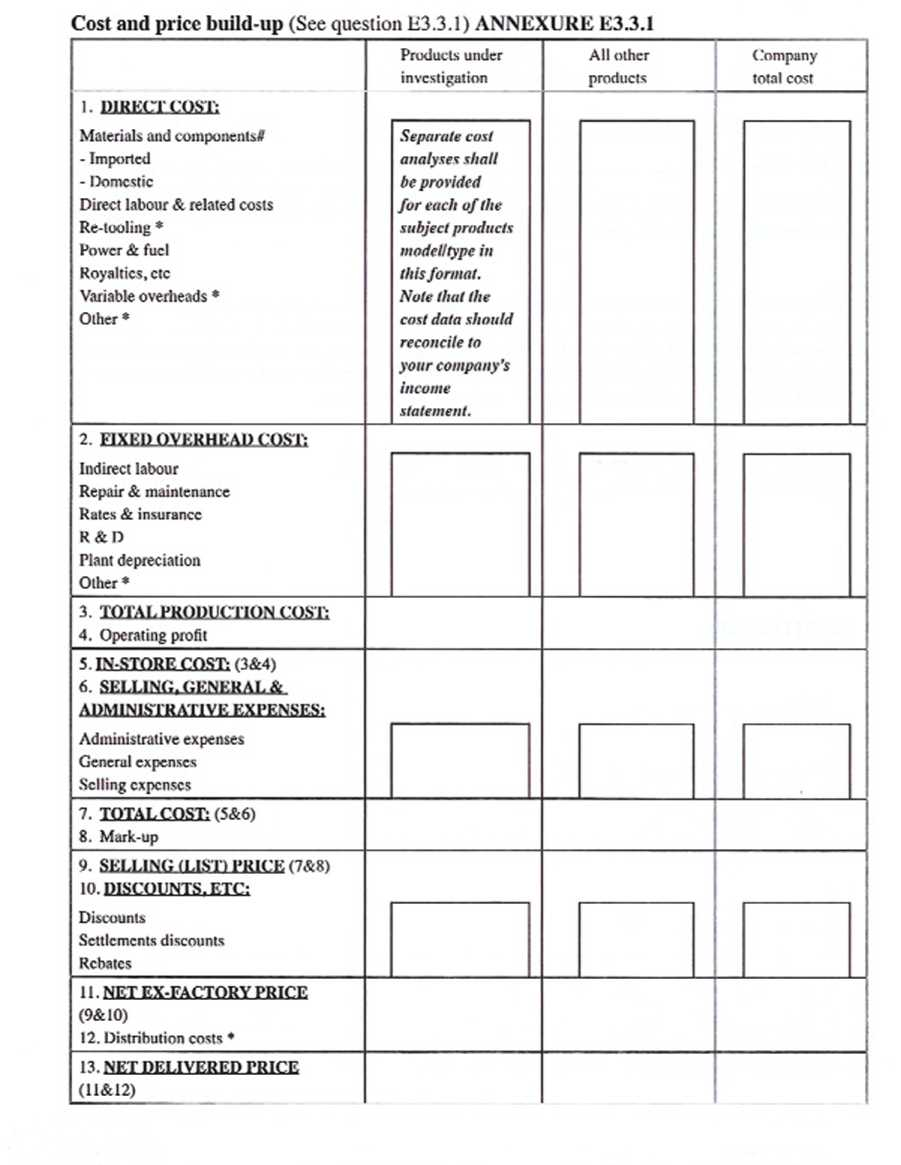
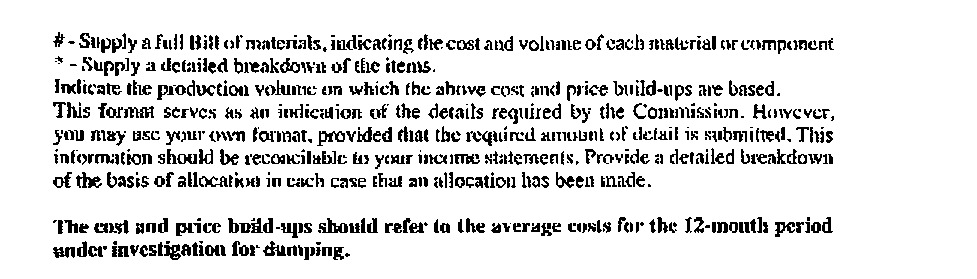
BOTSWANA TRADE COMMISSION (COUNTERVAILING INVESTIGATION) REGULATIONS
(section 37)
(28th February, 2025)
ARRANGEMENT OF REGULATIONS
REGULATION
PART I
Preliminary
1. Citation
2. Interpretation
PART II
Application for Investigation
3. Application for investigation
4. Evidence and information required in application
5. Acknowledgment of receipt of application
6. Compliance assessment of application
7. Confidentiality
8. Notification of receipt of application for investigation
9. Notification after Board approval to initiate investigation
10. Response to initiation notice by interested party
11. Deficient response by interested party
12. Extensions for submission of response
PART III
Investigation process
13. Investigation
14. Duration of investigation
15. Representation
16. Oral hearing
17. Preliminary report
18. Comments on preliminary report
19. Conclusion of investigation
20. Withdrawal of application
21. Termination for insufficient evidence, de minimus or negligible volume
22. Subsidies
23. Countervailability of subsidies
24. Subsidies not alleged in application
25. Calculation of subsidy margin
26. Material injury
27. Threat of material injury
28. Material retardation of establishment of SACU industry
29. Causality
30. Currency conversion
31. Level of countervailing duty
32. Verification of information
33. Communication of final decision of SACU Council
34. Non-cooperation by exporter or foreign producer
35. Form of provisional measure
36. Duration of application of provisional measure
37. Definitive countervailing duty
38. Price undertaking
39. Acceptance of price undertaking
40. Notification of price undertaking
41. Continuation of investigation
42. Violation of price undertaking
PART IV
Review
43. Initiation of review
44. Notification
45. Publication
46. Response by interested party
PART V
Interim Review
47. Time frame
48. Change of circumstances
49. Review procedure
50. Final recommendation
PART VI
New Shipper Review
51. Eligibility
52. Information required
53. Withdrawal of countervailing duty
54. Review procedure
55. Final recommendation
PART VII
Sunset reviews
56. Time frame
57. Initiation of sunset review
58. Notification
59. Review procedure
60. Information required
61. Non-cooperation
62. Final recommendation
PART VIII
Anti-circumvention review
63. Circumvention
64. Review procedure
65. Information required
66. Final recommendation
PART IX
Miscellaneous.
67. Judicial review
68. Application for refund
69. Refund following interim review
>SCHEDULES
S.I. 29, 2025.
PART I
Preliminary
These Regulations may be cited as the Botswana Trade Commission (Countervailing Investigation) Regulations.
In these Regulations, unless otherwise the context requires—
“anti-circumvention” means a review undertaken in a case where an alleged countervailing duty is being circumvented;
“countervailing measure” means a special measure imposed for the purpose of offsetting the subsidy bestowed directly or indirectly upon the manufacture, production or export of any merchandise;
“day” means any day other than a Saturday, Sunday or any day which is a public holiday under the Public Holidays Act (Cap. 03:07);
“de minimis“ means a subsidy margin of less than one per cent ad valorem or where the investigation concerns a product from a developing country, two per cent ad valorem;
“facts available” means the information that is available to the Commission at the time of making a determination, whether preliminary or final;
“interested party” means—
(a) a producer in SACU;
(b) an exporter;
(c) a foreign producer;
(d) an importer;
(e) a trade or business association whose members are—
(i) SACU producers, exporters or importers, or
(ii) foreign producers, exporters or importers; or
(f) the Government of the country of origin and of export of the product under investigation;
“interim review” means an investigation to determine whether an existing countervailing duty should be varied or revoked due to a change of circumstances;
“investigation period for a subsidy” means a period for which the exports from the country under investigation benefited from subsidies, which period shall be 12 months or more;
“investigation period for injury” means a period for which it is assessed whether the SACU industry experienced material injury from the subject product alleged to be subsidised;
“lesser duty” means the provisional payment or countervailing duty imposed at the lesser margin of subsidy or the margin of injury which is deemed to be sufficient to remove the injury caused by the subsidised export;
“like product” means—
(a) a product which is identical or alike to the product under investigation; or
(b) in the absence of such a product, another product that has characteristics closely resembling those of the product under investigation;
“margin of subsidy” means the total value of a subsidy of a product under investigation;
“material injury” means the economic effects of the subsidised imports on the SACU industry determined by either price undercutting, price depression or price suppression, or injury that has been caused to the SACU industry which is not negligible;
“material retardation” means a standard of determining the injury to the establishment of the SACU industry as opposed to the actual injury or threat of material injury;
“new-shipper review” means a review undertaken to determine the subsidy margin for a new producer or exporter who did not export, and is not related or affiliated with an exporter or producer that exported to SACU during the original investigation period;
“price disadvantage” means the extent to which the price of the imported product is lower than the unsuppressed selling price of the like product produced by the SACU industry, as measured at the appropriate point of comparison;
“price suppression” means where the—
(a) cost-to-price-ratio of the SACU industry increases; or
(b) SACU industry sells at a loss during the investigation period;
“price undercutting” means the price of the imported product which is lower than the price of the like product produced by the SACU industry, as measured at the appropriate point of comparison;
“SACU industry” means the domestic producers in the SACU of the like products or producers whose collective output of the products constitutes a major proportion of the total domestic production of those products;
“single investigation phase” means a preliminary assessment undertaken by the Commission which is followed by a recommendation to the SACU Tariff Board without following the investigation process under Part III of these Regulations;
“subsidies agreement” means the Agreement on Subsidies and Countervailing Measures of the World Trade Organisation which provides the rules for the use of Government subsidies for the application of the remedies to address the subsidies trade that has harmful commercial effects;
“subject-product” means a product under consideration or investigation in the application for investigation;
“sunset review” means an investigation to determine whether there is a likelihood that the removal of the existing countervailing duty would lead to a continuation or reoccurrence of an injurious effect;
“third country” means any country outside SACU that is neither the export or the foreign producer’s country; and
“unsuppressed selling price” is the price at which the SACU industry would have been able to sell the like products in question in the absence of subsidised exports.
PART II
Application for Investigation
3. Application for investigation
(1) The SACU industry or a person acting on behalf of the SACU industry shall, in writing, apply to the Commission for an investigation.
(2) An application referred to under subregulation (1), shall be in Form A set out in the Schedule and accompanied by an application fee of P 500.
(3) An applicant shall attach to an application, a non-confidential summary with sufficient details so as to permit a reasonable understanding of the substance of the information submitted in confidence.
(4) An application shall be regarded as brought by or on behalf of the SACU industry where—
(a) at least 25 per cent of the SACU producers by domestic production volume supports the application; and
(b) of those producers that express an opinion, at least 50 per cent by domestic production volume support the application.
(5) An application shall include evidence of—
(a) a subsidy;
(b) an injury; and
(c) the causal link between subsidised imports and the injury to the SACU industry.
(6) The Commission may amend the questionnaire when needs arises, in a particular manner as it may be required or may forgo, in whole or in part, for the purposes of the use of the questionnaire:
Provided that an applicant provides the Commission with the sufficient information to allow the Commission to understand the nature and the basis for the requested information.
4. Evidence and information required in application
An application for investigation shall include—
(a) the name, address and telephone number of the applicant;
(b) the volume and value of SACU like product produced by the applicant and by any other identified SACU producer;
(c) a description of the allegedly subsidised product including the technical characteristics and uses of the product and the product’s current tariff classification number;
(d) the country in which the alleged subsidised product is manufactured or produced, where it is imported from a country other than the country of manufacturer or production, the intermediate country from which the product is or imported;
(e) the name and address of each person the applicant believes sells the allegedly subsidised product and the proportion of total exports to SACU;
(f) the evidence with regard to the existence, amount and nature of the subsidy; and
(g) a causal link between the subsidised imports and the alleged injury to the SACU industry.
5. Acknowledgment of receipt of application
(1) The Commission shall, in writing, acknowledge receipt of the application under regulation 3, within five days of receipt of such application.
(2) The Commission shall include details of the assigned lead investigating officer in the acknowledgment letter.
6. Compliance assessment of application
(1) Upon receipt of an investigation, the Commission shall assess the application and may decide that such application is deficient where—
(a) the application is not in the manner and form set out by the Commission;
(b) the required information under regulation 4 has not been provided in full; and
(c) the application contains confidential information and the applicant has failed to provide a non-confidential version in accordance with regulation 7.
(2) The Commission shall in the case of a deficient application, inform an applicant in writing to rectify the deficiency by providing more information within the time provided by the Commission.
(3) The applicant shall submit the corrected application in accordance with regulations 3(3) and 4.
(4) The applicant shall provide the information required under regulation 4 by the Commission within 14 days of request, and in the event the applicant fails to provide the requested information within the set time, the Commission shall exercise its discretion to regard the application as materially deficient and reject the application.
(5) Where the Board, using the information reasonably available determines that—
(a) there is insufficient evidence of a subsidy, injury or causal link;
(b) the volume of imports of the allegedly subsidised product from a country into SACU is negligible; or
(c) the subsidy margin or the rate of subsidisation is de minimis, the Board shall not authorise the Chief Executive Officer to carry out the investigation.
(6) The Commission shall evaluate an application for investigation and where the Commission rejects the application, he or she shall notify the applicant of the reasons why the application was rejected.
(7) Where the Commission approves the application, the Commission shall submit a preliminary recommendation to initiate an investigation to the Board.
(1) An applicant or any interested party who provides confidential information in any correspondence, shall—
(a) furnish non-confidential information in summary to the Commission; and
(b) indicate in detail the reasons for confidentiality.
(2) The non-confidential information referred to in subregulation (1) shall be sufficient in detail to permit a reasonable understanding of the substance of the information submitted in confidence.
(3) The Commission shall keep confidential information which—
(a) by nature is confidential;
(b) if disclosed, could have a significant adverse effect upon the owner of or a person supplying the information; and
(c) was provided on a confidential basis by the parties to the investigation.
(4) The following information shall be deemed to be confidential, if such information—
(a) concerns the financial condition of a company which is not publicly available, including—
(i) management accounts,
(ii) financial accounts of a private company,
(iii) actual and individual sales prices,
(iv) actual costs, including cost of production and importation cost, and
(v) actual sales volume, the release of which could have significant adverse effect on the owner of, or the person that provided the information;
(b) concerns the cost, identification of customers, sales, inventory, shipment, amount or source of any income, profit, loss or expenditure related to the owner of or the person that provided the information; or
(c) would be of significant competitive advantage to a competitor of the owner of the information.
(5) The Commission shall—
(a) notify an applicant where a request for confidential treatment is not warranted; and
(b) state, in writing, reasons for refusal to treat information submitted by an applicant as confidential.
(6) The Commission may disregard any information indicated as confidential, that is not accompanied by a non-confidential summary.
(7) An applicant aggrieved by a decision of the Commission under this regulation, may appeal to the Minister, within 14 days from the date of the Commission’s decision.
(8) The Commission may not disregard any information indicated to be confidential until the Minister determines the application made under subregulation (7) or until the 14 days have elapsed with no application being made to the Minister.
8. Notification of receipt of application for investigation
The Commission shall, before the initiation of an investigation, and after verification of SACU industry’s injury, notify a representative of a country of origin and of export that the Commission has received a properly documented application for an investigation.
9. Notification after Board approval to initiate investigation
(1) Where the Board approves the recommendation to initiate the investigation, the Commission shall—
(a) inform any known interested party of the initiation of the investigation; and
(b) provide an interested party with relevant documentation inclusive of the non-confidential version of the application.
(2) The Commission shall publish a Notice to initiate investigation in the Gazette to allow interested parties to comment, within four weeks of publication of such Notice.
(3) The notice published in the Gazette shall include the following—
(a) the name, address and telephone number of the applicant;
(b) the nature of the application and its reference number;
(c) the name and contact details of the assigned investigating officer;
(d) the name of the country of export and the country of origin, of the investigated product;
(e) a complete description of the investigated product, including the technical characteristics and uses of the product and the product’s current tariff classification number;
(f) a description of the alleged subsidy practice to be investigated;
(g) a summary of the factors on which the allegations of injury and causal link are based;
(h) the address where information and comments should be submitted;
(i) the date of initiation of the investigation;
(j) the proposed schedule for the investigation; and
(k) the time period for publication and due date for comments.
(4) The Commission shall inform SACU Secretariat of the Board’s decision to initiate an investigation.
10. Response to initiation notice by interested party
(1) The Commission shall issue a questionnaire, in a formal to be determined by the Commission, to an interested party so that the interested party may note its response to the public Notice referred to under regulation 9(2).
(2) An interested party shall be deemed to have received the questionnaire under subregulation (1), seven days after the dispatch of the questionnaire by the Commission.
(3) An interested party shall on receipt of the questionnaire under subregulation (1), respond to the Commission within 30 days.
(4) An interested party not directly informed of the investigation by the Commission shall, submit the questionnaire to the Commission within 40 days, from the date of the initiation of such investigation.
(5) A response by an interested party shall be in writing and submitted in a format to be determined by the Commission.
(6) The Commission shall treat responses that are not indicated confidential as non-confidential.
(7) The Commission may render any submissions by interested parties as deficient where the submissions do not comply with the provisions of this regulation.
11. Deficient response by interested party
(1) An interested party shall within seven days from the date of receipt of a questionnaire, address any deficiencies noted by the Commission.
(2) The Commission shall not consider any deficient submissions after the deadline indicated under subregulation (1), for the purpose of its preliminary finding to the Board.
12. Extensions for submission of response
(1) The Commission may grant parties an extension of time for submission of responses on good cause shown by an interested party.
(2) An extension granted under subregulalion (1), shall apply only to a party to which such extension was granted and not to any other interested party.
(3) Notwithstanding subregulation (1), the Commission shall not grant an extension for the submission where there was ignorance of an ongoing investigation by the interested party.
PART III
Investigation process
(1) An investigation shall be initiated by the Commission upon acceptance of a written application under regulation 3.
(2) Notwithstanding subregulation (1), the Commission may initiate an investigation without having received a written application for the initiation of such investigation.
(3) The Commission shall initiate an investigation where the Commission has sufficient evidence of a subsidy, injury or a causal link to justify the initiation of such investigation.
(4) At any stage of the investigation, the Commission may request or gather additional information.
The Commission shall conclude a countervailing investigation within one year and such countervailing investigation may, extend to a period of not more than 18 months.
(1) Where an interested party is represented by an outside patty in an investigation, the interested party shall provide—
(a) the Commission with a letter of appointment of the interested party’s representative; and
(b) in the letter of appointment under subparagraph (a)—
(i) details of the representative, scope and duration of the representation; and
(ii) a signature by the highest level of authority or an authorised representative, with proof of authorisation.
(2) Where an interested party terminates representation such interested party shall provide the Commission with a letter of termination signed by the highest level of authority or an authorised representative, with proof of authorisation.
(3) Where an interested party has appointed a representative, communication between the Commission and the interested party shall be through the appointed representative.
(4) Notwithstanding subregulation (3), the Commission may communicate directly with an interested party.
(5) The communication of the appointment of an interested party’s representative shall be made at the time of submitting an application referred to under regulation 3.
(1) The Commission shall provide an opportunity for any interested party concerned to defend the party’s interest during the period of investigation and the Commission may, upon request, hold a hearing for an interested party to present the interested party’s view and arguments.
(2) Any interested party may present oral submissions during the hearing.
(3) The interested party shall within seven days of the oral hearing reduce the information presented during the oral hearing to writing and a non-confidential version of the information shall be placed on the public file.
(4) Where an interested party fails to submit the written oral submission in accordance with subregulation (3) the Commission shall not consider the oral submissions under subregulation (2).
(5) Where a party requests for an oral hearing, such party shall indicate the reasons for not relying on written submissions only.
(6) The Commission may reject a request for an oral submission where the Commission determines that—
(a) substantially similar information has already been submitted in written form to the Commission;
(b) written submission, in the Commission’s view, adequately sets out the matter intended for an oral submission; or
(c) the oral submission would unduly delay finalisation of the investigation.
(7) An interested party requesting an oral hearing shall at the time of request provide the Commission with an agenda for an oral hearing.
(1) Where the Commission has made its preliminary findings, the Commission shall publish a preliminary report in the Gazette.
(2) The Commission shall make available a non-confidential report within seven days of the publication of the Commission’s preliminary report.
(3) The preliminary report shall contain the following—
(a) the identity of the applicant;
(b) a full description of the product under investigation;
(c) the date of the decision of the Commission to initiate the investigation;
(d) the initiation date and notice number;
(e) the date of the preliminary findings of the Commission on subsidisation and injury;
(f) the margin of subsidisation in respect of each subsidy;
(g) the methodology used by the Commission to determine the margin of subsidisation;
(h) the injury factors considered;
(f) the causality factors considered; and
(j) the Commission’s finding.
(4) The preliminary report shall, while preserving the requirements of confidentiality, contain the relevant issues of fact and law considered by Commission when reaching the Commission’s preliminary determination.
18. Comments on preliminary report
(1) An interested party shall comment, in writing, within 14 days of receipt of a preliminary report.
(2) Notwithstanding subregulation (1), the Commission may grant an interested party an extension of days to submit comments, on good cause shown by such interested party.
(3) A request for extension under subregulation (2), shall be in writing, at least seven days prior to the deadline and the request shall contain proper motivation for the request.
(4) The Commission shall not accept new information following a preliminary finding, other than as contemplated under subregulation (5).
(5) Where an interested party has submitted deficient responses and has addressed such deficiencies prior to the deadline under subregulation (1), subject to the discretion of the Commission and the requirement to finalise an investigation timely, the interested party may be deemed to be a cooperating party and the Commission may consider information of such party, in the Commission’s final finding.
19. Conclusion of investigation
(1) The Commission shall, upon conclusion of an investigation, submit recommendations to the Board in terms of section 31(6) of the Act.
(2) Upon receipt of a recommendation under subregulation (1), the Board shall make a determination regarding—
(a) whether a countervailable subsidy is being provided with respect to the subject product and the amount of such countervailable subsidy; and
(b) whether—
(i) the subject products are, through the effects of the subsidy, causing or threatening to cause material prejudice to the SACU industry producing like products, or
(ii) the subject product is through the effects of the subsidy, materially impeding the establishment of the SACU industry, for the production of like products.
(3) Where the Board makes a negative final determination, the Board shall cause the Commission to terminate the investigation and publish a Notice of the negative determination and reasons for the negative determination.
(4) The Commission may, where an applicant requests, grant the SACU industry an oral hearing to discuss the reasons for rejecting the application.
(5) Where the Board makes an affirmative determination, the Board shall recommend to the SACU Tariff Board, for the imposition of the countervailing duties on the subject products investigated.
(6) The recommendation in accordance with subregulation (5) shall be accompanied by a report, which contains the following—
(a) the identity of the applicant;
(b) a full description of the product under investigation;
(c) the initiation date and notice number;
(d) the margin of subsidy;
(c) the methodology used by the Commission to determine the margin of subsidy;
(f) the injury and causality factors considered; and
(g) the Board’s finding.
(7) The Commission and the Board shall preserve the requirements of confidentiality and consider relevant issues of fact and law, in referring the recommendation to the SACU Tariff Board.
(1) An application made under regulation 3, may be withdrawn at any time after an investigation has been initiated, and the Commission shall terminate the investigation.
(2) Notwithstanding the provisions of subregulation (1), the Commission shall continue an investigation where it is in the public interest to continue such investigation.
21. Termination for insufficient evidence, de minimus or negligible volume
(1) An investigation may be terminated at any time where the Commission or Board is satisfied that there is insufficient evidence of subsidy, injury or causal link.
(2) The Commission may terminate an investigation where the Commission determines that the subsidy is de minimis, the volume of subsidised imports, actual or potential or the injury is negligible.
(1) For purposes of these Regulations, a subsidy shall be deemed to exist if—
(a) there is a financial contribution by a Government or any public body within the territory of an exporting country, where—
(i) a Government or public body provides a direct transfer of funds such as grants, loans and equity infusion,
(ii) a Government revenue that is otherwise due is foregone or not collected,
(iii) a Government provides goods or services other than general infrastructure or purchase of goods, and
(iv) a Government make s payment to a funding mechanism or entrust, or directs a private body to carry out one or more of the type of functions referred to under subparagraphs (i) and (iii), which would be vested in the Government;
(b) there is any form of income or price supported by the Government; and
(c) a benefit conferred.
(2) For the purpose of subregulation (1), the territory of a country shall include any area set aside as an export processing or development zone and other similar areas.
23. Countervailability of subsidies
(1) A subsidy shall be countervailable where such subsidy—
(a) is granted to a specific enterprise or industry; and
(b) causes material injury to the SACU industry producing the like product.
(2) An export subsidy shall be deemed to be a specific subsidy, regardless of whether the subsidy has explicitly or in fact been made contingent upon export performance.
(3) The Commission shall take into account the length of time during which the subsidy programme has been in operation, where a subsidy is deemed specific under subregulation (2).
(4) The Commission may impose a countervailing measure where, a subsidy is one per cent or more of the invoiced export price:
Provided that, for developing countries, the subsidy shall be two percent.
(5) The Commission shall establish the extent of a subsidy before the Commission determines whether the subsidy exceeds the de minimis standard.
24. Subsidies not alleged in application
The Commission shall consider any subsidies not alleged in an application under regulation 3, which the Commission discovers during the course of an investigation.
25. Calculation of subsidy margin
(1) The amount of subsidy is the amount of money which represents a benefit conferred on a recipient.
(2) The Commission may take into account the following to determine the margin of a subsidy conferred on a recipient—
(a) with regards to a grant—
(i) it may include equity infusion, the conversion of a loan into equity or waiver of debt due to agreement, and
(ii) it may be determined by an amount of subsidy countervailable in a particular year, and shall provide for the time and the value of the money and include—
(aa) reference to the amount originally paid, the number of years that have lapsed since the grant was paid; or
(bb) the average life cycle of the plant or equipment and the interest rate payable in the country of origin;
(b) with regards to a loan—
(i) a provision of a loan by a foreign government shall not be deemed to be a subsidy, unless the amount or interest rate that the recipient of the loan pays under the loan is less than the amount or rate that the recipient would pay under a comparable commercial loan, that such recipient would obtain on the market, in which case, the benefit to the recipient shall be deemed to be the difference between those two amounts or rates, or
(ii) in determining subsidy countervailable in a particular year the Commission shall, consider time and the value of the money which include reference to the original amount of the loan, the number of years that have lapsed since the grant was paid, the average life cycle of the plant or equipment, the interest rate payable on the loan and the market interest rate applicable in the country of origin.
(c) of a foregoing of revenue in determining an amount of subsidy countervailable in a particular year, the Commission shall take cognisance of any revenue due to the government of the exporting country that was forgone by such government and the products to which such revenue applies;
(d) with regards to a tax holidays and rebates—
(i) corporate tax that is not paid on export earnings are a prohibited subsidy except for developing countries listed in annex VII of the Subsidies Agreement,
(ii) the Commission shall in determining the margin of subsidy regarding tax holiday and rebates consider —
(aa) the company’s export earnings for the period under review and the corporate tax rate in that country; or
(bb) the amount of tax paid in relation to the amount payable in the absence of such tax holiday, and the products to which such subsidy applies;
(e) with regards to an input subsidy, the Commission shall consider the effect of such input subsidy on the cost or price of the product under investigation;
(f) with regards to an over-reimbursement of customs duty—
(i) over-reimbursement of customs duty occurs where a manufacturer imports raw materials that are used to manufacture final products, that are exported and the duty paid on importation is over-reimbursed, or where the exporter cannot provide proof that the imported product, on which reimbursement was claimed, is actually incorporated in the export product, and
(ii) the Commission shall consider the amount of customs duty payable or rebated when determining the margin of over-reimbursement of customs duty;
(g) with regards to a preferential interest rates for export—
(i) the Commission shall consider—
(aa) interest rates lower than those prevailing in the market granted to a company by government or a public body at the behest of government as a subsidy, and
(bb) interest rate payable on domestic and export markets, the original amount of the loan and the value of the product exported in determining the margin of subsidy;
(h) with regards to a loan guarantee—
(i) the Commission shall consider a provision of a loan guarantee by a foreign government to a recipient a subsidy where—
(aa) the loan granted under the government guaranteed loan is less than the amount that the recipient would pay under a comparable commercial loan that is not guaranteed, and
(bb) the benefit of the loan guarantee shall be deemed to be the difference between the two amounts;
(i) with regards to other subsidies—
(i) the Commission shall determine the margin or amount of subsidy for any subsidy not indicated under this section,
(ii) the Commission shall consider the following, in determining whether a subsidy has been granted—
(aa) the true value for money,
(bb) the duration of subsidy,
(cc) whether the subsidy is linked to exports or to all sales or production, and
(dd) any other relevant information at the Commission’s disposal.
(3) The Commission shall establish the amount of the subsidy according to the available data, if the Commission does not have sufficient data to verify the amount of the subsidy.
(4) For the purposes of this regulation, “input subsidy” means a subsidy paid on the input cost of a product that is exported.
(1) The Commission shall consider the following, when determining material injury suffered by the SACU industry—
(a) a significant increase in subsidised imports to production in SACU industry;
(b) whether there is a significant price undercutting by the subsidised imports as compared with the price of the like product in SACU;
(c) whether the effect of such imports is to depress prices of the like product to a significant degree; or
(d) whether the effect of such imports, is to prevent price increases which otherwise would have occurred.
(2) The Commission shall consider effects of the subsidised imports on the SACU industry, reflected by the following—
(a) the actual and potential decline in sales, profits and loss, production, market share, productivity, return on investment or utilisation of capacity;
(b) factors affecting SACU industry prices;
(c) the actual and potential negative effects on cash flow, inventories, employment, wages, investment, growth and ability to raise capital or investment; or
(d) any other factor the Commission deems to be significant.
(1) The Commission shall, when determining a threat of injury to the domestic industry, verify that the threat of injury is clear and imminent.
(2) The Commission shall, when determining a threat of material injury to the domestic industry under subregulation (1), consider the following—
(a) the rate of increase of the subsidised imports;
(b) the likelihood of significant increase in subsidised imports into SACU, for contracts or future purchase orders;
(c) whether imports are entering at prices that will have a significant depressing or suppressing effect on SACU prices, and would likely increase demand for further imports;
(d) the existence of significant export capacity or inventories of the product in question, in the exporting companies; and
(e) any other factors which the Commission determines has an economic effect on the SACU industry.
28. Material retardation of establishment of SACU industry
(1) The Commission shall not initiate an investigation on the basis of a material retardation of the establishment of a SACU industry, unless the industry or a proposed industry has supplied the Commission with a comprehensive business plan indicating the establishment of such industry in the absence of a subsidisation.
(2) The Commission may request a provisional payment or recommend a countervailing duty where the establishment of SACU industry is materially retarded by subsidised imports.
(3) The Commission may recommend that a countervailing duty be withdrawn, where significant progress has not been made to establish an industry under subregulation (2), within one year following the imposition of a countervailing duty.
(1) The Commission shall determine whether there is a causal link between subsidised imports and injury to the SACU industry.
(2) The causal link between the subsidiesd imports and the injury to the SACU industry shall be based on an examination of relevant factors including—
(a) the change in the volume of subsidised imports, whether absolute or relative to the production in the SACU market;
(b) the price undercutting experienced by the SACU industry in relation to the imported product;
(c) the market shares of the subsidised import;
(d) the magnitude of the margin of subsidisation; and
(e) the price of fairly traded imports available in the market.
(3) The Commission shall examine any known factor other than the subsidised import which is injuring the SACU industry, and the injury caused by such factor shall not be attributed to the import.
(4) The factors referred to under subregulation (3) shall include—
(a) the volume and price of non-subsidised import of the product in question;
(b) contraction in demand or change in the pattern of consumption;
(c) trade restrictive practice and competition between the foreign and SACU producers;
(d) development in technology; and
(e) the export performance and productivity of the SACU industry.
(5) The Commission may cumulatively assess the effect of the subsidised imports, where cumulation is appropriate for—
(a) competition between imports from different countries;
(b) competition between the imported products and the SACU like products;
(c) negligible imports from countries; and
(d) the margin of subsidy which is one per cent or more when expressed as a percentage of the export price.
(6) The volume of export shall be regarded as negligible where the volume of imports for the like product is found to account for less than three per cent of the total imports of the like product into the SACU market:
Provided that the volume of the subsidised imports shall not be regarded as negligible if the volume of subsidised imports, from the individual countries found to account for less than three per cent of the total imports of the like product into the SACU market, collectively account for more than seven per cent of the total imports of the like product into the SACU market.
(1) The Commission shall where price comparison requires a conversion of currency, make such conversion based on the rate of exchange on the date of sale.
(2) The date of sale shall be the date of contract, purchase order, order confirmation or invoice, whichever establishes the material terms of sale.
(3) The Commission shall not take into account fluctuations in exchange rates.
31. Level of countervailing duty
The Commission may apply the lesser duty rule, where both the corresponding importer and exporter are cooperating fully.
32. Verification of information
(1) The Commission may, during the course of an investigation satisfy itself of the accuracy of the information supplied by an interested party, by conducting verifications as it deems necessary.
(2) The Commission may conduct on-the-spot verification visits to obtain information and data required for investigation.
(3) The Commission may, in writing, inform the interested party concerned of the dates of an intended verification visit under subregulation (2).
(4) The Commission shall inform the country concerned of the dates of the intended verification visit and shall conduct the verification on those dates, unless that country objects to the verification.
(5) Where the country concerned objects to the Commission’s verification. the Commission may—
(a) make a preliminary or final decision based on the facts available; and
(b) exclude any information submitted by any party in that country.
(6) The Commission may terminate any verification activity and disregard the information submitted by an interested party and come to a conclusion, according to the best information available, where for purposes of verification, an interested party—
(a) refuses to attend the verification;
(b) refuses the Commission access to relevant information;
(c) fails to provide information within the timeline determined by the Commission; or
(d) otherwise acts so as to impede the verification process.
(7) The Commission shall after the verification visit, prepare a report stating the information which was verified and which information was not available for verification.
(8) The verification report shall be intended to identify information that was verified by the Commission and the interested party.
(9) Where an interested party fails to agree on information verified, the Commission shall not be precluded from using such information in the Commission’s findings.
(10) The Commission shall maintain a public register which shall be open to the public for inspection and a non-confidential verification report shall be placed on the public register for inspection.
(11) An interested party shall be given seven days, to comment on the verification report and where an interested party shows good cause why an extension may be granted, the Commission may grant such an extension.
33. Communication of final decision of SACU Council
(1) The Commission shall inform an applicant, in writing, of the decision by the SACU Council.
(2) The Commission shall publish by Notice in the Gazette, the decision of the SACU Council in relation to the application.
(3) The Notice under subregulation (2), shall detail the findings and conclusions reached on issues of fact and law by the SACU Council which led to the decision.
34. Non-cooperation by exporter or foreign producer
(1) Where an exporter or foreign producer does not cooperate in a countervailing investigation by the set deadline, the Commission may immediately request the imposition of a provisional payment on the basis of the facts available.
(2) Where an exporter or producer in a particular country cooperates while other exporters or producers do not cooperate, the Commission may for purposes of the non-cooperating exporters or producers base the Commission’s preliminary decision on the best information available.
(3) Where an exporter has submitted a deficient submission by the set deadline, the Commission may, disregard the deficient submission for the purpose of the Commission’s preliminary finding.
(4) The Commission may split investigations between cooperating and non-cooperating exporters in order to expedite the proceedings.
35. Form of provisional measure
A provisional measure may take the form of a cash deposit which is not greater than the provisionally estimated margin of subsidy.
36. Duration of application of provisional measure
(1) The Commission may not recommend for the imposition of the provisional measures within less than 60 days, after initiation of an investigation.
(2) The provisional measures recommended under subregulation (1) shall be for a period not exceeding four months and such period may be extended to nine months.
37. Definitive countervailing duty
(1) A definitive countervailing duty shall remain in place for a period of five years from the date of the publication of the SACU Council’s final decision, unless that period is otherwise specified or reviewed prior to the lapse of the five-year period.
(2) A definitive countervailing duty may be imposed with retroactive effect.
(3) The Commission may—
(a) base final findings for an interested party that fails to cooperate on the facts available; and
(b) determine the level of countervailing measure on such facts available.
The Commission may suspend or terminate an investigation without the recommendation for imposition of provisional measures or countervailing duty, following the receipt of a satisfactory price undertaking under which—
(a) a country agrees to eliminate or limit the subsidy or take other necessary measures; or
(b) the exporter agrees to revise price or to cease exports to SACU at subsidised prices, so that the Commission is satisfied that subsidised export or the material injury is eliminated.
39. Acceptance of price undertaking
(1) The Commission shall not accept an undertaking, unless it has made a preliminary affirmative determination of subsidisation, injury and causal link.
(2) Where the Commission declines to accept an undertaking, the Commission shall provide the—
(a) exporter or where appropriate, the Government of the exporting country that offered the undertaking the reasons for its decision; and
(b) exporter or Government an opportunity to make written comments on the decision.
(3) The Commission may require from any exporter or country from which an undertaking has been accepted, periodical information relevant to the fulfillment of the undertaking and to permit verification of pertinent data.
(4) An undertaking under subregulation (3), shall not be accepted by the Commission where the Commission considers acceptance impractical.
40. Notification of price undertaking
(1) Where the Commission accepts a price undertaking from an interested party, the Commission shall publish, by Notice in the Gazette such acceptance of price undertaking.
(2) The Notice referred to under subregulation (1), shall include the non-confidential part of the undertaking and shall be forwarded to the Government of the country of the products which are the subject of the price undertaking, and to any other interested party.
41. Continuation of investigation
Notwithstanding the fact that an undertaking has been accepted, the Commission may upon the request of an exporter or where it thinks fit, complete the investigation.
42. Violation of price undertaking
The Commission may, in a case where an undertaking is violated by an exporter—
(a) resume the countervailing investigation of injury to SACU industry and make recommendation on the basis of the best information available; and
(b) in the interim while undertaking the investigation, recommend for the imposition of the provisional measures.
PART IV
Review
(1) An interested party or representative of an interested party shall apply in writing to initiate the following—
(a) an interim review;
(b) a sunset review;
(c) a new shipper review; or
(d) anti-circumvention review.
(2) An application referred to under subregulation (1) shall be determined by the Commission.
(3) Notwithstanding subregulation (1), the Commission may initiate a review without having received a written application from the relevant interested party and in such cases, the Commission shall proceed, if it has sufficient evidence of a significant change in circumstances relating to a subsidy, material injury or a causal link, to justify the initiation of such review.
(1) The Government of the country concerned shall be notified of the review under regulation 43 (1), as soon as a properly documented review application has been received.
(2) The Government of the country concerned and interested parties shall be supplied with the relevant non-confidential information, as soon as the review in question has been initiated by publication in the Gazette.
The Commission shall initiate a review by notice published in the Gazette and such notice shall indicate the following—
(a) the identity of the applicant;
(b) the product under consideration;
(c) the investigation periods for subsidisation and injury, respectively;
(d) the scope of the review;
(e) the current countervailing measures in place; and
(f) a summary indicating the basic information on which the review is based.
46. Response by interested party
(1) An interested party shall be issued a questionnaire in a format to be determined by the Commission, to note its response to a Notice referred to under regulation 44(2).
(2) An interested party shall be deemed to have received the questionnaire under subregulation (1), seven days after the dispatch of the questionnaire by the Commission.
(3) An interested party shall on receipt of the questionnaire under subregulation (1), respond to the Commission within 30 days.
(4) An interested party not directly informed of the investigation by the Commission shall, within 40 days of publication in the Gazette of the date of initiation of investigation, submit questionnaires to the Commission.
(5) An interested party shall submit responses, in writing.
(6) The Commission shall treat responses that are not indicated confidential as non-confidential.
(7) The Commission may render any submissions by interested parties as deficient, if they do not comply with the provisions of this regulation.
PART V
Interim Review
The Commission shall not consider an application for an interim review, sooner than 12 months after the publication of SACU Council’s final finding, in the original investigation or the previous review.
(1) The Commission shall only initiate an interim review, if the party requesting such interim review can prove significantly changed circumstances.
(2) Where an interested party has not cooperated in the Commission’s investigation that led to the imposition of the countervailing duty, and such interested party is subsequently willing to supply such information, this change in disposition shall not qualify as significantly changed circumstances.
(3) An interested party shall not be precluded by the Commission from requesting an interim review, simultaneously with a sunset review, in order to expand or limit the scope of application or level of any countervailing duties.
(1) An interim review shall consist of a single investigation phase.
(2) The Commission may verify such information as it deems necessary to confirm, the accuracy and the adequacy of the information submitted by any interested party.
The Commission’s final finding, in the form of a recommendation to the SACU Tariff Board, may result in an increase, decrease, the withdrawal or the reconfirmation of the existing countervailing duty.
PART VI
New Shipper Review
(1) An exporter that did not export to SACU during the original investigation period for subsidisation, may request a new shipper review.
(2) An exporter requesting a review under subregulation (1), shall provide sufficient information to prove that it is not and was not related to any party to which the countervailing duty was applied.
(3) The Commission shall not consider a request for a new shipper review, before definitive countervailing duties have been imposed.
(1) A new shipper shall—
(a) provide the Commission with full information on subsidies and any other information deemed necessary by the Commission; and
(b) submit such information in a manner to be determined by the Commission.
(2) Where a new shipper has not exported any product to SACU industry during the period under review, the new shipper shall provide the Commission with the required information in such form as may be requested by the Commission.
53. Withdrawal of countervailing duty
(1) A countervailing duty in respect of the new shipper shall be withdrawn simultaneously with the initiation of a new shipper review.
(2) The Commission may recommend to SACU Tariff Board for imposition of provisional payments at the same level as the countervailing duties, simultaneously with withdrawal of the countervailing duty and such provisional payments, shall remain in force for the duration of the review.
(1) The Commission may verify such information the Commission deems necessary, to confirm the accuracy and the adequacy of any information submitted by an interested party.
(2) An exporter’s margin of subsidisation shall normally be determined as the subsidy expressed as a percentage of the export price to Botswana.
(3) Where no export price to Botswana can be established, the Commission may determine the export price on any reasonable basis, including with reference to the new shipper’s export price to an appropriate third country.
The Commission’s final finding may result in a recommendation to the SACU Tariff Board for—
(a) imposition of a countervailing duty, equal to or lower than the margin of subsidisation; or
(b) termination of the provisional payment.
PART VII
Sunset reviews
(1) A countervailing duty, shall remain in force for a period not exceeding five years, from the imposition of a sunset review or from the last sunset review.
(2) Where a sunset review has been initiated prior to the lapse of a countervailing duty, such countervailing duty shall remain in force, until the sunset review has been finalised.
57. Initiation of sunset review
(1) The Commission shall publish a Notice in the Gazette indicating that, a countervailing duty will lapse unless a sunset review is initiated approximately six months prior to the lapse of such countervailing duty.
(2) The Commission shall directly inform an interested party known from the original investigation or last review of the subject product, of the imminent lapse of the countervailing duty as soon as the notice contemplated in subregulation (1), has been published.
(3) An interested party shall receive 30 days from the publication of the notice contemplated in subregulation (1), to request a sunset review.
(4) Where the Commission decides to initiate a sunset review, the Commission shall publish an initiation notice in the Gazette prior to the lapse of such duties.
(1) The Commission shall notify the Government of any country concerned and any other interested party of—
(a) the initiation of the investigation; or
(b) the termination of the proceeding;
after the Notice under regulation 57 has appeared in the Gazette.
(1) A sunset review shall consist of a single investigation phase.
(2) The Commission may verify such information, as the Commission deems necessary to confirm, the accuracy and the adequacy of any information submitted by any interested party.
(1) Following publication of the notice, the SACU industry shall indicate whether it will request a sunset review to be undertaken.
(2) The SACU industry shall provide the Commission with detailed information in such form as may be requested by the Commission, indicating the likelihood of a continuation or recurrence of subsidised exports and injury in the event that the countervailing duty is removed.
(3) Once a sunset review has been initiated, the exporters and foreign producers shall be required to submit information in the required format to enable the Commission to make a finding on subsidisation.
(4) The exporters and foreign producers under subsection (3), shall not be precluded from supplying any other information they may deem relevant.
(5) The Commission may require importers to supply any information the Commission deems necessary and an importer shall not be precluded from supplying any other information that he or she may deem relevant.
(1) Where the SACU industry does not request a sunset review or does not supply the required information following a Notice published in the Gazette within the deadline indicated, the Commission shall recommend that the countervailing duty lapse on the date indicated in such Notice.
(2) Where the SACU industry has supplied the required information and the exporter or foreign producer does not cooperate within the set time frames, the Commission may rely on the facts available to reach the Commission’s final decision.
(3) For the purposes of this regulation, “deadline” means the final date communicated by the Commission, for submission, response, comment and requests.
The Commission’s recommendation to the SACU Tariff Board, may result in the withdrawal, amendment or reconfirmation of the original countervailing duty.
PART VIII
Anti-circumvention review
(1) Other than circumvention contemplated in subregulation (2)(a) and (d) circumvention shall be deemed to take place, if one or more of the following conditions are met—
(a) a change in the pattern of trade between third countries and Botswana or the common customs area of the SACU which results from a practice, process or work for which there is no or insufficient cause or economic justification other than the imposition of the countervailing duty; or
(b) remedial effects of the countervailing measure are being undermined in terms of the volumes or prices of the products under investigation.
(2) For purposes of anti-circumvention the following types of circumvention shall be treated separately—
(a) improper declaration of the—
(i) value of the product,
(ii) origin of the product, or
(iii) the nature or classification of the product;
(b) minor modification to the product subject to the countervailing duty;
(c) the export of parts, components and sub-assemblies with assembly in a third country or within Eire common customs area of the SACU;
(d) absorption of the countervailing duty by either the exporter or the importer;
(e) a declaration under a different tariff heading, even where such different tariff heading does provide for the clearance of that product; and
(f) any other form of circumvention as may be submitted for the Commission’s consideration.
(3) Any instance of circumvention as contemplated in subregulation (2)(a), shall be referred to the Botswana limited Revenue Services for further investigation and shall not preclude the Commission from taking countervailing action, if the information at the Commission’s disposal, including information obtained through submissions by interested parties, warrants such action.
(4) Any minor modification of the product shall be deemed to have taken place, if the subsequently exported product—
(a) has materially the same production processes, uses the same raw materials and has basically the same physical appearance or characteristics; or
(b) is a substitute for the product on which countervailing duties have been imposed.
(5) An Assembly in a third country or within the common customs area of the SACU, shall be deemed to take place if the value added in such third country or in the common customs area of the SACU, does not exceed 25 per cent or does not constitute a major transformation process.
(6) An assembly referred to under subregulation (5), shall not be regarded as changing the country of origin.
(7) The value added in terms of subregulation (5), shall be determined with reference to the direct and indirect costs of production only and shall not include selling, general, administrative or packaging expenses or profit.
(8) An absorption of the countervailing duty shall be deemed to take place, if—
(a>) the exporter decreases its export price in any manner to compensate the importer or a third party for the extra burden imposed by the countervailing duties, unless there is a correspondent decrease in the normal value of the product;
(b) the importer does not increase its price in line with the countervailing duties, unless such importer can provide evidence indicating that it absorbed such countervailing duties without assistance from any other party, and only from revenue generated by the specific product in question; or
(c) in cases involving tenders, the tender price is not increased by the effect of the countervailing duty.
(1) Where an anti-circumvention complaint is lodged with the Commission within one year of the publication of the SACU Council’s final determination, the SACU industry shall not be required to update the SACU industry’s injury information.
(2) The Commission shall not require injury information in cases of circumventions under regulation 63(2)(b) or (c).
(3) Where an anti-circumvention complaint is lodged with the Commission prior to or within one year of the publication of the Commission’s final finding, and in relation to any circumvention alleged in regulation 63(2)(b), (c), (d), (e), or (f), the Commission may use the information previously established on the subsidies to determine the margin of subsidisation until such time as the exporter, foreign producer or foreign Government has submitted the proper information.
(4) The Commission may impose provisional payments on the basis of the margin of subsidy determined.
(5) The Commission may make a preliminary or final determination on the basis of the facts available, in the event that the relevant interested parties have not submitted appropriate information before the set deadline.
(6) Where there is a deficient response, an interested party shall be given the opportunity to address any deficiencies within seven days and such additional information shall be taken into consideration by the Commission in the Commission’s determination.
(7) Where an anti-circumvention review involves absorption, the Commission may determine the level of the absorption with reference to the failure in the movement in the resale price of the subsidised imported product.
(8) The Commission may conduct such verifications as the Commission deems necessary to confirm the accuracy and the adequacy of any information submitted, by any interested party.
(1) The SACU industry or other interested party shall provide information to the Commission, that is reasonably available to it, to indicate that circumvention is taking place.
(2) Any request for an anti-circumvention review, shall include information of the specific type of circumvention that is alleged to take place.
(3) The Commission may require any interested party to submit such information as it deems necessary to properly conduct the review.
(4) Where the party against whom the allegation is made, fails to respond within the stated deadline the Commission may make a decision on the facts available to it.
If the Commission, makes a finding that circumvention has taken place, the Commission’s final recommendation may result in—
(a) increase of countervailing duties to compensate for absorption of countervailing duties; or
(b) extension of the scope of the countervailing duties to apply to parts, components or substitute new models and the like products.
PART IX
Miscellaneous
Any person who is aggrieved by a decision of the Commission, may within 30 days of such decision, appeal to the High Court against such decision.
(1) An importer or exporter may request reimbursement of countervailing duties collected by the Commission, where it is shown that the subsidy margin, on the basis of which countervailing duties were paid, has been eliminated or has been reduced to a level which is below the level of the duty in force.
(2) Any request containing all the required information, for a refund shall be submitted to the Commission during the anniversary month of the countervailing duty, and shall relate only to the preceding 12 months’ period.
(3) An application for refund shall—
(a) be considered as duty supported by evidence, where it contains precise information on the amount of the refund of countervailing duty claimed and customs documentation relating to the calculation and payment of such countervailing duty; and
(b) include, for the relative period under review, information on normal values and export prices to the SACU for the producer or exporter to which the countervailing duty applies.
(4) An application for a refund shall be in a format to be determined by the Commission.
(5) The Commission may, at any time after receiving a refund application, initiate an interim review, whereupon the information and findings from such interim review shall be used to determine whether a refund is justified.
69. Refund following interim review
Where the Commission, following an interim review, recommends that the existing countervailing duty be decreased or withdrawn, the relevant importer or importers may request that countervailing duty be refunded, in accordance with the SACU Council’s final findings.
SCHEDULE
Application for countervailing investigation
(regulation 3 (2))

1. Introduction
1.1 This questionnaire should be completed by an Applicant alleging that the subsidised export of a particular product is causing it material injury. It is important that the Applicant provides all the information required in the prescribed manner.
1.2 When completing this questionnaire, please read all instructions carefully. You should be aware that your response to the questionnaire and any subsequent additional requests formulated by the Commission will constitute the basis of which preliminary and final findings will be made regarding the investigation.
1.3 Non-submission of all relevant information, or the submission of incomplete information can have unfavourable consequences on the outcome of the investigation. In this respect, it is essential that your response to the questionnaire is accurate and complete as possible and should attach supporting documents. Do not leave any question or section blank.
2. Purpose
2.1 The purpose of this questionnaire is to help the Southern African Customs Union (SACU) industry to bring together in a concise and logical form the information needed by the Botswana Trade Commission (the Commission) to investigate the alleged subsidy.
3. Legal framework
3.1 Countervailing investigations are conducted in terms of (i) the Botswana Trade Commission (Commission) Act, 2013 which mandates the Commission to investigate allegations of subsidised exports within the Southern African Customs Union (SACU) and (ii) Countervailing Investigation Regulations (CIR) which provide for the manner in which the investigations are to be initiated and conducted.
3.2 Being a member of the World Trade Organisation (WTO), the Commission must act consistently with Article VI of the General Agreement on Tariffs and Trade 1994 and the WTO Subsidies and Countervailing Measures Agreement.
3.3 This document is available at www.botc.org.bw.
4. Submission of Confidential and Non-confidential Information
4.1 If the response to the questionnaire is based in part on confidential material, it must contain a non-confidential version of the confidential material together with an explanation of why it is confidential. The information must be provided in the manner below—
4.1.1 A person may, when submitting information to the Commission, identify information that the person claims to be information that—
(a) is confidential by its nature; or
(b) the person otherwise wishes to be recognised as confidential.
4.1.2 A person making a claim in terms of paragraph (4.1.1) must support that claim with—
(a) a written statement in the prescribed form—
(i) explaining, in the case of information that is confidential by its nature, how the information satisfies the requirements set out in the definition of “information that is by nature confidential” in paragraph 1(2); or
(ii) motivating, in the case of other information, why that Information should be recognised as confidential; and
(b) either—
(i) a written abstract of the information in a non-confidential form; or
(ii) a sworn affidavit setting out the reasons why it is impossible to comply with subparagraph (i).
4.2 These summaries should be in sufficient detail to permit a reasonable understanding of the substance of the information submitted in confidence. Therefore, where confidential and non-confidential versions are supplied, parties must—
(a) indicate where information has been omitted in each case;
(b) provide reasons for confidentiality in each instance;
(c) provide a summary of the confidential information which permits a reasonable understanding of the substance of the confidential information in each instance; and
(d) where information is not susceptible to a non-confidential summary, indicate this in each instance and provide a sworn affidavit setting out the reasons why the information is not susceptible to summarisation.
4.3 The Commission will not accept as duty completed any response to its questionnaires unless a proper non-confidential version has been submitted. If the Commission finds that a request for confidentiality is not warranted and if the foreign manufacturer/exporter is either unwilling to make the information public or to authorise its disclosure in summarised format, the Commission will not consider such information in determining the findings of the investigation.
5. General
5.3 Foreign manufacturers/exporters should provide full and accurate information and provide supporting documentary evidence. The Commission will not consider unsubstantiated information. All cost related information should be reconcilable to the financial statements or management accounts.
5.4 Please take note that the rules relating to confidential information and the submission of non-confidential versions of your responses applies to all correspondence, which unless clearly indicated to be confidential and filed together with a non-confidential version, will be placed on the public file and be made available to other interested parties.
5.5 If a document is indicated to be confidential but a proper non-confidential document complying with the above-mentioned rules is not filed, then the document will not be taken into consideration by the Commission.
5.6 If your response is in respect of more than one product, a reference to “product” should be considered to be a reference to “products”, and the foreign producer/ exporter should respond to the relevant question(s) in respect of all products separately.
5.7 The response to this questionnaire, as well as to any other additional request formulated by the Commission, is to be made in hard copy and electronic form. Regarding hard copy submissions, the applicant must submit one (1) original and three (3) copies of the original (both confidential and non-confidential versions) and address same to:
Chief Executive Officer, Botswana Trade Commission, Plot No. 55745, Main Airport Road, Block 8, BOBS Building, Private Bag 3AAD, Poso House, Gaborone.
5.8 Regarding electronic submissions, both confidential and non-confidential versions must be submitted electronically and must be made on a flash drive, which must be write-protected and labelled clearly indicating (i) the company’s name, (ii) product(s) concerned and (iii) whether the information is confidential or non-confidential.
5.9 Further to the above mandatory submission formats, the company has an option to make additional submissions by email to (info
5.10 Any documents, whether hard copies or electronic submissions, not complying with the above formalities may be returned to the party submitting them and not be used by the Commission for the purpose of this investigation.
5.11 Should you require an extension, kindly contact the officer in charge before the expiry of the deadline to request an extension. No request for an extension will be attended to unless they are received before the expiry of the deadline and provision of good cause for such extension.
5.12 Kindly note that a response submitted after the lapse of the deadline or one the submission of a deficient response may be rejected by the Commission. In this respect, the Commission may establish preliminary or final findings based on the information available in the application.
6 Verification of Information Provided
6.3 The Commission has authority to verify any information provided in response to the questionnaire or any subsequent information provided.
7 Language of the Investigation
The investigation is to be conducted in English and therefore only information for which an English version or translation is provided will be considered in the investigation.
8 False Statements
Any person who knowingly or wilfully provides false, misleading or incorrect information to the Commission, whether in an application received here under or otherwise in connection with an investigation under the BOTC Act, shall be guilty of an offence and shall on conviction be liable to a fine of P2 000 or to imprisonment for a term not exceeding two years or both.
9 Public File
In accordance with CIR, the Commission is required to ensure that all interested parties are given reasonable opportunity to have access to all non-confidential information that is relevant to the presentation of their cases and that is used by the Commission in the investigation. To meet this requirement, all non-confidential documents relating to an investigation will be placed on a public file accessible to the public.
10 Assistance with Questionnaire
In the event you encounter any difficulty in interpreting the information requested in this questionnaire, contact can be made so the officers in charge of the investigation.
GLOSSARY
|
CIR |
Countervailing Investigation Regulations |
|
Subsidies and Countervailing Agreement |
General Agreement on Tariffs and Trade 1994 and the WTO Subsidies and Countervailing Measures Agreement. |
|
Commission |
Botswana Trade Commission |
|
SACU |
Southern African Customs Union (Botswana, Lesotho, Namibia, South Africa and Swaziland) |
|
WTO |
World Trade Organisation |
PARAGRAPH A: APPLICANT
A1. Company Name:
Contact person:
Postal Address:
Physical Address:
Tel:( )
Fax:( )
Webpage:
Email:
NB: Please attach a map indicating how to reach you as Annex A1.
Applicant’s production relative to total SACU production (%) is:
A2 State the names, telephone numbers of and positions held by the company’s officers to be contacted.
Name:
Postal Address:.
Physical Address:
Tel:( )
Fax:( )
Webpage:
Email:
*Note: The contact person should be somebody that has been involved with the completion of the Questionnaire and that would be in a position to answer questions the Commission might raise.
A3 Have you appointed a consultant, legal or other representative? If yes, please attach a copy of the letter of appointment setting out the scope and duration of the appointment, as required by the CIR as Annexure A3. Alternatively, if you have appointed a legal representative to assist you in these proceedings, attach the original Power of Attorney.
Name:
Designation:
Address:
Tel:( )
Fax:( )
Email:
A4 *Note: Without authorisation in accordance with template A-1 or A-2, the Commission will only liaise with the contact person and cannot engage in any contact with the nominated representative. This is to protect the Commission and prevent the unauthorised release of any information that might be regarded as confidential.
A5 Provide a diagram of your company’s group structure and indicate the percentage stockholdings and cross-holdings. Attach this as Annexure A5.
A6. Indicate all shareholders holding more than 5% of equity in your company. Attach this as Annexure A6.
|
Name of shareholder |
Number of shares |
Percentage shareholding |
|
|
|
|
|
|
|
|
|
|
|
A7 The foreign manufacturer/exporter is an industrial organisation or public company, private company or closed corporation, if other please specify.
A8 Indicate the franchise, manufacturing, licensing, know-how, technology and distribution agreements in place in respect of inputs, manufacturing and outputs, and which relate to the product that is the subject of this application.
A9 Please attach a copy of the Articles of Association and the Memorandum of Association and attach it as Annexure A9.
A10 List all members of the Board of Directors and of the Board of Shareholders. For each of the members, please state what they represent, what their function is and what their voting rights are:
Person:
Function:
Voting rights
A11 Furnish an organogram indicating the nature of each component in the structure, e.g. financing, manufacturing (product range), distribution (product range), etc.
A12 The name(s) and address(es) of the related firms who provide inputs for your processing/manufacturing and give details of these inputs.
A13 The name(s) and address(es) of the related firms involved with the distribution of the product(s) being the subject of this investigation.
A14 Provide a flow chart of your marketing/distribution channels for the product(s) concerned in the application and indicate the percentage off-take for each channel.
A15 Provide proof of registration of the company with competent Authorities and attach it as Annexure A15.
A16 Name the product allegedly being subsidised:
A17 Country of origin/export
A18 Indicate which of the following is the basis for normal value—
(a) the normal value is based on domestic sales in the country of origin;
(b) export price to a third country; and
(c) a constructed normal value.
A19 List the factors in respect of which actual material injury threat of material injury/the material retardation of the establishment of an industry is alleged.
(i)
(ii)
(iii)
(iv)
(v)
(vi)
(vii)
(viii)
PARAGRAPH B: PRODUCTS
Note on like product
The Countervailing Regulations defines like product as
(a) a product which is identical, i.e. alike in all respects to the product under consideration; or
(b) in the absence of such a product, another product which, although not alike in all respects, has characteristics closely resembling those of the product under consideration.
Further details on like product are contained in the CVR.
B1 Imported (subject) product
Note: If there is more than one imported product competing directly with the SACU product, information should be submitted separately for each such product.
B1.1 Give a full description of the alleged subsidised imported product.
B1.2 The main raw materials/components/inputs used in the production is/are
B1.3 The production process used is as follows:
B1.4 The products’ technical characteristics and appearance are as follows:
B1.5 The application and end-use of the products is for
** (If possible, provide pictures, brochures or catalogues) and specifically provide details for the above)
B1.6 The SACU like product is substitutable with the imported product to the following extent:
B1.7 The following tariff dispensation applies to the imported product:
|
Tariff subheading |
Description |
Unit of measurement |
Rate of customs duty |
Rebate provision item number |
Rebate provision description |
|
|
|
|
|
|
|
|
|
|
|
|
|
|
|
|
|
|
|
|
B1.8 Indicate if you are aware of any possible loopholes in the tariff classification, i.e. whether the product can be imported under any other tariff heading.
B2 SACU like product
Note: If remedial action is requested in respect of more than one product, the following information should be submitted separately for each product. where the application is lodged in respect of numerous product lines, e.g. shoes, car tyres or circuit breakers, a sample must be selected for investigation purposes and the basis for determining the sample must be indicated. Note that the Commission may request information relating to products falling outside the sample after it has received the exporters’ and importers’ responses.
B2.1 Give the name and description of the SACU product
B2.2 The main raw materials/components/inputs used in the production are:
B2.3 The production process used is as follows:
B2.4 The products’ technical characteristics and appearance are as follows:
B2.5 The application and end-use of the SACU product is for:
B2.6 The following tariff dispensation applies to the SACU product:
|
Tariff subheading |
Description |
Unit of measurement |
Rate of customs duty |
Rebate provision item number |
Rebate provision description |
|
|
|
|
|
|
|
|
|
|
|
|
|
|
|
|
|
|
|
|
B2.7 Enumerate in detail any differences between the imported product and the SACU like product
B2.8 Give details of all standards or specifications applicable to the product concerned in the SACU prescribed by law or otherwise.
**Note: In that regard, the applicant is expected to describe both the SACU product as well as the imported product In sufficient detail for proper comparison and understanding of the product.
B3 Like product in the country of export or origin
B3.1 Give the name and description of the product sold in the exporting country
B3.2 The main raw materials/components/inputs used in the production is/are:
B3.3 The production process used is as follows:
B3.4 The products’ technical characteristics and appearance arc as follows:
B3.5 The application and end-use of the products is for
B3.6 The SACU like product is substitutable with the imported product to the following extent:
B3.7 Enumerate in detail any differences between the imported product and the like product sold in the country of origin or export:
PARAGRAPH C: INTERESTED PARTIES
C1 If there is a SACU representative organisation submit the following information:
(a) Names, address, telephone and fax numbers and Email addresses of and position held by the organisation’s officers to be contacted;
Name of organisation:
Name of contact person:
Designation:
Postal Address:
Physical Address:
Tel:( )
Fax:( )
Webpage:
Email:
(b) Name the SACU producers in the industry affiliated with the organisation and provide their names, full contact details, postal and physical address, telephone number; fax number, email as well as names and details of their contact person.
Name of organisation:
Name of contact person:
Designation
Postal Address:
Physical Address:
Tel:( )
Fax( )
Webpage:
Email:
C2 Provide the names, full contact details, postal and physical address, telephone number, fax number, email as well as names and details of the contact person of all other SACU producers of the like product.
Name of organisation:
Name of contact person:
Designation:
Postal Address:
Physical Address:
Tel:( )
Fax:( )
Webpage:
Email:
An application shall be regarded as brought by or on behalf of the SACU industry if—
(a) at least 25 per cent of the SACU producers by domestic production volume support the application; and
(b) of those producers that express an opinion on the application, at least 50 per cent by domestic production volume support such application.
Without this support, BOTC cannot accept an application for investigation. Letters of support for or opposition to the application must be attached to the application as Annexure C2.
C3 Indicate the industry support and/or opposition to the application in the following format:
|
Industry Standing (Total domestic production of like goods for the 12 months preceding the lodging of the application) |
|
Producer |
Production volume- Support Application |
Production volume- Oppose application |
Production volume- Neutral |
|
Your Company |
|
|
|
|
Other producers 1. 2. 3. |
|
|
|
|
Total SACU |
|
|
C4 Give details of exporters and foreign producers in the investigation in the following format:
Name of organisation:
Name of contact person:
Postal Address:
Physical Address:
Tel:( )
Fax:( )
Webpage:
Email:
C5 Give details of the importers of the product under investigation in the following format:
Name of organisation:
Name of contact person:
Postal Address:
Physical Address:
Tel( )
Fax:( )
Webpage:
Email:
PARAGRAPH D: COUNTERVAILING/SUBSIDISED EXPORT
1. Countervailing action is against subsidised exports which causes injury to the SACU industry. In terms of Regulation 23 of CR, a subsidy shall be deemed to exist if—
1.1 there is a financial contribution by a government or any public body within the territory of an exporting country, where—
(a) a government or public body provides a direct transfer of funds through grants, loans, and equity infusion;
(b) government revenue that is otherwise due is foregone or not collected;
(c) a government provides goods or services other than general infrastructure, or purchases goods;
(d) a government makes payments to a funding mechanism, or entrusts or directs a private body to carry out one or more of the type of functions illustrated in (ii) to (iii) above which would normally be vested in the government and the practice, in no real sense, differs from practices normally followed by government.
1.2 there is any form of income or price support by government; and
1.3 a benefit is conferred.
2. In view of the above, the application the applicant shall provide information, in the sense of proof, regarding each of the following elements—
2.1 Existence of a financial contribution;
2.2 From a government or any public body in the territory of the country(ies) covered by the application; and
2.3 The financial contribution confers a benefit to its recipient.
3. Existence of a subsidy programme
D.1 Give details of the financial aid or assistance programme, substantiating your response with supporting documents and indicate the following—
D1.1.1 Name and description of the subsidy programme(s) which are believed to apply to the allegedly subsidised goods, and the legislation or regulation under which the programme operates.
D1.1.2 Conditions for granting the subsidy.
D1.1.3 The statutory body or authority responsible for the administration of the programme.
D1.1.4 The nature and operation of the programmes, including the product coverage and the form of assistance provided, identify the benefits provided under the programmes, export subsidy, government grants, loan guarantees, tax credits.
D1.1.5 Estimated amount of subsidy, calculated as a percentage of the value for duty of the goods when imported into SACU and full calculations should be shown.
D.1.6 Details of the financial aid or other assistance scheme regarding any inputs of the product under investigation.
4. Specificity
4.1 In addition to the above requirements, the applicant must proof that the subsidy is specific. Regulation 24 of CR sets forth that a subsidy shall be countervailable only if—
(a) if the granting authority explicitly limits access to a subsidy to an enterprise or industry or group of enterprises or industries, or if the Commission finds in fact that the subsidy is used by a limited number of enterprises or industries or a disproportionately large amount of the subsidy is granted to a limited number of enterprises or industries or certain enterprises or industries; and
(b) it causes material injury to the SACU industry producing the like product.
4.2 In view of the above, the applicant will have to submit prima facie evidence that the that each programme included in the application has a subsidy specific to a company, a group of companies, an industry, a group of industries, a region, or several regions in the jurisdiction of the exporting country.
D.2 Name the country in which the government provides the financial aid or other assistance.
D.3 Name the product(s) that benefit from the assistance.
PARAGRAPH E: MATERIAL INJURY
Note: Before the Commission can initiate a countervailing investigation, it must have prima facie evidence to reach a reasonable conclusion that the alleged subsidised exports are causing or threatening to cause material injury to a SACU industry.
The applicant must provide sufficient evidence to reach a reasonable conclusion that alleged subsidised exports are causing or threatening to cause material injury to a SACU industry. The applicant must provide data showing the negative impact that the alleged subsidised imports have.
When preparing the information requested in the following sections, please note the following:
Product
The injury determination must be based exclusively on data for the like product manufactured and sold by the applicant. Only where such separate identification of that production is not possible, the effects of the allegedly subsidised imports can be assessed by the examination of the production of the narrowest group or range of products, which includes the like product, for which the necessary information can be provided. If data are determined on the basis of estimates, the applicant must explain the basis for such estimates.
Period for submission of data
The period of investigation is normally three years. However, for certain factors such as price undercutting the data may cover a shorter, but recent and representative period of time.
E1 General Information
E1.1 Provide a flow chart of your marketing/distribution channels for the product(s) concerned in the application and indicate the percentage off-take for each channel.
E1.2 Provide full details of your terms and conditions of sale and selling price to each class of customer, e.g. wholesaler, retailer, downstream producer, etc. Attach a copy of your standard terms and conditions as Annexure E1.2.
E1.3 Give the reasons and basis for your categorisation of customers.
E1.4 Enumerate major changes over the past three years in your answers to the above questions.
E2 FINANCIAL INFORMATION
Note: All financial information should be in a reconciled format. If such requested information is not readily available in the same format or needs adjustment or re-apportionment, please qualify by way of explanatory notes or discuss the merits of the situation with the Commission.
E2.1 Indicate your normal accounting period.
E2.2 Provide copies of your audited financial statements, including detailed manufacturing, trading and profit and loss statements for the most recent three financial years. If your statutory statements do not include detailed accounts or schedules, please provide such accounts/schedules separately.
E2.3 Provide copies of your year-to-date management accounts, including detailed manufacturing, trading and profit and loss accounts for the period between the last financial year end and the most recent month end. Provide ancillary schedules if not part of published accounts.
E2.4 Provide a separate sales and profit before tax contribution analysis of all the product line items manufactured by your company, including a percentage analysis. The information should be sufficient to allow proper verification of your like product information.
The requested income statements should be analysed in a departmental or divisionalised format detailing the product concerned as a separate activity. The analysis should also be in respect of three prior financial years and the most recent year-to-date management accounts period. If the requested information is not available from your financial database, please discuss alternatives with officials of the Commission.
E3 Effects on the SACU prices
E3.1 Price depression
Price depression occurs when the SACU industry’s domestic selling prices are reduced because of the imports. Outline the extent to which the imports are causing price depression.
E3.1.1 Provide the following information with regard to your average per unit ex-factory selling prices:
|
|
Year 1 |
Year 2 |
Year 3 |
|
Your ex-factory price per unit |
|
|
State the unit of measurement
E3.1.2 If your prices decreased significantly during the last 12 calendar months, please supply the average ex-factory prices for each of the last 12 months. Please attach as Annexure E3.1.1.
E3.1.3 Indicate any other factors that have depressed your ex-factory selling price that do not reflect in the above table, e.g. longer payments terms, higher year-end rebates, additional free stock.
E3.2 Price suppression
Price suppression occurs when price increases that would otherwise have taken place do not occur because of the subsidised exports and can be determined with reference to—
(a) the expected or d return of the SACU industry for the like or similar products;
(b) the profit margins of the industry for the like products before the entry of the subsidised imports; or
(c) the prices obtained for the like products by the industry directly before the entry of the subsidised imports; or
(d) any other reasonable basis.
E3.2.1 Outline the extent to which the allegedly subsidised goods have caused prices to be suppressed. Supporting evidence preferably in the form of financial data should be provided and the format of the Table below may assist you in providing this information.
|
|
Year 1> |
Year 2 |
Year 3 > |
|
Your ex-factory price per unit |
|
|
|
|
Your production cost per unit |
|
|
|
|
Your gross profit per unit |
|
|
|
|
Your gross profit % |
|
|
|
|
Your production cost as a % of selling price |
|
|
State the unit of measurement
E3.2.2 If price suppression is more pronounced during the last 12 months supply the information as requested in Table E3.2.1 separately for each of the last 12 months. Please attach as Annexure E3.2.2.
E3.2.3 Indicate any other factors that have suppressed your ex-factory selling price that do not reflect in the above table, e.g. longer payments terms on sales, shorter payment terms on purchases, higher year-end rebates, additional free stock, etc.
E3.3 Cost build-up
E3.3.1 Please supply a cost build-up in the format indicated in Annexure E3.3.1 Where your management accounts do not allow for the specific cost elements indicated in the pro forma, please indicate the information that is available and supply as much detail as possible.
E3.3.2 Please supply a Bill of Materials for the domestic like product.
E4 SACU INDUSTRY SALES
E4.1 Please supply the following information on your sales volume by your industry.
|
|
Year 1 |
Year 2 |
Year 3 |
|
Your sales volume |
|
|
|
|
Sales by other SACU producers 1. 2. 3. |
|
|
|
|
Total volume of SACU sales by SACU producers |
|
|
State the unit of measurement
E4.2 If sales of the product are of a cyclical nature comment on the nature thereof, indicating the length of the cycle and the prices both during the up and down phases.
PROFIT AND LOSS
E5 Actual and potential decline in profit
E5.1 Explain how the gross and net profit on your sales of like goods have been affected by the allegedly subsidised goods. To substantiate your claim, provide your audited accounts for last three years.
|
|
Year 1 |
Year 2 |
Year 3 |
|
Units sold |
|
|
|
|
Your total gross profit |
|
|
|
|
Your total net profit |
|
|
E5.2 Comment on the actual and potential decline in your profits.
OUTPUT
E6 Actual and potential decline in output
E6.1 Supply the following information regarding your actual production volumes over the last three years. Note that this should relate to total output of the product under consideration, regardless of whether destined for the domestic or export market.
|
|
Year 1 |
Year 2 |
Year 3 |
|
Your total production of the product concerned |
|
|
|
|
Other SACU producers’ production |
|
|
State the unit of measurement
E6.2 Comment on the actual and potential decline in your production, both total and for SACU consumption.
MARKET SHARE
E7 Actual and potential decline in market share
E7.1 Provide applicant’s share in the SACU market for the most recent three years and compare the market share of SACU industry with the shares of imports of the allegedly subsidised product and imports from other countries for the three years:
|
|
Year 1 |
Year 2 |
Year 3 |
|
Market share in volume (unit):> |
|
|
|
|
Applicant |
|
|
|
|
Dumped imports |
|
|
|
|
Other imports |
|
|
|
|
Total SACU market |
|
|
|
|
Percentage share held by: |
|
|
|
|
Applicant |
|
|
|
|
Dumped imports |
|
|
|
|
Other imports |
|
|
E7.2 Supply the following information, based on sales (and not on output) value, for the past three years:
|
|
Year 1 |
Year 2 |
Year 3 |
|
Your market share (%) |
|
|
|
|
Other SACU producers’ market share (%) |
|
|
|
|
Total SACU producers’ market share (%) |
|
|
|
|
Market share of alleged dumped imports by country 1. 2. 3. |
|
|
|
|
Total market share of alleged dumped imports (%) |
|
|
|
|
Market share of other imports (%) |
|
|
|
|
Year 1 |
Year 2 |
Year 3 |
|
Your market share (%) |
|
|
|
|
Other SACU producers’ market share (%) |
|
|
|
|
Total SACU producers’ market share (%) |
|
|
|
|
Market share of alleged subsidised imports by country 1. 2. 3. |
|
|
|
|
Total market share of alleged subsidised imports (%) |
|
|
|
|
Market share of other imports (%) |
|
|
E7.3 Comment on the trends revealed in Tables E7.1 and E7.2.
PRODUCTIVITY
E8 Actual and potential decline in productivity
E8.1 Show how productivity has been affected over the period covered by the alleged injury on a monthly or quarterly basis if possible and state the basis used for measuring productivity:
|
|
Year 1> |
Year 2> |
Year 3> |
|
Total production volume> |
|
|
|
|
Number of employees (manufacturing only) |
|
|
|
|
Units per employee |
|
|
E8.2 Comment on the actual and potential decline in productivity identified in Table E8.1
RETURN ON INVESTMENT
E9 Return on investment
E9.1 Show return on assets or a similarly appropriate measure of return on investment over the period covered by the alleged injury and explain how it has been affected by the allegedly subsidised goods.
Please reflect the profit before tax, interest and extraordinary items.
|
|
Year 1 |
Year 2 |
Year 3 |
|
Net profit (product concerned) |
|
|
|
|
Total net profit (all products) |
|
|
|
|
Net assets (product concerned) |
|
|
|
|
Total net assets (total) |
|
|
|
|
Return on net assets (product) |
|
|
|
|
Return on net assets (total) |
|
|
CAPACITY UTILISATION
E10 Actual and potential decline in capacity and capacity utilisation
E10.1 Provide the industry’s production capacity over the period covered by the alleged injury and explain how it has been affected by the allegedly subsidised goods. Supply the information requested below regarding your actual and potential capacity and capacity utilisation for the product concerned, State the unit of measurement.
|
|
Year 1 |
Year 2 |
Year 3 |
|
Your capacity (units) |
|
|
|
|
Your actual production |
|
|
|
|
Your capacity utilisation %> |
|
|
|
|
Rest of SACU capacity |
|
|
|
|
Rest of SACU production |
|
|
|
|
Rest of SACU capacity utilisation % |
|
|
E10.2 State the normal number of shifts per week, number of hours per shift and number of labour units involved, for each—
|
|
Year 1 |
Year 2 |
Year 3 |
|
Your company |
|
|
|
|
Number of shifts |
|
|
|
|
Workers per shift |
|
|
|
|
Other SACU producers Number of shifts 1. 2. |
|
|
|
|
Other SACU producers Workers per shift 1. 2. |
|
|
E10.3 Comment on the trends revealed in Tables E10.1 and E10.2.
CASH FLOW
E11 Actual and negative effects on cash flow
E11.1 Provide the following information regarding your cash flow:
|
|
Year 1 |
Year 2 |
Year 3 |
|
Product specific Cash flow: incoming Cash flow: outgoing Net cash flow |
|
|
|
|
Company Cash flow: incoming Cash flow: outgoing Net cash flow |
|
|
E11.2 Comment on your cash flow situation relating to the subject product.
INVENTORIES
E12 Actual and potential effect on inventories
E12.1 Supply the following information regarding your inventories for the subject product.
|
|
Year 1 |
Year 2 |
Year 3 |
|
Volume |
|
|
|
|
Value |
|
|
E12.2 Supply your inventories for the subject product on the same basis as in E12.1 for the last 12 calendar months as Annexure E12.2.
E12.3 Is the level of monthly inventories subject to fluctuation? If affirmative, please elaborate.
E12.4 What is the effect of the change in your inventories over the injury investigation period?
EMPLOYMENT
E13 Actual and potential negative effect on employment
E13.1 Supply the following information regarding employment:
|
|
Year 1 |
Year 2 |
Year 3 |
|
Direct labour units: production |
|
|
|
|
Indirect labour units: production |
|
|
|
|
Total labour units: production |
|
|
|
|
Labour units: Selling and Administrative |
|
|
|
|
Rest of SACU: Total labour units: production |
|
|
E13.2 Comment on the actual and potential negative effect on employment, including comments on the possibility of moving employees to other production areas, the minimum number of employees required to operate the machinery, etc.
WAGES AND SALARIES
E14 Actual and negative effects on wages and salaries
E14.1 Supply the following information regarding wages and salaries relating the subject product:
|
|
Year 1 |
Year 2 |
Year 3 |
|
Total wages: Production |
|
|
|
|
Wages per employee |
|
|
* – Indicate the time period, e.g. per hour, day, week or month
E14.2 Comment on the wage rates, indicating factors that have led to increases and/or decreases.
GROWTH
E15 Actual and potential negative effect on growth
E15.1 Supply the following information:
|
|
Year 1 |
Year 2 |
Year 3 |
|
Size of the SACU market |
|
|
|
|
% growth from previous year |
|
|
|
|
Your sales volume |
|
|
|
|
Your growth % |
|
|
|
|
Rest of SACU producers volume |
|
|
|
|
Rest of SACU growth %> |
|
|
|
|
Alleged dumped imports |
|
|
|
|
Alleged dumped imports growth % |
|
|
|
|
Other imports |
|
|
|
|
Other imports growth %> |
|
|
E15.2 Comment on the growth in the SACU market and factors affecting the growth.
CAPITAL AND INVESTMENT
E16 Ability to raise capital and investment
E16.1 Supply the following information regarding capital and investment:
|
|
Year 1 |
Year 2Year 3 |
|
Total capital/investment in subject product |
|
|
|
Capital expenditure during year on subject product |
|
E16.2 Comment on your ability to raise additional capital or investments for the like product and indicate whether such capital or investments would be internally sourced, provided by your parent company or be provided by an outside institution.
E17 Other Adverse Effects
B17.1 Please provide appropriate explanations and evidence to support claims of alleged injurious effects in terms of (actual and potential) effects in any of the following relevant areas—
(i) cash flow:
(ii) inventories – Report the volume and value of stocks of the like product;
(iii) employment – Report data on employment (or an estimate thereof) involved in the production, administration and sales of the like product;
(v) wages;
(vi) growth;
(vii) ability to raise capital;
(viii) investments – Report any investments made related to production, administration and sales of the like product.
E17.1 Comment on other factors affecting domestic prices.
E17.3 Future plans on production and capacity
Please comment on your future plans for production and capacity of the products concerned in the event that—
(a) Countervailing Measures are imposed; and
(b) Countervailing Measures are not imposed.
E17.4 Future plans for sales
Please comment on your future forecasts for sales of the products concerned in the event that—
(a) Countervailing Measures are imposed; and
(b) Countervailing Measures are not imposed.
E17.5 Please indicate any other injury information to be considered by the Commission and not covered by the questions above.
PARAGRAPH F: THREAT OF MATERIAL INJURY
Note: It is not necessary to complete this section if you can prove actual material injury with section E above.
F1.1 Where the applicant’s situation does not show actual material injury, it may lodge a complaint for imposition of countervailing measures provided applicant successfully shows that such imports pose a real threat of causing material injury to it.
F1.2 The determination of threat of material injury will be based on facts and not merely on allegations. For this reason, the applicant must provide evidence showing that the injury is clearly foreseen and imminent.
F1.3 Where the application is only based on a threat of material injury, it is advisable that estimates for all injury factors as contained in paragraph E be provided in addition to the information requested below.
F1.4 Give information relevant to your allegation that the infliction of material injury is imminent. The existence of sufficient freely disposable or an imminent, substantial increase in capacity of the exporters may indicate the likelihood of substantially increased subsidised exports to SACU.
F1.5 Substantiate any significant increase of allegedly subsidised imports into the SACU market indicating the likelihood of substantially increased importation.
F1.6 State whether the products concerned enter the country at prices that will have a significant depressing or suppressing effect on SACU prices and are likely to increase demand for further imports. Substantiate your reply.
F1.7 Indicate the exporters’ inventories of the product being investigated. The built-up of significant volumes of inventories in the exporting country is a factor that may indicate the likelihood of substantially increased subsidised exports to SACU.
F1.8 Indicate the state of the economy of the country of origin/export and its influence on the operations of the manufacturers/exporters.
Material retardation
SACU companies potentially interested in producing a product may be discouraged to do so due to imports of an allegedly subsidised product. When this occurs, those companies may apply for countervailing relief alleging material retardation in the establishment of a domestic industry. Any such application will nonetheless have to clearly document the efforts undertaken to establish the domestic industry to produce the allegedly subsidised product.
SECTION G CAUSE OF MATERIAL INJURY
Note: In order to justify action against the alleged subsidised imports the Commission must be satisfied that material injury is caused by the alleged subsidised imports. Further details on causation are contained in the Countervailing Regulations.
General
G1 Give the reasons for your belief that the alleged subsidised imports are the cause of the alleged material injury or threat thereof.
Imports
Volume of the subsidised Imports
The volume of exports from a country shall normally be regarded as negligible if the volume of imports for the like product from that country is found to account for less than three per cent of the total imports of the like product into the SACU market, unless countries which individually account for less than three per cent of the total imports of the like product into the SACU market for the like product collectively account for more than seven per cent of the total imports of the like product into the SACU market.
Give the following information on the imports of the product, being the subject of the application, for the latest three calendar years and separately on a monthly basis for the period subsequently to the end of the last calendar year.
G2.1 Import volumes per annum (State unit of measurement)
|
|
Year 1 |
Year 1% |
Year 2 |
Year 2% |
Year 3 |
Year 3% |
|
Subject countries 1. 2. |
|
|
|
|
|
|
|
Subtotal Other countries |
|
|
|
|
|
|
|
Total |
|
|
|
|
|
Year %, etc — express the volume of imports from the different countries as a percentage of the total volume imports for the year.
G2.2 Import values per annum
|
|
Year 1 |
Year 1% |
Year 2 |
Year 2% |
Year 3 |
Year 3% |
|
Subject countries 1. 2. |
|
|
|
|
|
|
|
Subtotal Other countries |
|
|
|
|
|
|
|
Total |
|
|
|
|
|
Year %, etc — express the value of imports from the different countries as a percentage of the total value imports for the year.
G2.3 Import prices per unit
|
|
Year 1 |
Year 2 |
Year 3 |
|
Subject countries 1. 2. 3 |
|
|
|
|
Subtotal Other countries |
|
|
|
|
Total |
|
|
G2.4 If subsidised imports are alleged against more than one country, state the reasons why you believe imports from the different countries may be cumulated.
G3 Monthly import statistics
G3.1 Import volumes per month
Attach as Annexure G3.1 a table indicating in the same format as under section G2.1, the monthly volumes of imports from the various countries for the last 12 consecutive months. If you believe that the statistics do not properly reflect the increasing trend in imports, you may include the monthly import statistics for the last 18 consecutive months.
G3.2 Import values per month
Attach as Annexure G3.2 a table indicating in the same format as under section G2.2, the monthly volumes of imports from the various countries for the last 12 consecutive months. If you believe that the statistics do not properly reflect the increasing trend in imports, you may include the monthly import statistics for the last 18 consecutive months.
G3.3 Price per unit per month
Attach as Annexure G3.3 a table indicating in the same format as under section G2.3, the monthly volumes of imports from the various countries for the last 12 consecutive months. If you believe that the statistics do not properly reflect the increasing trend in imports, you may include the monthly import statistics for the last 18 consecutive months.
G4 Own imports
G4.1 Provide the following information on your own imports of the product:
|
|
Year 1 |
Year 2 |
Year 3 |
|
Volume imported from countries under investigation |
|
|
|
|
Volume imported from other countries |
|
|
|
|
Total volume imported |
|
|
|
|
Value imported from countries under investigation |
|
|
|
|
Value imported from other countries |
|
|
|
|
Total value imported |
|
|
|
|
Price per unit imported from countries under investigation |
|
|
|
|
Price per unit imported from other countries |
|
|
|
|
Total average price per unit imported |
|
|
G4.2 State your reasons for importing the product.
G4.3 List all your transactions over the injury investigation period in the following format (duplicate as required and attach as Annex G4.3):
|
|
Shipment/file number |
Shipment/file number |
|
Invoice date DA 500 date DA500 number Volume (units) |
|
|
|
Invoice price (foreign currency) Invoice terms (FOB/CIF, etc) Exchange rate/forward cover rate |
|
|
|
Ex-factory price (BWP) Costs to FOB |
|
|
|
FOB price (BWP) Ocean freight Insurance |
|
|
|
CIF price (BWP) Customs duty Landing and clearing costs |
|
|
|
Landed costs Domestic transport |
|
|
|
In-store cost |
|
|
|
In-store cost per unit |
|
G5 Price undercutting
The Countervailing Regulations define price undercutting as the extent to which the price of the imported product is lower than the price of the SACU product. The price should be compared at the same level of trade and with the same terms and conditions of trade, normally at the SACU ex-factory level compared to the landed cost of the imported product.
G5.1 Provide the following information regarding your selling price per unit and the landed cost per unit of the imported product during the POI (indicate separately for each country against which the allegation is lodged):
|
(R/unit) |
POI |
|
Your ex-factory selling price |
|
|
Other SACU producers |
|
|
Landed cost of imports from 1. 2 3. |
|
|
Undercutting per unit 1. 2. 3. |
|
|
Undercutting % 1. 2. 3. |
Undercutting %: express the undercutting per unit as a percentage of your ex-factory selling price.
Indicate the level of trade and selling conditions of your product and of the imported product separately, i.e. ex-factory/delivered, payment terms, distributor/wholesaler/ retailer.
G5.2 Comment on the trends indicated by this information and substantiate how this factor is indicative of material injury. (If the trends do not support your argument, you must provide other substantiating evidence as proof.)
Market Share
G6 Supply the following information, based on sales (and not on output) volume, for the past three years (refer question E7.1):
|
|
Year 1 |
Year 2 |
Year 3 |
|
Your market share (%) |
|
|
|
|
Other SACU producers’ market share (%) |
|
|
|
|
Total SACU producers’ market share (%) |
|
|
|
|
Market share of alleged subsidised imports by country 1. 2. 3. |
|
|
|
|
Total market share of alleged subsidised imports (%) |
|
|
|
|
Market share of other imports (%) |
|
|
MAGNITUDE OF THE MARGIN OF SUBSIDISATION
G7 Indicate how the magnitude of the margin of subsidisation supports your allegation that subsidies is causing material injury to the SACU industry.
Prices of non-subsidised products available in SACU
G7.1 indicate the prices of non-subsidised products available in the market and the effect thereof on SACU industry prices:
|
|
Year 1 |
Year 2 |
Year 3 |
|
Your ex-factory selling price |
|
|
|
|
Landed cost of product imported from countries not alleged to be subsidised |
|
|
|
|
Total SACU producers’ market share (%) 1. 2. 3. 4. |
|
|
G7.2 The Countervailing Regulations defines unsuppressed selling price as “the price at which the SACU industry would have been able to sell the like product in question in the absence of subsidised imports, and can be determined with reference to—
(a) the expected or required return of the SACU industry for the like or similar product;
(b) the profit margins of the industry for the like product before the entry of the subsidised imports;
(e) the prices obtained for the like product by the industry directly before the entry of the subsidised imports; or (d) any other reasonable basis.
State what your unsuppressed selling price is at present.
Other factors causing Injury.
G8.1 Indicate any contraction in demand for or changes in the patterns of consumption of the product under consideration over the past three years.
G8.2 Indicate any trade restrictive trade practices of and competition between the foreign and SACU producers.
G8.3 Indicate any recent developments in technology.
G8.4 Indicate any other factors affecting the SACU prices.
G8.5 Comment on the SACU industry’s export performance.
G8.6 Comment on the productivity of the SACU industry vis-a-vis that of the exporting countries.
G8.7 Have you had any strikes, go-slows or lock-outs during the past twelve calendar months?
Please elaborate.
G8.8 Indicate what the effect of the changing exchange rate has been on—
(a) Your production cost;
(b) your selling price; and
(c) the price of the imported product.
G8.9 Indicate any other factors affecting your sales or your sales prices, including the state of the economy and the industry.
PARAGRAPH H: PROVISIONAL COUNTERVAILING DUTY
H1.1 At any time after an investigation has been initiated, a provisional a countervailing duty may be imposed where a preliminary recommendation, approved by the Commission’s Board of Directors, has made an affirmative determination that increased subsidised imports are causing or threatening to cause material injury to the SACU industry and the Board considered it necessary or expedient that provisional measures be taken to prevent further injury being caused while the investigations are being carried out. A provisional countervailing duty can be applied up to a maximum of 200 days.
H1.2 Please indicate whether you are seeking the imposition of a provisional countervailing duty. If you are requesting the imposition of a provisional measure, explain why you consider the measure as a necessity.
PARAGRAPH I: GENERAL
Provide any other information or evidence you wish to bring to the attention of the Commission.
CERTIFICATION
The undersigned certifies that all information herein supplied in response to the questionnaire is complete and correct to the best of his knowledge and belief and understands that the information submitted may be subject to audit and verification by the Botswana Trade Commission, The undersigned has been authorised to represent (company name).
|
Date |
Signature of authorised person |
|
|
Name and title of authorised person (in print) |
ANNEXURE A1
LETTER OF AUTHORISATION
Type the following letter on your company letterhead
To whom it may concern
We the undersigned, hereby authorise………………………………………………………………………………..to act on our behalf in all manners relating to this application, including signing all documents and being the point of contact.
Any and all acts carried out by the agent/representative on our behalf shall have the same effect as acts of our own.
Further details of the agent/representative are provided below:
Name of organisation:
Name of contact person:
Postal Address:
Physical Address:
Tel:( )
Fax:( )
Webpage:
Email:
This authorisation is valid for the entirety of the application and investigation process or until further notice from (your company name), whichever occurs first.
| Yours sincerely | |
| …………………………………… | |
| (duty authorised person) (Name and Title) |
ANNEXURE A
POWER OF ATTORNEY
I, the undersigned,
……………………………….
in my capacity as………………………………………………………………do hereby nominate, constitute and appoint
………………………………………………………….with power of substitution, to be my lawful Agent/Representative
in my name, place and stead to represent (company name) in the application for the initiation of a safeguard investigation concerning imports of……………………..
And generally, for effecting the purposes aforesaid, to do or cause to be done whatsoever shall be requisite, as fully and effectually, for all intents and purposes, as might or could do if personally present and acting herein; hereby ratifying, allowing and confirming and promising and agreeing to ratify, allow and confirm all and whatsoever my/our said Agent/Representative shall lawfully do, or cause to be done, by virtue of these present.
SIGNED AT………………………………THIS………………..DAY OF……………………………202_ IN THE PRESENCE OF THE UNDERSIGNED WITNESSES:
|
|
…………………………………… |
|
|
(Name) |
|
AS WITNESSES: |
|
|
1…………………………… |
|
|
2…………………………… |
|
|
Cost and price build-up (See question E3.3.1) |
ANNEXURE E3.3.1 |
The cost and price build-up should refer to the average costs for the 12-month period under investigation.